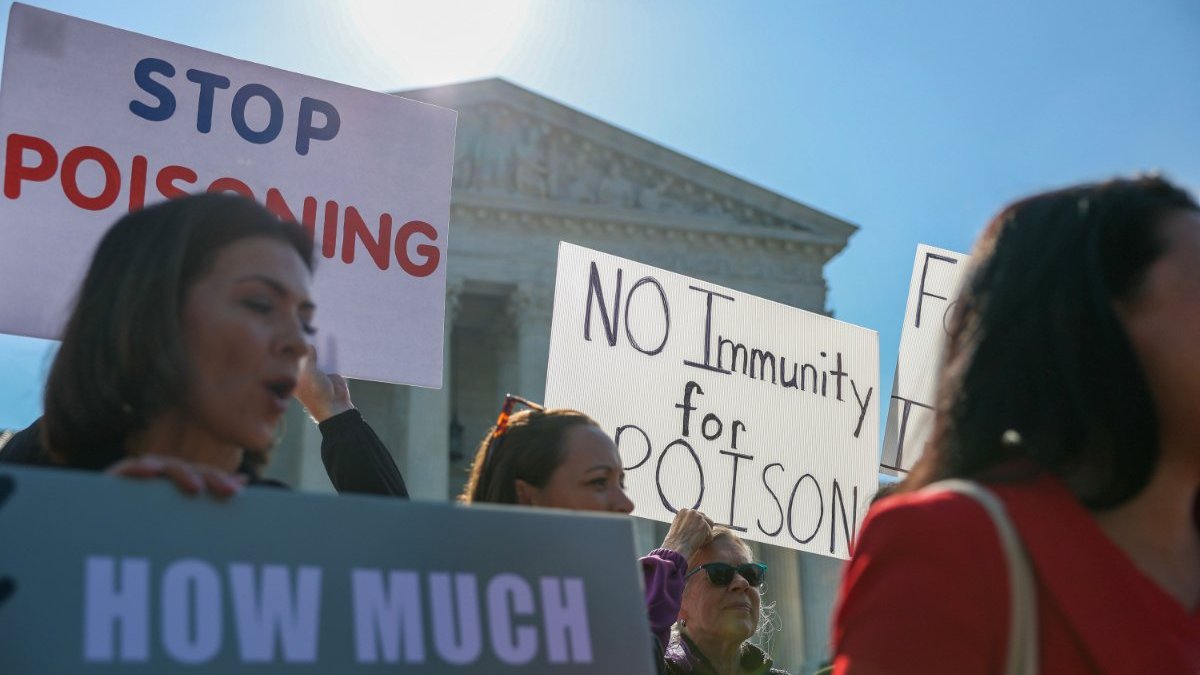
This ruling empowers the movement to stop pesticide companies from causing harm.
This ruling empowers the movement to stop pesticide companies from causing harm.
July 7, 2026
There’s no sugarcoating it: The Supreme Court’s decision last month in favor of Bayer and other pesticide companies was a gut punch for the millions of Americans who have had their lives turned upside down by debilitating health problems linked to pesticides.
Expand your understanding of food systems as a Civil Eats member. Enjoy unlimited access to our groundbreaking reporting, engage with experts, and connect with a community of changemakers.
Already a member?
Login
The ruling shields pesticide companies from lawsuits brought by people who claim they’ve been harmed by EPA-approved pesticides and were not warned about their potential danger. While the Supreme Court’s case specifically dealt with the Roundup weedkiller glyphosate, its ruling encompasses all pesticides approved by the federal government.
Those who have for years been successfully fighting the efforts of the Trump administration and Congress to shield these companies from liability may understandably feel deflated. After all, pesticides’ links to debilitating diseases like cancer and Parkinson’s disease remain the same—the only thing that has changed is the level of difficulty for people to hold these companies liable for harms caused.
Yet there is reason to be optimistic that pesticide use will be curtailed in the not-too-distant future. The movement fighting pesticide harm is getting stronger by the day, fueled by the millions of people who are paying attention, banding together, and agitating in a good way.
That’s not to say the path will be an easy or quick one. The Environmental Protection Agency’s utter failure to protect Americans from dangerous pesticides is well documented.
Take this fact, for example: The agency routinely approves pesticide products that include ingredients the agency itself has linked to cancer without any warning at all.
According to a recent analysis of all currently approved pesticides, the EPA has instituted cancer warnings on just 69 of 4,919 pesticide labels (1.4 percent) containing a chemical it has designated as a “likely” human carcinogen.
“The Supreme Court just gave the EPA sole power over pesticide label cancer warnings, a job the agency already fails at more than 98 percent of the time.”
And the agency has instituted cancer warnings on just 242 of the 22,147 pesticide labels (1.1 percent) that contain a chemical it has designated as a “possible” human carcinogen.
The Supreme Court just gave the EPA sole power over pesticide label cancer warnings—a job the agency already fails at more than 98 percent of the time.
The fact that the EPA has approved use of 85 pesticides banned or being phased out in the European Union, China, or Brazil (a number that has ballooned to 119 since that study was conducted in 2018) demonstrates that the U.S. pesticide approval system has never worked for anyone except pesticide companies.
A few days after the Supreme Court decision, the Trump EPA announced it had approved three long-lasting, cancer-linked PFAS pesticides never before used in the United States, an alarming indication that the EPA is going to be doubling down on approving ongoing use of dangerous pesticides tied to numerous health problems.
The amount of industry influence in our pesticide regulatory system is extensive. Right now, the top four officials in the EPA’s chemicals office are former industry lobbyists. Over the years, most of the officials who oversaw the EPA went to work for industry after their tenure. This industry-controlled regulatory system has routinely failed at its most important function: protecting the public from harm.
That’s precisely why many sick Americans have been left with no choice but to sue for damages from pesticide companies after their health has already been harmed.
For decades, the threat of tort litigation has been the only thing keeping these companies in check. It was only after that kind of legal pressure, for example, that pesticide giant Syngenta announced that it would no longer make and sell the Parkinson’s-linked pesticide paraquat.
But it’s telling that the EPA continues to allow dozens of other companies to sell paraquat, which is so toxic that it’s banned in more than 70 countries.
Tort lawsuits are an important tool for people harmed by unscrupulous companies, including pesticide giants. But people are always better served if they never become victims in the first place.
That’s the resounding takeaway from the Supreme Court’s glyphosate decision: The legal challenges at the heart of this case were triggered by the failure of EPA’s pesticide office to prevent our brothers, sisters, kids, and loved ones from becoming victims of pesticides’ harms.
The Supreme Court ruling limiting tort lawsuits and this administration’s egregious actions to endanger even more Americans will undoubtedly end up spurring more people to join the millions already pushing for meaningful reform of U.S. pesticide regulation.
An ever-growing trove of independent research is showing troubling links between pesticides like glyphosate, atrazine, chlorpyrifos, paraquat, and dicamba and health problems—including cancer, birth defects, developmental harms to children, neurodegenerative disease—as well as widespread environmental damage.
It’s precisely that kind of research, conducted by independent scientists untethered to the pesticide industry, that convinced one jury after another to reach multimillion-dollar verdicts against Bayer and other pesticide companies in recent years. The Supreme Court, the EPA’s pesticide office, and multibillion-dollar pesticide companies can’t hide from that research.
The science is solidly on the side of those pushing for long-overdue reforms.
“This movement to force the EPA to finally start doing its job and protect us all from dangerous poisons is the strongest it’s ever been.”
Public opinion also favors meaningful change. More than 70 percent of American adults are now worried about harmful chemicals in food and say the government must do more. This is not a niche issue, but one that resonates with the overwhelming majority of people regardless of their political leanings. In fact, those who disagree on many political and social issues are increasingly becoming allies in the fight to protect people from chemicals that are making their families and loved ones sick.
The movement is resonating in Congress, too. Bills that would protect the public from harmful pesticides are more likely to be bipartisan now than ever before. Multiple damaging pesticide provisions—including legal shields for pesticide companies—were recently removed from the House farm bill: More than 70 Republicans voted with nearly every Democrat to defeat them. Just two years ago that wasn’t even within the realm of possibility.
This movement to force the EPA to finally start doing its job and protect us all from dangerous poisons is the strongest it’s ever been.
Despite the momentum, we’re still facing a challenging political landscape. In the days since the Supreme Court’s decision, the Trump administration’s actions have made clear its plan to simply “message” its way past the growing opposition to dangerous pesticides.
On the day of the Supreme Court’s decision, Trump signed an executive order claiming to invest in regenerative, sustainable agriculture. But rather than offering any concrete, meaningful steps to begin the process of reducing the nation’s escalating addiction to harmful, cancer-linked pesticides, the EO directed the EPA to expedite approval of new pesticides. The EO also called for increased reliance on “New Approach Methodologies”—industry-supported studies that have already been used to allow 10-times-higher residues of acephate, a neurotoxic pesticide, on food.
The EPA has also recently been touting other meaningless actions masquerading as steps toward curbing pesticide use, like hosting a roundtable discussion on paraquat.
“The science is there, public opinion is there, and lawmakers on both sides of the aisle are starting to make some noise.”
Tellingly, while the agency highlighted the EO and roundtable with press releases, the agency’s recent approval of four new pesticides in one day, in addition to significant new uses for two other pesticides, was quietly posted on an obscure regulatory website that few people even know about.
These recent actions have reaffirmed the ongoing reality: The EPA’s long-held institutional, industry-driven bias toward keeping dangerous pesticides on the market is unlikely to change without an unprecedented level of pressure from consumers and legislators.
The tools for change are falling into place: The science is there, public opinion is there, and lawmakers on both sides of the aisle are starting to make some noise.
But this fight won’t be won by politicians, lawyers, or social media influencers. This kind of far-reaching regulatory reform will require that millions of people show up to vote on issues that impact the next generation. It will require people to have challenging conversations with their pesticide-spraying neighbors. And it will require getting out and showing up in each of our communities to demand change.
We deserve a system where our children don’t have to scrap it out in court to get compensation for a life swept out from under them. They deserve to grow old in a world where the silent threat of these poisons no longer exists.
If public momentum continues to build in the weeks, months, and years ahead, we will find that this Supreme Court decision ignited an ever-widening firestorm of opposition not just to glyphosate, but to the many other EPA-approved pesticides that are devastating public health.
July 7, 2026
The agreement will now be up for renegotiation every year, which critics say will mean uncertainty for American farmers.
Like the story?
Join the conversation.
Sentinel — Human
The text reads like a passionate advocacy piece that skillfully mixes legal context with environmental and political critique, demonstrating strong human rhetorical intent.