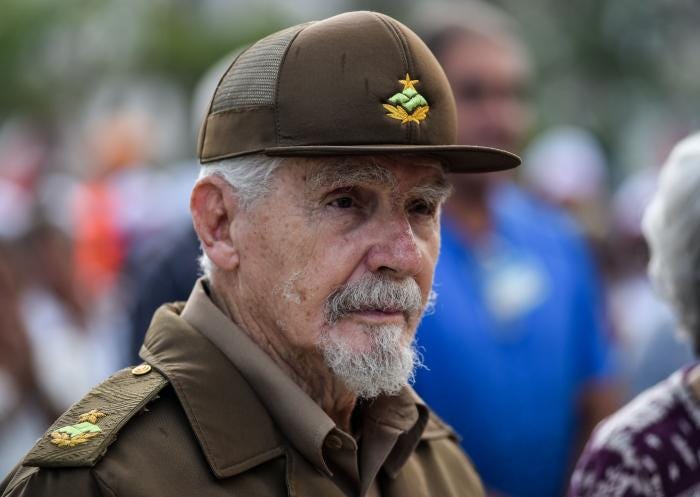
Journalist John Dinges recalls bringing together Cuba’s secret police chief and the CIA’s former Miami station chief at a Havana conference on the Bay of Pigs invasion
He spent a lifetime quashing threats, but in the end he could not defeat the one that eventually catches up to all mortals, no matter how powerful: time.
Ramiro Valdés Menéndez, a longtime CIA nemesis, spymaster and architect of internal repression, died in a Havana hospital last week, age 94.
Long near the pinnacle of Cuba’s leadership, Valdés kept a low profile internationally, as befitted the man who controlled one of the world’s most effective secret police forces, stifling Cuba’s internal opposition for decades. Inside Cuba he was revered, respected and feared as one of the four or five “Comandantes” closest to Fidel Castro, outranking for many years even Castro’s brother and successor Raul Castro.
Last Monday, long lines of Cubans showed up at his funeral to pay their respects. Abroad, opponents of the regime celebrated his death. “Valdés’ nicknames — ‘El Carnicero de Artemisa’ (The Butcher of Artemisa), ‘Charco de sangre’ (‘Pool/puddle of blood’), and ‘El Verdugo de Cuba’ (The Executioner/Hangman of Cuba) — reflect his direct association with this machinery of terror,” wrote John Suarez, executive director of the Center for a Free Cuba, an anti-Castro organization.
But Valdés had also earned the grudging respect of his adversaries in the CIA, going all the way back to 1961, when he played a key role in the resounding and humiliating defeat of the U.S.-backed Bay of Pigs invasion. Over the ensuing decades, as the regime’s minister of interior and chief of its Dirección General de Inteligencia (DGI/DI), Cuba’s intelligence service, he exported the revolution abroad and thwarted one CIA plot after another at home.
Sentinel — Human
The text exhibits strong signs of human authorship, characterized by focused emotional framing and the integration of layered historical context, suggesting it was written for narrative impact rather than mere factual reporting.