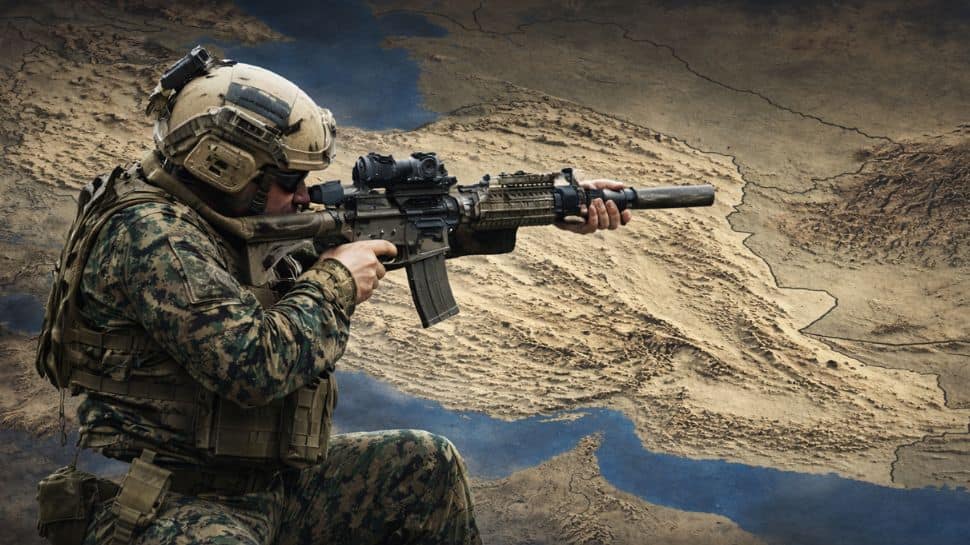
Iran’s strategic outlook is deeply shaped by its physical landscape. The Iranian Plateau forms a broad, elevated region defined by rugged, mountainous terrain, dominated by the Zagros and Alborz mountain ranges, providing a natural defence against external threats.
Trending Photos
The Pentagon is preparing for a possible ‘weeks-long’ ground invasion in Iran, as war in West Asia enters its second month, the United States is escalating its presence across the Gulf.
Thousands of US Marines and soldiers have surged into position, laying the groundwork for a lightning campaign if President Trump greenlights the strike.
Iran, on the other hand, has been preparing itself to welcome US troops in ‘hell.’
Iran’s English daily, Tehran Times, blared a chilling front-page warning to Washington, "Welcome To Hell."
Any US troops daring Iranian soil, it vowed, "will leave only in a coffin." The threat read.
Similarly, Senior Iranian military officials, including Brigadier General Ali Jahanshahi, commander of Iran’s Army Ground Force, have publicly warned that a US ground incursion would be “more dangerous and costly” for American forces, promising that Iranian troops will “incapacitate the enemy” and defend every inch of territory.
Apart from threats and claims, the most powerful military in the world can not avoid Iran’s natural defence.
The Zagros zone: Nature's ultimate defence
Iran’s strategic outlook is deeply shaped by its physical landscape. The Iranian Plateau forms a broad, elevated region defined by rugged, mountainous terrain, dominated by the Zagros and Alborz mountain ranges.
To the north and west, Iran is shielded by vast deserts, fertile valleys, and expansive plains.
The Zagros in the west and the Elburz in the north effectively encircle Iran like a natural fortress, rendering a conventional ground invasion logistically daunting for any adversary.
The US military can not avoid Iran’s natural fortress, which comes with risks of being encircled in a ‘Quagmire’ situation similar to Vietnam.
The sheer scale of the Iranian Plateau enables Tehran to disperse its military and nuclear infrastructure, giving the state a significant degree of strategic depth.
Tehran uses its physical barriers as an effective security architecture, which has enabled it to challenge regional adversaries without provoking a full‑scale war.
By leveraging the sea and its rugged topography, Iran has crafted a regional strategy focused on building a defensive buffer that deters invasion and blocks any conventional land war on its own territory.
Historical Ghosts: A lesson for a lifetime
History screams a warning for those who listen carefully: Alexander the Great, who bypassed the Zagros heartland in 331 BC, opting for flanks, still losing 20% of his army to Napoleon, dreamed of Persia but never marched, and these lessons are to be recalled in times like now.
The most recent example of all is Saddam Hussein's 1980 invasion, which stalled in the mountains, costing thousands of lives.
Risk for multi-front escalation
US ‘boots on the ground’ could also escalate into a multi-frontal’ war. The Iran-Backed Houthis have already entered the West Asia war, with the risk of closure of another oil artery, Bab-El-Mandeb, looming large.
Iran's October 2025 "Axis of Resistance" surge, Hezbollah rockets from Lebanon, Houthis choking Red Sea shipping, any ground push invites multi-front escalation.
The ground invasion can turn into a ‘final kneel in the coffin’ for the already suffering oil economy.
The world can not risk another chokepoint closure, with the closure of the Strait of Hormuz, the risk for Bab-El-Mandeb can prove catastrophic for the world.
The risk for Vietnam 2.0
The United States can not ignore the ‘Vietnam syndrome’, the hard lessons which compelled the US to rethink war strategies, especially open-ended ground operations.
The guerrilla warfare was accompanied by Vietnam’s unfamiliar muddy terrain. The Vietnam War eroded public trust in Washington, fueled massive anti‑war protests, and contributed to a crisis of confidence in the presidency.
It pushed Congress to pass the War Powers Act, tightened constraints on future wars, and left a lasting legacy.
Stay informed on all the latest news, real-time breaking news updates, and follow all the important headlines in india news andworld News on Zee News.
Live Tv
Facts Only
The Pentagon is preparing for a possible "weeks-long" ground invasion of Iran, with thousands of U.S. Marines and soldiers deployed in the Gulf region.
Iran’s geography is dominated by the Zagros and Alborz mountain ranges, creating a natural fortress that complicates ground invasions.
Iranian officials, including Brigadier General Ali Jahanshahi, have warned that a U.S. ground incursion would be "more dangerous and costly" for American forces.
The Tehran Times published a front-page warning to Washington: "Welcome To Hell," stating that U.S. troops entering Iran "will leave only in a coffin."
Historical examples, such as Alexander the Great’s losses in the Zagros (331 BC) and Saddam Hussein’s stalled 1980 invasion, illustrate the difficulties of invading Iran.
Iran has dispersed its military and nuclear infrastructure across the Iranian Plateau, leveraging its terrain for strategic depth.
A U.S. ground invasion could escalate into a multi-front war, involving Iran-backed groups like the Houthis in Yemen and Hezbollah in Lebanon.
The Houthis have already entered the West Asia conflict, posing risks to the Bab-el-Mandeb strait, a critical oil shipping route.
The article compares the potential invasion to the Vietnam War, citing risks of guerrilla warfare, unfamiliar terrain, and public backlash.
The Vietnam War led to the War Powers Act and eroded public trust in U.S. military interventions.
Iran’s strategy includes using its geography and regional proxies to deter conventional land wars.
The closure of the Strait of Hormuz or Bab-el-Mandeb could have catastrophic effects on global oil markets.
Executive Summary
Iran’s rugged geography, particularly the Zagros and Alborz mountain ranges, presents a formidable natural barrier to any potential ground invasion by the U.S. The Pentagon is reportedly preparing for a possible "weeks-long" ground campaign, with thousands of U.S. Marines and soldiers deployed in the Gulf region. Iranian officials, including Brigadier General Ali Jahanshahi, have issued stark warnings, vowing to make any U.S. incursion "more dangerous and costly" and promising to defend every inch of territory. Historical precedents, such as Alexander the Great’s losses in the Zagros and Saddam Hussein’s stalled 1980 invasion, underscore the challenges of conquering Iran’s mountainous terrain. Additionally, a U.S. ground invasion risks escalating into a multi-front conflict, with Iran-backed groups like the Houthis and Hezbollah potentially opening new battlefronts in Yemen and Lebanon. The closure of critical chokepoints like the Strait of Hormuz or Bab-el-Mandeb could further destabilize global oil markets. The article also draws parallels to the Vietnam War, highlighting the risks of guerrilla warfare, unfamiliar terrain, and public backlash against prolonged ground operations.
The narrative presents Iran’s geographic and strategic advantages as a deterrent, while also emphasizing the potential economic and military costs of a U.S. invasion. However, the piece leans heavily on Iranian threats and historical analogies, without exploring alternative U.S. strategies or diplomatic avenues. The focus on Iran’s defensive posture and the risks of escalation suggests a cautionary perspective, though it does not delve into the broader geopolitical context or the likelihood of such an invasion occurring.
Full Take
The strongest version of this narrative is that Iran’s geography and asymmetric warfare capabilities make a U.S. ground invasion strategically unwise, if not outright suicidal. The article effectively highlights the Zagros and Alborz mountain ranges as natural fortifications, reinforced by historical failures of invaders from Alexander to Saddam. It also underscores the risk of a multi-front war, with Iran-backed proxies like the Houthis and Hezbollah activating across the region. The comparison to Vietnam is compelling, as it taps into the U.S. public’s collective memory of a prolonged, unwinnable war that eroded trust in government. By framing Iran’s warnings as both defiant and credible, the piece amplifies the deterrent effect of Tehran’s posture.
However, the narrative leans heavily on emotional exploitation (ARC-0005) and fear appeals (ARC-0012), particularly with phrases like "Welcome To Hell" and "will leave only in a coffin." These are not just warnings but calculated provocations designed to deter through psychological intimidation. The article also employs historical cherry-picking (ARC-0021), focusing on failed invasions while ignoring instances where foreign powers successfully projected influence in Iran (e.g., British and Russian interventions in the 19th and 20th centuries). The lack of discussion around alternative U.S. strategies—such as cyber warfare, economic sanctions, or diplomatic pressure—creates a false binary (ARC-0030) between full-scale invasion and inaction.
The root cause of this narrative is the assumption that military force is the primary lens through which U.S.-Iran tensions should be viewed. It echoes Cold War-era deterrence logic, where geography and proxies define strategic calculus. Yet it ignores the paradigm shift in modern warfare, where hybrid tactics, economic leverage, and information operations often outweigh traditional ground invasions. The implications for human agency are stark: if this framing dominates, it could lock both sides into a self-fulfilling prophecy of escalation, where the only "win" is avoiding the other’s worst moves.
Key questions emerge: How would Iran’s strategy adapt if the U.S. pursued non-kinetic warfare instead of boots on the ground? What diplomatic off-ramps exist that neither side is publicly acknowledging? And how much of this posturing is performative, designed for domestic audiences rather than actual war planning?
If this were part of a coordinated influence campaign, the playbook would involve amplifying Iran’s deterrent capabilities while downplaying U.S. alternatives, creating a narrative where invasion is the only option—and thus, a self-defeating one. The actual content aligns partially with this, as it focuses on the costs of invasion without exploring other avenues. However, it stops short of outright disinformation, instead relying on selective framing to shape perceptions.
Patterns detected: ARC-0005 Emotional Exploitation, ARC-0012 Fear Appeals, ARC-0021 Historical Cherry-Picking, ARC-0030 False Binary