The Bio-Pharma Industry and Society
Available Downloads
Please join the CSIS Global Health Policy Center on March 17, from 10:00am – 11:30am, for an exploration of how private bio-pharmaceutical firms can better support the critically important societal goals of improved affordability, access, quality, and innovation. This is a particularly important and timely exchange, given the bio-pharmaceutical industry’s need to strengthen trust and confidence -- and ultimately the health and well being -- of individuals.
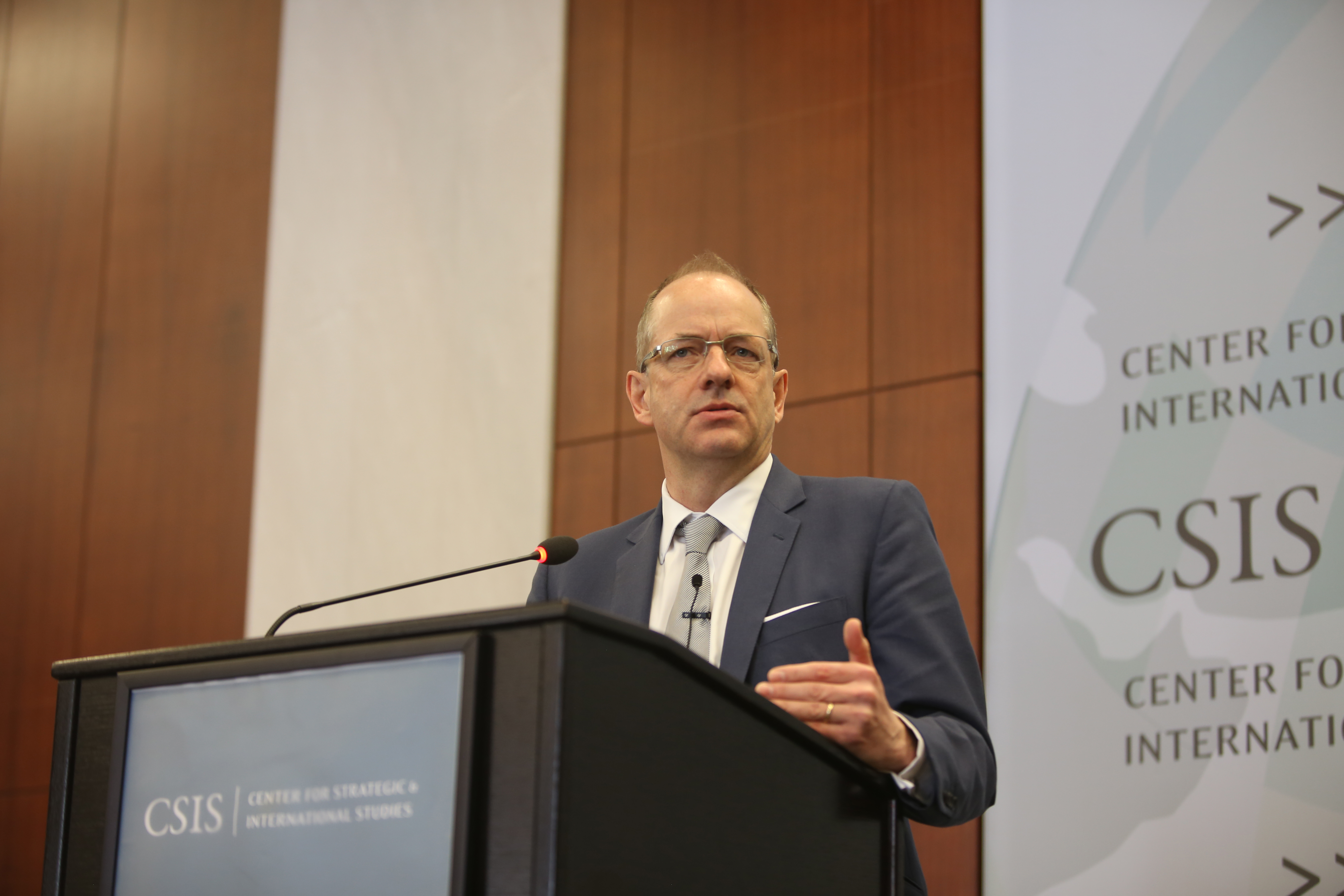
Sir Andrew Witty, Chief Executive Officer of GlaxoSmithKline, will open the session with a keynote address on how GlaxoSmithKline’s recent reforms are changing its engagement across different markets worldwide. He will outline new approaches on sales and marketing, transparency of clinical trials data, pricing, and research and development into meeting unmet medical need. His speech comes at a key moment, as the UN Secretary-General's High-Level Panel on Access to Medicines, on which Sir Witty serves, carries forward its deliberations.
Following Sir Andrew’s presentation, there will be a roundtable conversation that will explore these themes in more depth. The panelists will include: Sir Andrew Witty, Dr. Margaret Hamburg, Foreign Secretary of the Institute of Medicine, and Dr. Ezekiel Emmanuel, Vice Provost for Global Initiatives and Chair of the Department of Medical Ethics and Health Policy at the University of Pennsylvania. J. Stephen Morrison, Senior Vice President and Director of the CSIS Global Health Policy Center will moderate. We do hope you can attend!
Facts Only
The CSIS Global Health Policy Center is hosting an event on March 17 from 10:00am to 11:30am.
The event focuses on how private bio-pharmaceutical firms can support societal goals like affordability, access, quality, and innovation.
Sir Andrew Witty, CEO of GlaxoSmithKline, will deliver the keynote address.
Witty will discuss GlaxoSmithKline’s reforms in sales, marketing, clinical trial transparency, pricing, and research and development.
The event coincides with the deliberations of the UN Secretary-General's High-Level Panel on Access to Medicines, on which Witty serves.
A roundtable discussion will follow the keynote, featuring Witty, Dr. Margaret Hamburg of the Institute of Medicine, and Dr. Ezekiel Emanuel of the University of Pennsylvania.
J. Stephen Morrison, Senior Vice President and Director of the CSIS Global Health Policy Center, will moderate the discussion.
The event aims to address trust and confidence in the bio-pharmaceutical industry.
The discussion will explore themes of affordability, access, quality, and innovation in healthcare.
The event is open to attendees, with an invitation extended in the announcement.
Executive Summary
The CSIS Global Health Policy Center is hosting an event on March 17 from 10:00am to 11:30am to discuss how private bio-pharmaceutical firms can better support societal goals such as affordability, access, quality, and innovation. Sir Andrew Witty, CEO of GlaxoSmithKline, will deliver a keynote address highlighting the company’s reforms in sales, marketing, clinical trial transparency, pricing, and research and development to address unmet medical needs. This event is timely, as Witty also serves on the UN Secretary-General's High-Level Panel on Access to Medicines, which is currently deliberating on these issues. Following his speech, a roundtable discussion will feature Witty, Dr. Margaret Hamburg of the Institute of Medicine, and Dr. Ezekiel Emanuel of the University of Pennsylvania, moderated by J. Stephen Morrison of CSIS. The event aims to foster dialogue on strengthening trust in the bio-pharmaceutical industry and improving global health outcomes.
The discussion reflects broader industry and policy efforts to balance commercial interests with public health priorities, particularly in the wake of ongoing debates about drug pricing, transparency, and equitable access to medicines. The participation of high-profile figures from industry, academia, and policy underscores the complexity and importance of these challenges.
Full Take
This event reflects a strategic moment in the bio-pharmaceutical industry’s engagement with public trust and global health equity. The strongest version of this narrative is that industry leaders, policymakers, and academics are proactively addressing systemic challenges—such as drug pricing, transparency, and access—through reform and dialogue. GlaxoSmithKline’s reforms, as outlined by Witty, suggest a shift toward greater accountability, which could serve as a model for the sector. The inclusion of high-profile panelists from diverse backgrounds lends credibility to the discussion, framing it as a balanced exploration of complex issues.
However, the narrative also invites scrutiny of potential patterns. The event’s framing emphasizes industry-led solutions, which could subtly reinforce the idea that private firms are the primary drivers of change—potentially sidelining broader systemic critiques or the role of public policy. The focus on "trust and confidence" may imply that skepticism toward the industry is the core issue, rather than structural barriers to access or affordability. This could align with a pattern of *ARC-0024 Ambiguity*, where the problem is framed in broad terms without confronting deeper tensions between profit motives and public health.
Root causes here include the long-standing tension between market-driven innovation and equitable healthcare delivery. The event’s timing, amid UN deliberations, suggests an effort to shape the narrative around access to medicines before policy recommendations are finalized. Who benefits? Industry leaders gain a platform to define reform on their terms, while critics might argue that systemic change requires more than voluntary corporate measures.
Implications for human agency and dignity are significant. If reforms are superficial, marginalized populations may continue to face barriers to essential medicines. Conversely, genuine transparency and pricing reforms could improve global health outcomes. Missing perspectives might include voices from low-income countries or patient advocacy groups directly affected by access issues.
Bridge questions: How might voluntary industry reforms compare to regulatory mandates in achieving equitable access? What evidence would demonstrate that these reforms are substantive rather than performative? Who is absent from this conversation, and how might their inclusion shift the dialogue?
Counterstrike scan: A coordinated influence campaign might use this event to preempt criticism by framing industry reforms as sufficient, thereby deflecting calls for stricter regulation. The actual content does not fully match this pattern, as it includes diverse panelists and acknowledges broader societal goals. However, the absence of stronger critiques or alternative policy frameworks could still serve industry interests by default.