Insider Brief
- Q*Bird and the Walton Institute at SETU deployed Ireland’s first multi-node, entanglement-based MDI-QKD network over existing fiber, marking a shift from research to operational national quantum-secure infrastructure within the IrelandQCI and EuroQCI frameworks.
- The telecom-grade network connects data centers and universities in Dublin through a hub-and-spoke architecture with dynamic optical switching, enabling scalable, interoperable quantum key distribution without trusted intermediaries.
- By eliminating detector vulnerabilities and addressing “harvest-now-decrypt-later” risks, the system is designed to provide long-term cryptographic protection for research, government communications, and critical infrastructure while supporting future expansion across Europe.
PRESS RELEASE — Q*Bird, the Dutch leader in quantum secure communication, in collaboration with the Walton Institute at South East Technological University in Waterford (SETU), has deployed Ireland’s first multi-node, entanglement-based Measurement-Device-Independent Quantum Key Distribution (MDI-QKD) network. The deployment forms part of the IrelandQCI project, the country’s national quantum communications initiative and a key contributor to EuroQCI, the EU-wide federated quantum communications infrastructure.
Operating over Ireland’s existing fibre infrastructure, the telecom-grade network transitions quantum security from research environments into live national infrastructure. It safeguards research, education and critical systems while enabling interoperable quantum connectivity across Ireland and Europe.
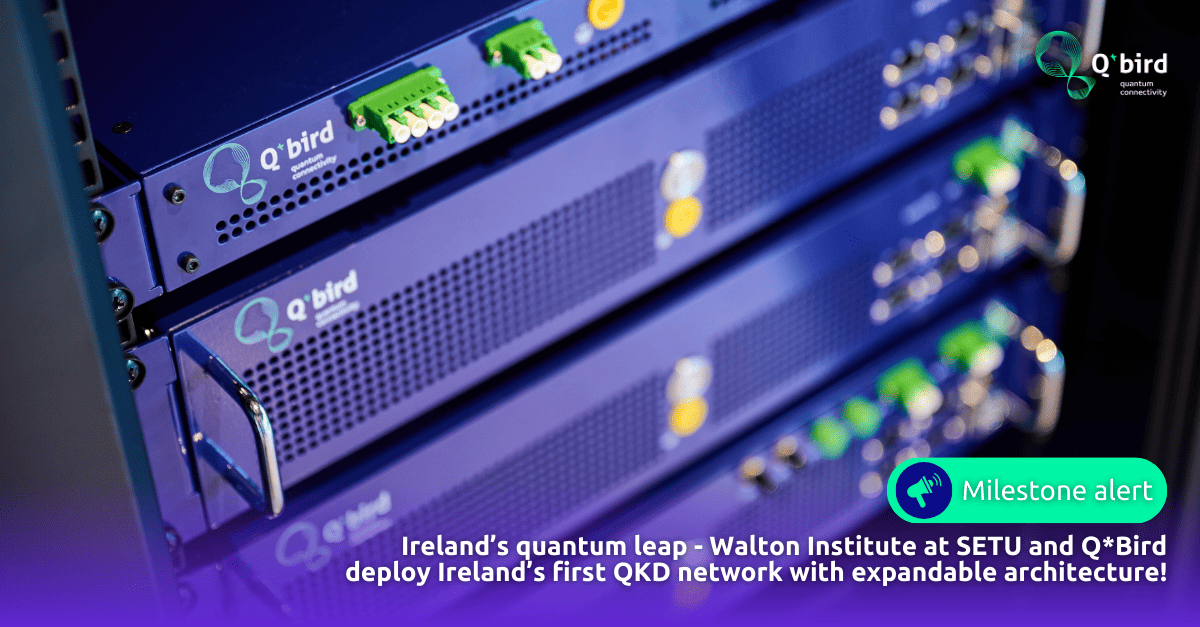
Importantly, it has been designed from the start with an expandable architecture in mind, so that any additional Q*Bird QKD Node can connect to the network with a single fiber link and then gain full quantum connectivity around the network.
“This multi-node deployment represents a major milestone for Ireland’s national quantum infrastructure,” said Dr. Deirdre Kilbane, Director of Research at Walton Institute at SETU and Coordinator of the €10 M IrelandQCI project which is co-funded by the Irish Department of Communications, Culture and Sport. “By integrating Q*Bird’s operational MDI-QKD Falqon® Series across research institutions, data centers and national networks, we are enabling secure, interoperable quantum communication while also creating a platform for other research institutions to join. It strengthens Ireland’s sovereignty over critical communications and contributes directly to EuroQCI and Europe’s federated quantum network vision.”
The hub-and-spoke architectural network comprises of four End Nodes, one Center Hub and one Quantum Optical Switch for a scalable metropolitan deployment and uses ESB Telecoms dark fibre for the quantum communication channel. The End Nodes are located in two Dublin data centres, Dublin City University and Trinity College Dublin, while the Center Hub is hosted at ASIERA (formerly HEAnet), Ireland’s National Education and Research Network. The collaborative expertise of Walton Institute at SETU, ASIERA and Q*Bird were responsible for the successful deployment of the highly secure connection between the strategic Dublin city locations. The Q*Bird Quantum-Optimized Optical Switch enables dynamic, secure routing of qubits around the network, ensuring full multi-node connectivity of QKD keys, without relying on trusted intermediaries.
Industry-grade security for research, education and critical infrastructure
At the core of the network is Q*Bird’s Falqon® Series, enabling entanglement-based quantum key distribution over operational fiber networks. Detector-side exploits have been identified by security authorities, including Germany’s Federal Office for Information Security (BSI), as the most critical attack vector in earlier QKD implementations. Q*Bird’s devices completely remove the requirement to trust any detector devices, thus establishing an architecture with a security model resilient against both present day cyber threats and future quantum-enabled attacks.
This ensures long-term cryptographic protection for sensitive research data, governmental communications and critical infrastructure systems, while addressing harvest-now-decrypt-later (HNDL) risk scenarios.
Interoperability by design, resilience by architecture
The network’s hub-and-spoke architecture of Q*Bird devices, along with the Quantum Optical Switch, enables precise synchronisation, dynamic routing and multi-node quantum key distribution. Designed for interoperability and compatibility with existing fibre infrastructure, it provides an open foundation for future integration with emerging quantum technologies such as quantum processors, sensors and modems.
“With this deployment, we continue demonstrating that secure, multi-node quantum networks are not theoretical constructs but operational systems ready for national infrastructure,” shares Dr. Joshua Slater, CTO of Q*Bird. “By combining field-proven hardware with MDI-QKD protocols, we deliver infrastructure resilient against both contemporary cyber threats and future quantum attacks. With this deployment, we are fully prepared for expansion and collaboration with additional research and educational institutions.”
Towards a federated European quantum network
Dr. Ingrid Romijn, CEO and Co-Founder of Q*Bird, added, “National security cannot depend on laboratory-grade assumptions. Quantum security must operate within live infrastructure, under real-world conditions. Ireland’s deployment not only reinforces Ireland’s position as a European hub for quantum secure connectivity, but also shows that scalable, sovereign and interoperable quantum networks can be implemented today over existing fibre and integrated directly into national communications infrastructure.”
“As quantum computing advances, defensive architectures must evolve accordingly. By eliminating detector vulnerabilities and enabling interoperable, cross-border quantum key distribution, we are building infrastructure that protects current communication networks and the integrity of future digital infrastructure.”
Q*Bird’s Falqon® Series has been purpose-built for operational, interoperable and sovereign quantum communications, supporting metropolitan, national and cross-border deployments. By securing Ireland’s research and education backbone and critical digital assets, this deployment positions Ireland as a key operational node within EuroQCI.
Designed, engineered and field-proven, the Q*Bird quantum network demonstrates how entanglement-based MDI-QKD can form the backbone of Europe’s future quantum secure infrastructure that is scalable, vendor-interoperable and resilient against the full spectrum of present and future threats.
With this milestone deployment, Q*Bird and Walton Institute at SETU, reinforce Ireland’s leadership in quantum secure communication and accelerate the transition from quantum research to quantum resilient infrastructure. The network delivers a future-ready and scalable foundation for expanding Ireland’s quantum connectivity, enabling new research, education and critical infrastructure partners to join the secure, interoperable ecosystem!
Facts Only
Q*Bird and the Walton Institute at SETU deployed Ireland’s first multi-node, entanglement-based MDI-QKD network.
The deployment is part of the IrelandQCI project and the EuroQCI initiative.
The network operates over existing fiber infrastructure in Dublin.
The hub-and-spoke architecture includes four End Nodes, one Center Hub, and one Quantum Optical Switch.
End Nodes are located in two Dublin data centers, Dublin City University, and Trinity College Dublin.
The Center Hub is hosted at ASIERA (formerly HEAnet), Ireland’s National Education and Research Network.
The network uses ESB Telecoms dark fiber for quantum communication.
Q*Bird’s Falqon® Series enables entanglement-based quantum key distribution.
The system eliminates detector vulnerabilities, addressing "harvest-now-decrypt-later" risks.
The network is designed for scalability and interoperability with existing fiber infrastructure.
The project is co-funded by the Irish Department of Communications, Culture and Sport.
Dr. Deirdre Kilbane is the Director of Research at Walton Institute and Coordinator of the IrelandQCI project.
Executive Summary
Q*Bird and the Walton Institute at South East Technological University (SETU) have deployed Ireland’s first multi-node, entanglement-based Measurement-Device-Independent Quantum Key Distribution (MDI-QKD) network. This network, part of the IrelandQCI project and the broader EuroQCI initiative, operates over existing fiber infrastructure, marking a transition from research to operational quantum-secure infrastructure. The hub-and-spoke architecture connects data centers and universities in Dublin, including Dublin City University and Trinity College Dublin, with a central hub at ASIERA (formerly HEAnet). The system uses Q*Bird’s Falqon® Series to eliminate detector vulnerabilities, addressing "harvest-now-decrypt-later" risks and providing long-term cryptographic protection for research, government communications, and critical infrastructure. Designed for scalability and interoperability, the network supports future expansion across Europe and integrates with existing fiber infrastructure, positioning Ireland as a key node in Europe’s federated quantum network.
The deployment highlights a collaborative effort between industry and academia to advance quantum-secure communication. By leveraging entanglement-based MDI-QKD, the network ensures security against both current cyber threats and future quantum-enabled attacks. The initiative underscores Ireland’s commitment to quantum sovereignty and its role in the EU’s broader quantum communications strategy, while also providing a platform for additional institutions to join the secure ecosystem.
Full Take
This deployment represents a significant step in operationalizing quantum-secure communication, moving beyond theoretical research into live national infrastructure. The strongest version of this narrative emphasizes the collaborative success of industry and academia in addressing a critical gap in cybersecurity—preparing for quantum-enabled threats while maintaining compatibility with existing systems. The use of MDI-QKD, which removes detector vulnerabilities, is a technical leap that strengthens the security model against both current and future attacks. The hub-and-spoke architecture, combined with dynamic optical switching, demonstrates a scalable solution that could serve as a blueprint for other nations.
However, the narrative also reflects broader patterns in technological adoption. The emphasis on "quantum sovereignty" and "federated European networks" aligns with geopolitical trends where nations seek to control critical infrastructure to mitigate dependencies on external actors. The framing of this deployment as a milestone for Ireland’s leadership in quantum communication may carry an implicit appeal to national pride, though it stops short of overt emotional manipulation. The focus on interoperability and future expansion suggests a strategic effort to position Ireland as a hub within the EU’s quantum ecosystem, which could have economic and political implications beyond pure security.
Root causes include the growing recognition of quantum computing’s potential to break classical encryption, driving investment in quantum-resistant technologies. The unstated assumption is that nation-states must act now to prevent future vulnerabilities, a paradigm that mirrors Cold War-era arms races in cybersecurity. The implications for human agency are mixed: while the technology promises greater security for critical infrastructure, it also centralizes control in the hands of institutions that manage these networks. Who benefits? Primarily governments, research institutions, and industries handling sensitive data. Who bears costs? Potentially smaller entities that may struggle to integrate with such advanced systems, creating a digital divide in security capabilities.
Bridge questions: How might the centralization of quantum-secure networks affect individual privacy and decentralized communication models? What safeguards are in place to prevent these systems from becoming tools of surveillance rather than protection? Would the narrative change if the focus shifted from national security to individual digital rights?
Counterstrike scan: A coordinated influence campaign pushing this narrative might emphasize urgency ("quantum threats are imminent!") while downplaying costs or limitations. The actual content, however, presents a measured technical achievement without exaggerated claims or fear appeals. It aligns with legitimate advancements in quantum communication rather than a manipulative playbook.
Patterns detected: none
Sentinel — Human
The article exhibits strong indicators of human authorship, including technical specificity, direct attribution, and alignment with documented projects, with minimal stylometric or coherence red flags.