Thank you for visiting nature.com. You are using a browser version with limited support for CSS. To obtain
the best experience, we recommend you use a more up to date browser (or turn off compatibility mode in
Internet Explorer). In the meantime, to ensure continued support, we are displaying the site without styles
and JavaScript.
A Chinese supercomputer has taken out first place on the list of the world’s fastest computers — the first China-based system to achieve this ranking in almost a decade. LineShine stands apart because it combines conventional computer processing with artificial-intelligence capabilities and represents the future of scientific computing, say researchers.
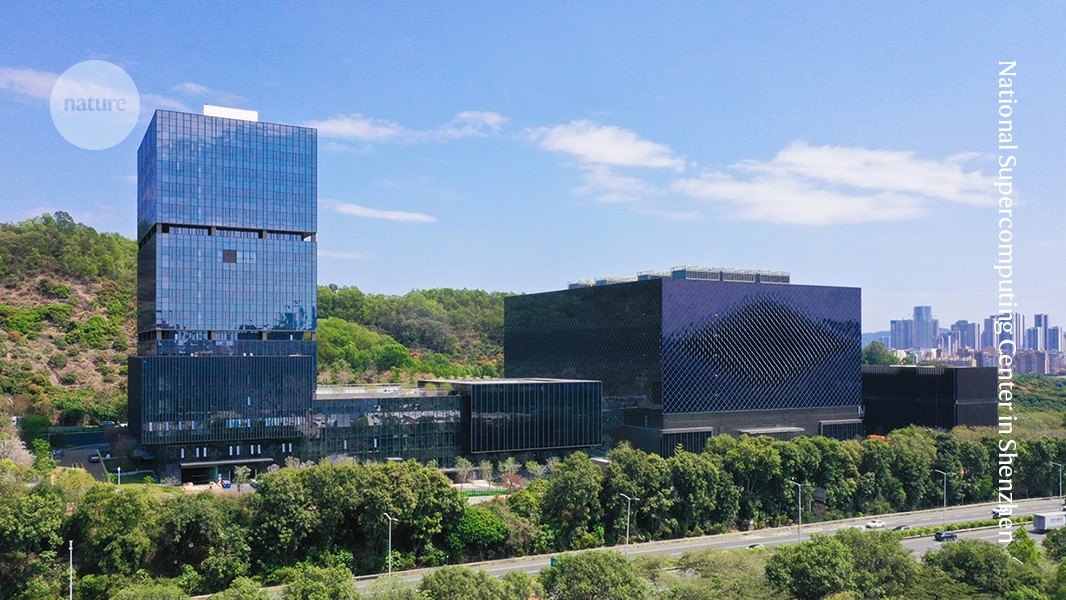
On Tuesday, LineShine, based at the National Supercomputing Center in Shenzhen, China, was placed first in the TOP500, which is published twice a year.
The computer is remarkable because it doesn’t use graphics processing units (GPUs), fast chips that can handle the concurrent calculations needed for AI computations. US companies have tended to lead advanced chip designs, but LineShine is made from Chinese parts, in part because the United States has restricted the export of its GPUs to China, citing national security concerns.
The machine’s power comes from combining sheer scale of components — made up of almost 14 million processing cores — with design innovations, including fast shuttling of data and specialized units that can perform some of the dense calculations that are performed by GPUs on other computers.
LineShine, which was publicly unveiled in April, can carry out more than two quintillion calculations per second, or 2.19 exaflops, making it 22% faster on the competition benchmark than its closest rival and previous top dog El Capitan at the Lawrence Livermore National Laboratory in California, which placed second.
Performance is judged on the TOP500 ranking’s ‘Linpack’ metric — a standard industry benchmark that measures a computer’s speed at solving a collection of linear equations.
Topping the ranking doesn’t necessarily make LineShine the fastest computer in the world for every scientific or AI application, says Jack Dongarra, a computer scientist at the University of Tennessee, Knoxville, and co-creator of the TOP500 list. The huge computer systems that AI companies, such as Google and Meta, use today are also superfast, but are designed and built to perform less precise calculations at a higher rate, so are hard to compare. Plus, those firms often don’t participate in the TOP500 competition, says Dongarra.
Future of computing
But LineShine’s win is significant. The last time a Chinese computer topped the list was in 2017 with Sunway TaihuLight. The latest win demonstrates China’s “very substantial capabilities” in areas such as computer-processor design, says Dongarra, and it suggests ways that a single computer can support both conventional scientific computing and emerging AI computations. “That may be particularly valuable as scientific computing and AI become increasingly intertwined.”
Haohuan Fu, a computing and geoscience researcher at Tsinghua Shenzhen International Graduate School, who has used LineShine, agrees that computers that bring these two capabilities together will be the next generation of scientific computing. “I am excited because systems like LineShine make it possible to study complex natural and engineered systems at larger scale, higher resolution and greater speed. More importantly, they allow us to bring together physical knowledge and data-driven AI in a much more integrated way,” he adds. Fu has used LineShine to show that conventional physics-based weather models can be combined with AI models to improve rainfall prediction models over East Asia.
Using the supercomputer, his team was able to test weather predictions between 2016 and 2025 in just 14.6 hours1. For real-world use, predictions must be done quickly enough for the forecast to be useful, he adds. “A typical computing cluster would not be able to support this combination of scale, speed and complexity.” LineShine has also been used by scientists to simulate magnetic materials at the atomic scale.
Home-grown technology
Enjoying our latest content?
Log in or create an account to continue
Access the most recent journalism from Nature's award-winning team
Explore the latest features & opinion covering groundbreaking research
Sentinel — Human
The text reads as well-structured journalism, balancing specific technological metrics with expert commentary on the future of integrated computing and AI.