This Week In Space podcast: Episode 203 — China Rising
With Dr. Namrata Goswami
Breaking space news, the latest updates on rocket launches, skywatching events and more!
You are now subscribed
Your newsletter sign-up was successful
Want to add more newsletters?
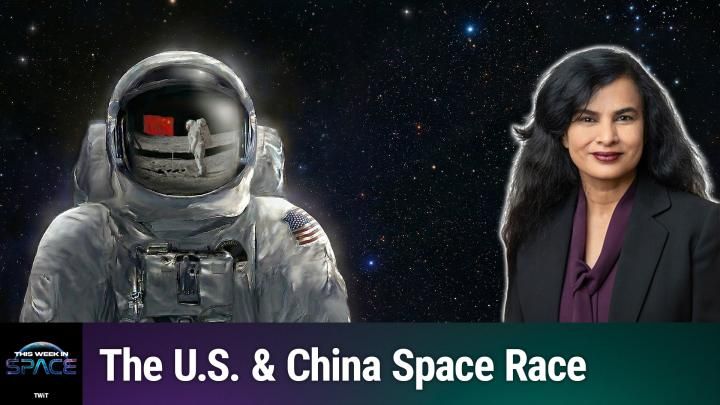
On Episode 203 of This Week In Space, Rod Pyle and Tariq Malik are joined by Dr. Namrata Goswami of Johns Hopkins University to examine the potential threats to American leadership in space.
Many suggest there is a new space race afoot, this time between the US and China. We've also know that America seems to be at its best in innovation and achievement when challenged by some external force. Will the Chinese human lunar program light the fuse of American innovation and accomplishment when it comes to our lagging lunar program and other spaceflight initiatives?
Who will be first to land astronauts on the moon? Does it really matter? Who controls what regions of the moon? Will cislunar space be contested between major space powers? This and much more in this episode of This Week in Space.
Article continues belowDownload or subscribe to this show at: https://twit.tv/shows/this-week-in-space
Get episodes ad-free with Club TWiT at https://twit.tv/clubtwit
Space news of the week
- What time is NASA's Artemis 2 moon launch on April 1?
- Incredible new NASA images reveal Saturn in a new light — and it's all thanks to a telescope team-up from Webb and Hubble
- 'For All Mankind' is confirmed for season 6, but it'll be the final mission for Apple TV's incredible space show
- Rattling the Roman Space Telescope | Space photo of the day for March 26, 2026
- Dr. Namrata Goswami
- NASA’s Rivalry/Not-Rivalry With China’s Space Agency Takes Off China’s Mengzhou is putting pressure on NASA’s lunar time frame
- China designates space sector an “emerging pillar industry,” sets deep space ambitions in new economic blueprint
- Treaty on Principles Governing the Activities of States in the Exploration and Use of Outer Space, including the Moon and Other Celestial Bodies
Model Falcon 9!
Looking for a telescope to see planets and comets? We recommend the Celestron Astro Fi 102 as the top pick in our best beginner's telescope guide.
Finally, did you know you can launch your own SpaceX rocket? Model rocket maker Estes' stunning scale model of a Falcon 9 rocket that you can pick up now. The launchable model is a detailed recreation of the Falcon 9 and retails for $149.99. You can save 10% by using the code IN-COLLECTSPACE at checkout, courtesy of our partners collectSPACE.com.
About This Week In Space
This Week in Space covers the new space age. Every Friday we take a deep dive into a fascinating topic. What's happening with the new race to the moon and other planets? When will SpaceX really send people to Mars?
Join Rod Pyle and Tariq Malik from Space.com as they tackle those questions and more each week on Friday afternoons. You can subscribe today on your favorite podcatcher.
Breaking space news, the latest updates on rocket launches, skywatching events and more!
Rod Pyle is an author, journalist, television producer and Editor-in-Chief of Ad Astra magazine. He has written 18 books on space history, exploration, and development, including Space 2.0, Innovation the NASA Way, Interplanetary Robots, Blueprint for a Battlestar, Amazing Stories of the Space Age, First On the Moon, and Destination Mars
In a previous life, Rod produced numerous documentaries and short films for The History Channel, Discovery Communications, and Disney. He also worked in visual effects on Star Trek: Deep Space Nine and the Battlestar Galactica reboot, as well as various sci-fi TV pilots. His most recent TV credit was with the NatGeo documentary on Tom Wolfe's iconic book The Right Stuff.
Responsible for Space.com's editorial vision, Tariq Malik has been the Editor-in-Chief of Space.com since 2019 and has covered space news and science for 18 years. He joined the Space.com team in 2001, first as an intern and soon after as a full-time spaceflight reporter covering human spaceflight, exploration, astronomy and the night sky. He became Space.com's managing editor in 2009. As on-air talent has presented space stories on CNN, Fox News, NPR and others.
Tariq is an Eagle Scout (yes, he earned the Space Exploration merit badge), a Space Camp veteran (4 times as a kid, once as an adult), and has taken the ultimate "vomit comet" ride while reporting on zero-gravity fires. Before joining Space.com, he served as a staff reporter for The Los Angeles Times covering city and education beats. He has journalism degrees from the University of Southern California and New York University.
Space.com is the premier source of space exploration, innovation and astronomy news, chronicling (and celebrating) humanity's ongoing expansion across the final frontier. Originally founded in 1999, Space.com is, and always has been, the passion of writers and editors who are space fans and also trained journalists. Our current news team consists of Editor-in-Chief Tariq Malik; Editor Hanneke Weitering, Senior Space Writer Mike Wall; Senior Writer Meghan Bartels; Senior Writer Chelsea Gohd, Senior Writer Tereza Pultarova and Staff Writer Alexander Cox, focusing on e-commerce. Senior Producer Steve Spaleta oversees our space videos, with Diana Whitcroft as our Social Media Editor.
You must confirm your public display name before commenting
Please logout and then login again, you will then be prompted to enter your display name.
Facts Only
Episode 203 of *This Week In Space* features Rod Pyle, Tariq Malik, and Dr. Namrata Goswami discussing U.S.-China competition in space.
The episode explores whether China's lunar program could motivate U.S. innovation in spaceflight.
Key topics include the race to land astronauts on the moon, control over lunar regions, and potential contests in cislunar space.
NASA's Artemis 2 moon launch is scheduled for April 1, 2026.
New images of Saturn were captured through a collaboration between the James Webb and Hubble telescopes.
Apple TV's *For All Mankind* has been renewed for a sixth and final season.
The Roman Space Telescope was featured as the space photo of the day on March 26, 2026.
China has designated its space sector as an "emerging pillar industry" in its economic blueprint.
The Outer Space Treaty governs state activities in space exploration, including the moon and other celestial bodies.
Estes offers a launchable model Falcon 9 rocket for $149.99, with a 10% discount available.
Rod Pyle is an author, journalist, and Editor-in-Chief of *Ad Astra* magazine.
Tariq Malik is the Editor-in-Chief of Space.com and has covered space news for 18 years.
Space.com was founded in 1999 and focuses on space exploration, innovation, and astronomy news.
Executive Summary
Episode 203 of *This Week In Space* features a discussion with Dr. Namrata Goswami of Johns Hopkins University, exploring the potential threats to American leadership in space amid a perceived new space race between the U.S. and China. The episode examines whether China's human lunar program could spur U.S. innovation, particularly in its lagging lunar initiatives. Key questions include who will first land astronauts on the moon, the significance of such a milestone, and whether cislunar space will become a contested domain among major powers. The episode also covers recent space news, such as NASA's Artemis 2 launch timeline, new images of Saturn from the Webb and Hubble telescopes, and China's designation of its space sector as an "emerging pillar industry." Additionally, the show highlights a model Falcon 9 rocket from Estes and discusses the broader implications of space exploration and geopolitical competition.
The conversation reflects broader debates about the future of space exploration, including the role of international treaties, the pace of technological advancement, and the strategic importance of lunar and deep-space missions. While the U.S. and China are framed as primary competitors, the discussion acknowledges the complexity of space governance and the potential for both cooperation and conflict in the coming decades.
Full Take
The strongest version of this narrative frames the U.S.-China space competition as a potential catalyst for American innovation, echoing historical patterns where external challenges have driven technological and strategic advancements. The discussion acknowledges the complexity of space governance, including the role of treaties like the Outer Space Treaty, and raises valid questions about the future of lunar exploration and cislunar dominance. However, the framing of a "space race" risks oversimplifying the geopolitical and technological dynamics at play. While competition can spur progress, it may also lead to unnecessary militarization or resource conflicts in space.
Patterns detected: ARC-0024 Ambiguity (the term "space race" is used loosely without clear definition), ARC-0043 Motte-and-Bailey (broad claims about "American leadership" without specifying metrics).
The root cause of this narrative lies in the assumption that space exploration is inherently a zero-sum game, where one nation's gain is another's loss. This paradigm ignores potential avenues for cooperation, such as joint missions or shared scientific research, which have historically been part of space exploration. The unstated assumption is that lunar and cislunar dominance equates to strategic superiority, a perspective that may not account for the long-term benefits of international collaboration.
The implications for human agency and dignity are significant. If space becomes a contested domain, the focus may shift from scientific discovery and human exploration to geopolitical posturing, potentially limiting access and innovation. The beneficiaries of this narrative are likely defense contractors, national space agencies, and policymakers advocating for increased funding, while the costs may be borne by taxpayers and the broader scientific community if resources are diverted from collaborative efforts.
Bridge questions: What metrics should define "leadership" in space—technological firsts, scientific output, or sustainable governance? How might a cooperative framework for lunar exploration differ from a competitive one in terms of long-term benefits? What historical examples of space cooperation could inform a more collaborative future?
Counterstrike scan: A coordinated influence campaign would likely amplify the "space race" framing to justify increased military or space funding, portraying China as an existential threat to U.S. dominance. The actual content does not fully align with this pattern, as it includes nuanced discussions about treaties and potential cooperation. However, the underlying competitive narrative could be exploited by bad actors to push for more aggressive space policies.