By Maria Popova
This essay is adapted from Traversal.
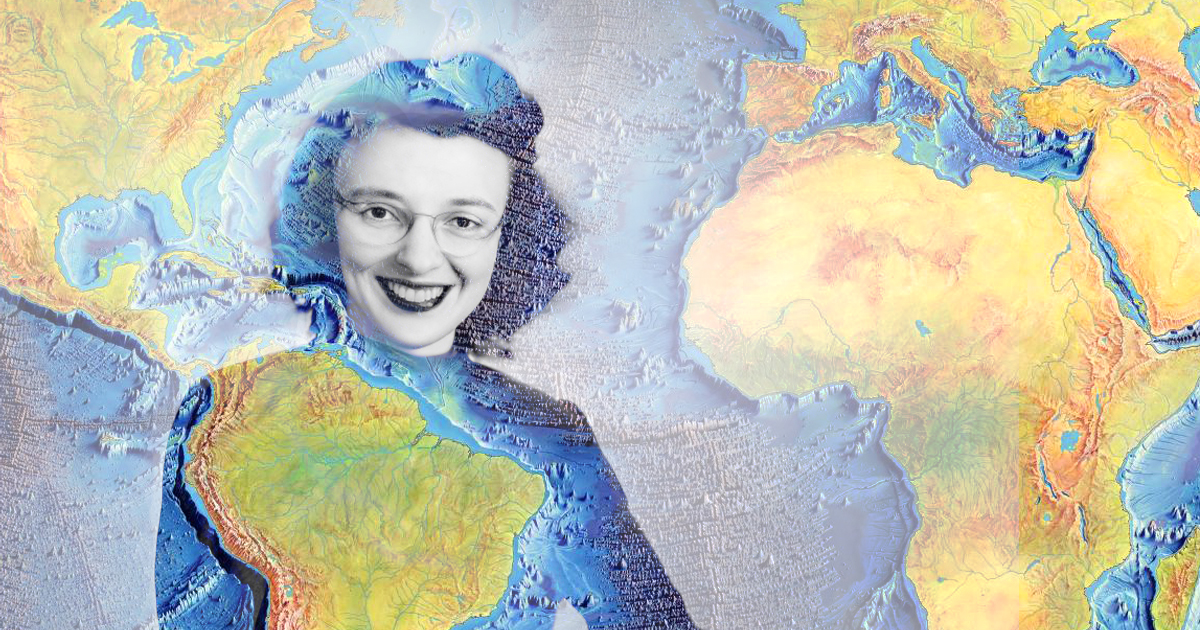
She is looking at the staff lines of a strange symphony in blue, her cautious disbelief punctured by a burst of delirious wonderment. Brushes and tubes of paint are scattered about her — paint she has spent years mixing into the perfect shades of blue to color a world’s worth of oceanic depths inside the contours of her enormous maps in the making. But now she is not looking at the blues. She is not looking at the maps. She is looking at the staff lines. Except they are staff lines only to her, a violinist since girlhood. To any other geologist, to her colleagues at the Lamont Geological Observatory high on the banks of the Hudson River, to the geochemists in the observatory basement carbon-dating rock samples trying to prove that the Earth was created in 4004 BCE, this object of disbelief and wonderment is an ordinary fathogram plotting the undulations of the ocean floor across five horizontal lines, evenly spaced along thousand-fathom increments of depth — the data output of a fathometer, an echo-sounding instrument pioneered in 1490 when Leonardo da Vinci dipped a tube into open water to gauge the distance of vessels, then perfected centuries later into the sonar technology used for detecting enemy submarines during the world’s first global war. Four centuries after Magellan conducted the first single-spot sounding by plunging a weighted line into the blue Pacific waters and declared the ocean fathomless when the line reached 410 fathoms, the invention of the fathometer in the early 1920s, with its ability to measure depths as immense as 3,000 fathoms, revolutionized the human sense of the world below the surface of the world — a world then more mysterious than the Moon. “Prais’d be the fathomless universe,” Whitman had exulted in Leaves of Grass, plunging the same exultant imagination into the unfathomed universe residing right here on Earth, in what he reverenced as “the world below the brine.”
A century after Whitman, with still only a fraction of one percent of that world studied in detail, with three-quarters of the planet appearing on any map as a homogenous and featureless blue background to terrestrial topography, with the bottom of the world imagined as an enormous bathtub, this violinist trained in spherical trigonometry is hearing with her mind’s ear something never heard before, something unspeakable — anathema to every accepted theory of how this rocky blue planet holds together as a world. Humming beneath it is the answer to the ancient mystery of how a tremor in a mountain can dismantle a town, a life, a world.
She has unrolled nearly a kilometer of paper stacked in the corner of her office — fathograms from soundings her boss and his graduate students have conducted on several Atlantic expeditions over the course of five years, expeditions not one of which she, any she, was permitted to join. She has spliced together a composite portrait of the ocean from the partial data sounded along the vessel’s various routes, recorded on blue linen paper with a crow quill pen and India ink. She has glued together strips of this blue linen paper into an enormous sheet sprawled across several drafting tables, magnified by a fortyfold scale of exaggeration to render the subtleties of the data legible; one of those subtleties would be the spark of revolution. On this enormous sheet, she has plotted the various depth measurements — the underwater peaks and troughs, the smooth slopes and the sudden plunges. She has marked each depth reading as a dot on the graph. A note on the staff. Dots spaced about an inch apart, to be connected into a melody of meaning.
And there in that void of data, in that inch of silence, is where the computational mind reaches its limit and the compositional mind begins, demanding a virtuosity of interpretation.
She has filled in the gaps with dotted hypotheses, sensical chords connecting the notes. And now, with the strange score before her, skeptical as a scientist, hopeful as a hymnodist, she is sight-reading the record of Earth’s largest geologic feature — undiscovered and unbelievable, singing there in the data without counterpoint: a rift valley at the bottom of the ocean, extending forty thousand continuous miles around the globe in jagged lines contouring something that cannot be, if what the world believes about the planet is true.
She is about to paint that revolutionary line in blazing red across her perfect blues. The tectonic record of a great inhale splitting Earth’s solar plexus apart.
The year is 1952. Marie Tharp is thirty-two. One of a handful of oceanographic cartographers in the world, she has spent four years drafting the ocean floor, mapping and remapping the vast majority of the planet’s surface, composing coherence out of strobing data — data that would confirm the highly controversial notion that the Earth is not a static planet but a dynamic, ever-changing world; that continental drift — the fringe theory the German meteorologist Alfred Wegener had proffered half a century earlier and paid for with his reputation, then his life — is true.
Half a century later, in the final years of her life, Marie Tharpe will look back on her discovery in its wider context with the same wonder-stricken disbelief:
Not too many people can say this about their lives: The whole world was spread out before me (or at least, the 70 percent of it covered by oceans). I had a blank canvas to fill with extraordinary possibilities, a fascinating jigsaw puzzle to piece together: mapping the world’s vast hidden seafloor. It was a once-in-a-lifetime—a once-in-the-history-of-the-world—opportunity for anyone, but especially for a woman in the 1950s. The nature of the times, the state of the science, and events large and small, logical and illogical, combined to make it all happen.
Marie had grown up messy-haired and mud-covered, cartwheeling on dirt roads, collecting snake skeletons, searching for arrowheads that she mounted like stone butterflies, getting sent home from school for wearing trousers, riding into the mossy rockscapes and sunlit forests of the American Midwest in a boxy 1920s truck, the green government truck her father drove and taught her to drive when she was eleven — her father, the publicly funded soil surveyor and poet without a public, whom she adored and who adored her. She would later joke that he took her on those field trips mostly to use her as a living metric, photographing the small girl next to various large geologic objects he wished to size up.
Under the demands of government geology, the tribe of three moved constantly—Indiana, Alabama, Ohio, D.C., more than two dozen miniature migrations before Marie graduated from adolescence, not minding the life of perennial nomads. When her father had saved up enough, he bought a farm in Ohio to fix up and settle the roaming band. Within a year, her mother was dead. Her mother was dead, and all Marie could do was play the violin. She played it into college, into the college symphony orchestra, into a life-plan that was about to get entirely remapped. But it never left her, the music, even after she grew enraptured by geology, pivoting toward it but still completing her majors in music and English, along with four minors across the visual arts. And now — a graduate degree in geology and a second baccalaureate in mathematics later — she is looking at the lines of the fathometer and seeing the symphony of the Earth.
The plate tectonics model that would arise from her discovery would go on to change our understanding of life itself: Tectonic activity mixes surface and ocean chemistry, recycling elements to keep atmospheric carbon dioxide and global temperature stable, and is what allowed Earth’s waters to remain liquid for the billions of years that complex life needed to evolve. Without it, we would have never risen from the oceans to measure the universe and fill the world with music.
The story of Marie Thrape’s life and her discovery — entwined with those of Alfred Wegener, Walt Whitman, Mary Shelley, Frederick Douglass, and other visionaries who changed our understanding of what makes a planet a world and what makes matter a mind capable of music and mathematics, of justice and love — comes alive in Traversal, the cover of which features her revolutionary map of the ocean floor.
—
Published July 1, 2026
—
https://www.themarginalian.org/2026/07/01/marie-tharp-traversal/
—
ABOUT
CONTACT
SUPPORT
SUBSCRIBE
Newsletter
RSS
CONNECT
Facebook
Twitter
Instagram
Tumblr
Sentinel — Human
This piece reads like sophisticated human-authored feature journalism, skillfully blending deep scientific history with poetic narrative to explore a singular life-changing discovery.