Truthout is a vital news source and a living history of political struggle. If you think our work is valuable, support us with a donation of any size.
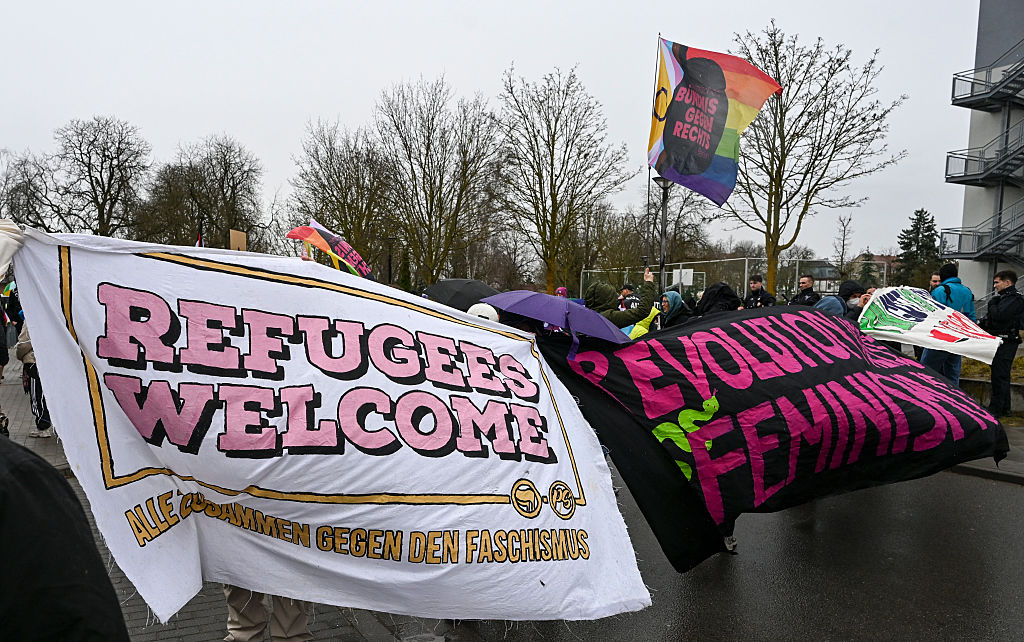
For years now, hard right, anti-immigrant, and in some cases overtly fascist political parties have been on the march in Europe, veering from one electoral triumph to the next. When large numbers of refugees fleeing the Syrian civil war began arriving in Europe in 2015, right populist groupings seized on the humanitarian crisis to cultivate a narrative that the whole continent would inevitably fall to the hard right.
An alliance of hard right parties have indeed been gaining seats and influence in the European parliament over the past decade. Hard right groups, broken into three blocs — European Conservatives and Reformists, Patriots for Europe, and Europe of Sovereign Nations — now control roughly a quarter of the parliamentary seats. And in a range of countries, including Austria, Sweden, Italy, Poland, Hungary, Slovakia, and elsewhere, hard right leaders have either joined governing coalitions or achieved outright political power. If this trend continues, some of the continent’s largest economies and militaries — Germany, France, Italy, and the U.K. — may all be controlled by governments with a hard right component by the end of the decade.
Of all these countries, it is Germany that could fall hardest, and with the most destructive consequences for the continent. The neo-Nazi Alternative for Germany (AfD) is polling ahead of both the Christian Democratic Union and the Social Democrats — which have both headed ineffectual coalition governments in the past decade. By decade’s end, AfD leaders could be in key roles in government, wielding the political clout to make real their campaign pledges to force huge numbers of immigrants to “remigrate” away from Germany, and reorienting much of Europe toward a neo-fascist vision of the continent.
Even though the AfD lost recent state elections in Rhineland-Palatinate to the CDU, it more than doubled its vote share, coming in with nearly 20 percent, marking the first time it has seen such large support in one of the wealthier western states in Germany. As the mainstream parties continue to struggle, it’s not at all clear that the much-vaunted post-World War II “firewall,” in which a combination of tactical voting and alliances between center right and social democratic parties has succeeded in keeping fascist parties out of power, will continue to hold over the coming years.
Yet in reality, the continental picture is not nearly so monolithic. While the hard right is growing in some countries and clearly remains a formidable electoral threat, progressive coalitions are starting to find their sea legs and push back. Over the past year, they have been buoyed by the hard right’s entanglement with the evermore unpopular Donald Trump and the public’s growing distaste for the U.S. president’s efforts to impose his ideology on Europeans, who associate it with the dark era of 1930s and 1940s fascism. JD Vance’s hectoring speech to the Munich Security conference in early 2025, Trump and Vance’s ambushing of Ukrainian Prime Minister Zelenskyy in the White House in February 2025, and U.S. territorial ambitions in Greenland — a territory that is part of the NATO member Denmark — have put the hard right on the defensive. It has attempted to push its ideological agenda, especially on immigration, without coming across as lackeys to a U.S. president who is historically unpopular in Europe. That has proven to be a difficult tightrope to walk.
In Spain, a progressive government has most successfully bucked the trend, managing to push pro-immigrant and anti-war policies; it recently legalized the status of half a million undocumented immigrants, and Spain’s prime minister, Pedro Sánchez, saw his poll numbers go up after he went head to head with Trump on the Iran war last month and refused to let Spanish bases be used in the conflict; at the same time the Vox Populi party of the hard right has seen its numbers decline. When Trump threatened to stop all trade between the U.S. and Spain, Sánchez doubled down, making a strong moral argument against the war of choice. Commentators noted it was both a moral and successful strategy.
In October of last year, as opinion polls suggested Geert Wilders’ right-wing Party for Freedom was about to win power in Holland, Dutch voters instead chose a center-left government, and 12 parliamentary members of Wilders’s party were defeated in their re-election bids. Three months later, an additional seven Party for Freedom legislators very publicly quit the party. Wilders, who has been a perennial in Europe’s hard right ecosystem for two decades now, suddenly found himself on his back foot.
Last week, France’s far right National Rally similarly underperformed in mayoral races, losing in key cities such as Marseille and Lyon that it had very publicly set its sights on. Surprisingly, the mainstream French socialist party saw an electoral rebound, winning the mayorship of Paris again, and giving itself a much-needed boost heading into the 2027 presidential election. While Le Pen’s party continues to poll ahead of the more centrist parties in the upcoming presidential and parliamentary elections, this is the second time in the past few years that voters have confounded the pollsters and succeeded in limiting the far right’s electoral gains.
In Italy, Prime Minister Giorgia Meloni, leader of the neo-fascist Brothers of Italy party, attempted to impose judicial reforms via referendum that would have given the executive greater disciplinary powers over the judiciary. Meloni framed the reforms as an effort to modernize and streamline the Italian state; critics decried them as an executive power grab. In Monday’s vote, the judicial reform went down in a shock defeat, reflecting growing dissatisfaction with the Meloni government. Meloni might soon find herself a lame duck.
The Italian leader is in trouble with the voting public for her much-touted close alliance with Trump, who has become politically toxic in Europe, even among those who like much of his populist, anti-immigrant rhetoric. Those who are seen as too close to him are starting to pay a price at the polls. A similar shift was seen in Canada last year, when the liberal Mark Carney came from behind to win the election after Trump made clear he had territorial ambitions in Canada and was going to use tariffs as a weapon to weaken the Canadian state.
In Hungary, Prime Minister Viktor Orbán, long a thorn in the side of the European Union and the most anti-Ukrainian of all the EU leaders, is also in deep trouble in the polls, with most showing his pro-Russian Fidesz Party likely to lose to a center-right, more pro-European party in next month’s parliamentary elections.
Orbán is widely seen as the doyen of Europe’s hard right, having ruled in an increasingly autocratic manner for the past 16 years. His methods — attacking the free press and universities; going after private philanthropic organizations, especially those with a base overseas; denouncing judicial figures as the enemy when they try to rein him in; cracking down on immigrants; and positioning himself as a defender of traditional cultural mores — have been widely emulated by the hard right on both sides of the Atlantic. Within the MAGA movement he is seen by many as a culture warrior hero second only to Donald Trump.
Hoping to buoy Orbán and prop up his vision of converting Europe into a continent of “illiberal democracies” that are hostile to mass immigration and on the “anti-woke” side of the culture war debates, the leading lights of Europe’s hard right movements gathered in Budapest this past Monday to sing his praises. Not wanting to be left out of the festivities, Donald Trump also praised him to the skies and gave an effusive endorsement via video. Yet as the election nears, Orban’s popularity does not seem to have rebounded.
And then there’s Britain. For the last two years, as Labour Prime Minister Keir Starmer has sunk into a bog of unpopularity, and as his party has come to be seen by many voters as being chronically incapable of improving their standard of living, Nigel Farage’s Reform U.K. party has surged. But, in the last few months, that momentum appears to have stalled out and Reform U.K. has begun to slip in the polls. It has lost bye-elections it had gone all out to win, and it has been riven in recent months by internal feuds.
While it is true that Reform is still polling ahead of Labour, Farage’s unfavourability rating has soared in recent months, likely propelled by his uncritical support of Trump, including of his launching of the Iran war, which is uniformly unpopular in the U.K. and the rest of Europe.
In polls, the combined Labour, Liberal Democrat, and Green vote is now at 50 percent, considerably higher than the combined Reform and Conservative vote. In a first-past-the-post system geared to two-party politics, the prospect of five national parties carving up the vote, with the Scottish, Welsh, and Irish nationalist parties also exercising an outsized influence in their respective countries, scrambles U.K. political predictions. It’s probable that the upcoming May local elections will show vast declines in support for the two traditionally dominant parties and a corresponding rise in support for the once-outsider parties — setting off a three-year scramble for position in a potential coalition government after the next general election.
That scenario might well offer a lifeline to progressive political forces in the U.K. Nigel Farage rose to the fore of British politics in an anti-European moment, when Brits were veering toward Brexit. A decade on, as the vaunted “special relationship” with the United States frays, and as Trump sabotages one carefully negotiated trade agreement after the next, polls show that most U.K. voters would like the country to rejoin the EU, or at the very least to have closer ties with the union. Farage promises the reverse: his go-it-alone policies when it comes to Europe, his MAGA-like promises to expel at speed hundreds of thousands of immigrants from the U.K. should he become prime minister, and his reliance on a bilateral relationship with an ever more unstable United States, look increasingly out of step in the post-Pax Americana age.
None of this is to say that the hard right dangers in Europe are past. A shockingly large percentage of European voters continue to support parties that share an ideology both with MAGA and with European fascist movements from the first half of the 20th century. And if centrist parties continue to chase voters by taking up far right stances on immigration while failing to implement serious programs of public investment, they could end up pushing more voters to the right. But there is at least a glimmer of hope in some of the recent polling and elections in Europe. And the more Trump shreds the international order, the more urgent it is for Europe to reanimate the electoral firewalls that have kept fascist movements out of power in the continent’s powerhouse countries for more than 80 years.
Urgent Appeal for Your Support
Truthout relies on individual donations to publish independent journalism, free from political and corporate influence. In fact, we’re almost entirely funded by readers like you.
Unfortunately, donations are down. At a moment when independent journalism is urgently needed, we are struggling to meet our operational costs due to increasing political censorship.
Truthout may end this month in the red without additional help. We still need to raise $7,000. Please make a tax-deductible one-time or monthly donation if you can.
Facts Only
Hard right and far-right parties have gained roughly a quarter of seats in the European Parliament, divided among three blocs: European Conservatives and Reformists, Patriots for Europe, and Europe of Sovereign Nations.
These parties have formed governments or joined coalitions in Austria, Sweden, Italy, Poland, Hungary, Slovakia, and other European countries.
Germany’s Alternative for Germany (AfD) is polling ahead of the Christian Democratic Union (CDU) and Social Democrats, with recent state elections in Rhineland-Palatinate showing AfD doubling its vote share to nearly 20%.
Spain’s progressive government, led by Prime Minister Pedro Sánchez, legalized the status of half a million undocumented immigrants and saw increased poll numbers after opposing U.S. policies on the Iran war.
In the Netherlands, Geert Wilders’ Party for Freedom lost 12 parliamentary seats in October 2024, with seven additional legislators quitting the party shortly after.
France’s far-right National Rally underperformed in recent mayoral races, losing in key cities like Marseille and Lyon, while the socialist party regained the Paris mayorship.
Italian Prime Minister Giorgia Meloni’s judicial reform referendum was defeated in a public vote, reflecting growing dissatisfaction with her government.
Hungary’s Prime Minister Viktor Orbán and his Fidesz Party are trailing in polls ahead of upcoming parliamentary elections, with a center-right, pro-European party leading.
Britain’s Reform UK party, led by Nigel Farage, has stalled in polls and lost bye-elections, with Farage’s unfavorability rising due to his support for Trump’s policies, including the Iran war.
Polls in the U.K. show combined support for Labour, Liberal Democrats, and Greens at 50%, higher than the combined Reform and Conservative vote.
Donald Trump’s unpopularity in Europe has become a liability for hard-right parties aligned with him, including Orbán and Meloni.
The AfD’s rise in Germany threatens to dismantle the post-WWII "firewall" that has historically kept far-right parties out of power.
Executive Summary
Full Take
The strongest version of this narrative highlights a genuine and concerning rise of hard-right politics in Europe, backed by verifiable electoral gains and policy shifts in multiple countries. The article deserves credit for acknowledging counter-trends, such as progressive pushback in Spain, the Netherlands, and France, and for linking the hard right’s struggles to its entanglement with Trump’s unpopular policies. However, the framing risks oversimplifying the dynamics at play. The hard right’s growth is not monolithic, and its setbacks are often tied to specific contextual factors—such as Trump’s toxicity—rather than a broad rejection of its ideology. The piece also leans into a pattern of emotional exploitation (ARC-0012 Fear Appeals) by emphasizing the potential "destructive consequences" of an AfD-led Germany, which, while plausible, is presented with a sense of urgency that could amplify anxiety rather than clarity.
The root cause of this narrative is a tension between two paradigms: the post-WWII liberal democratic order, which has historically marginalized far-right parties, and a resurgent nationalist-populist movement that thrives on anti-immigrant sentiment and cultural grievance. The unstated assumption is that Europe’s political future hinges on whether centrist parties can reclaim the narrative or whether they will continue ceding ground to the right by adopting its rhetoric. This echoes historical patterns from the 1930s, where economic instability and weak centrist responses enabled far-right ascendance—a parallel the article invokes explicitly.
The implications for human agency are significant. If centrist parties fail to address economic stagnation and social alienation, voters may continue drifting toward extremist solutions. Conversely, progressive coalitions that offer tangible alternatives—like Spain’s immigration reforms or Sánchez’s opposition to Trump—demonstrate that resistance is possible. The second-order consequences include potential fractures in NATO and the EU, as hard-right governments align more closely with Trump’s isolationist agenda, and a possible erosion of democratic norms if parties like AfD or Fidesz consolidate power.
Bridge questions: What structural economic or social conditions are driving voters toward the hard right, and can progressive policies address them without adopting far-right framing? How might the hard right adapt its messaging to distance itself from Trump’s unpopularity while retaining its core base? Would a shift in U.S. foreign policy under a different administration alter the hard right’s electoral fortunes in Europe?
Counterstrike scan: If this were part of a coordinated influence campaign, the playbook would involve amplifying fear of far-right dominance while subtly undermining centrist alternatives to create a sense of inevitability. The article does not fully match this pattern, as it provides genuine counterexamples of progressive resilience. However, the emphasis on Trump’s role as a unifying villain for Europe’s hard right could be exploited to oversimplify complex political dynamics, framing the issue as a binary struggle rather than a multifaceted crisis.
Patterns detected: ARC-0012 Fear Appeals