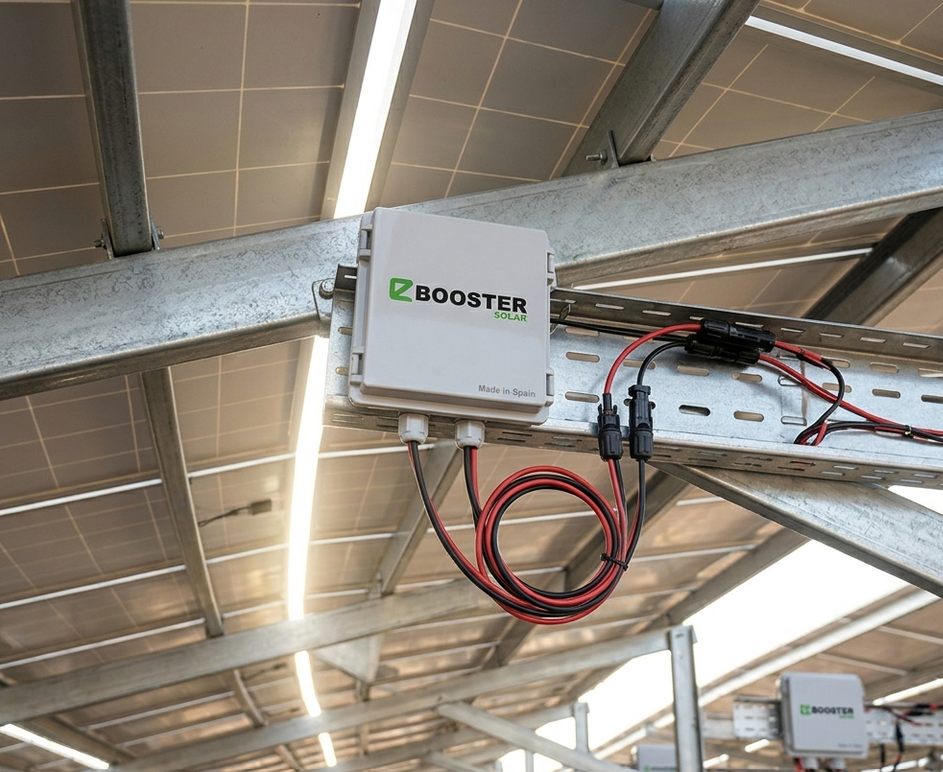
Ebooster Solar Solutions Global, an R&D and innovation engineering firm based in Murcia specializing in energy efficiency, has completed the technical development and field validation of its Ebooster device. Francisco José Arévalo, the company’s CEO, told pv magazine that the device is designed to optimize energy capture and output without altering installed surface area or the generator’s structural configuration.
Technical documentation reports production increases of up to 40% under real operating conditions, based on comparisons of daily generation curves with and without the device.
The system acts as a load equalizer, modifying current distribution between the module and the device, which “reduces the current flowing through the busbars.” According to Arévalo, this redistribution “lowers the temperature in the contact lines,” a factor that affects cell degradation and hot-spot formation.
Measurements included in the documentation show significant reductions in both average and peak operating temperatures.
The company says the device also stabilizes current and voltage along the string, “allowing the inverter to operate consistently at its maximum power point (MPPT).” The documentation additionally cites reduced voltage drops in the DC line, linked to lower ohmic losses.
The system is plug-and-play and requires one unit per solar panel. Two versions are available: one for one-device-per-panel configurations and another designed to manage two panels in higher-capacity systems.
Model selection is based on a preliminary technical assessment of module power, system configuration, and project energy requirements.
Arévalo said manufacturing is not fully based in Spain or Europe, but relies on an international supply chain, the details of which are not disclosed for confidentiality reasons. The full technical datasheet is also not publicly available and is shared only upon request. The company claims current production capacity could reach between 500,000 and two million units per month under an agreement with an international manufacturer.
He added that the device was developed entirely in-house by the company’s R&D team, without involvement from universities or external research centers.
“We have other solutions aimed at companies in the sector that we are holding back from announcing for the time being. Right now, the focus is on Ebooster,” Arévalo said.
Please login to comment
Facts Only
* Ebooster Solar Solutions Global is an R&D and innovation engineering firm based in Murcia.
* The company developed and field-validated the Ebooster device.
* The device optimizes energy capture and output without altering installed surface area or generator structure.
* Real operating conditions show production increases of up to 40% based on generation curve comparisons.
* The system acts as a load equalizer by modifying current distribution between the module and the device.
* This redistribution reduces current flowing through busbars, lowering temperature in contact lines.
* Measurements documented significant reductions in average and peak operating temperatures.
* The device stabilizes current and voltage along the string, allowing for consistent MPPT operation.
* The system features two versions: one for single-device configurations and one for managing two panels.
* Manufacturing relies on an international supply chain.
* Current production capacity is claimed to reach between 500,000 and two million units per month under an agreement with an international manufacturer.
Executive Summary
Full Take
The narrative centers on proprietary optimization technology developed in-house by a Spanish firm, positioning the Ebooster device as a critical advancement for solar energy efficiency through thermal management. The emphasis is placed on internal scientific rigor—in-house development without external academic involvement—to establish credibility and control the intellectual property. This framing elevates a specific engineering solution to an essential technological necessity in the renewable sector.
However, the reliance on an undisclosed international supply chain introduces a layer of systemic uncertainty regarding manufacturing standards, quality control, and geopolitical dependencies. While claims of production capacity up to two million units monthly suggest massive scalability, the lack of public technical documentation prevents independent peer review of the claimed 40% efficiency gains or temperature reduction metrics, which are central to the value proposition. This dynamic highlights a pattern where technological innovation is rapidly commercialized under controlled internal research, allowing the company to dictate the narrative while managing external scrutiny via restricted data sharing. The focus shifts from pure physical performance (validated by measurements) to strategic positioning (production targets and intellectual property control), suggesting that in the market for green technology, the ability to control the supply chain and the proprietary knowledge may be as valuable as the technical solution itself.
Sentinel — Human
The text exhibits characteristics consistent with professionally drafted technical reporting or a corporate press release, suggesting human authorship focused on conveying specific, proprietary data.