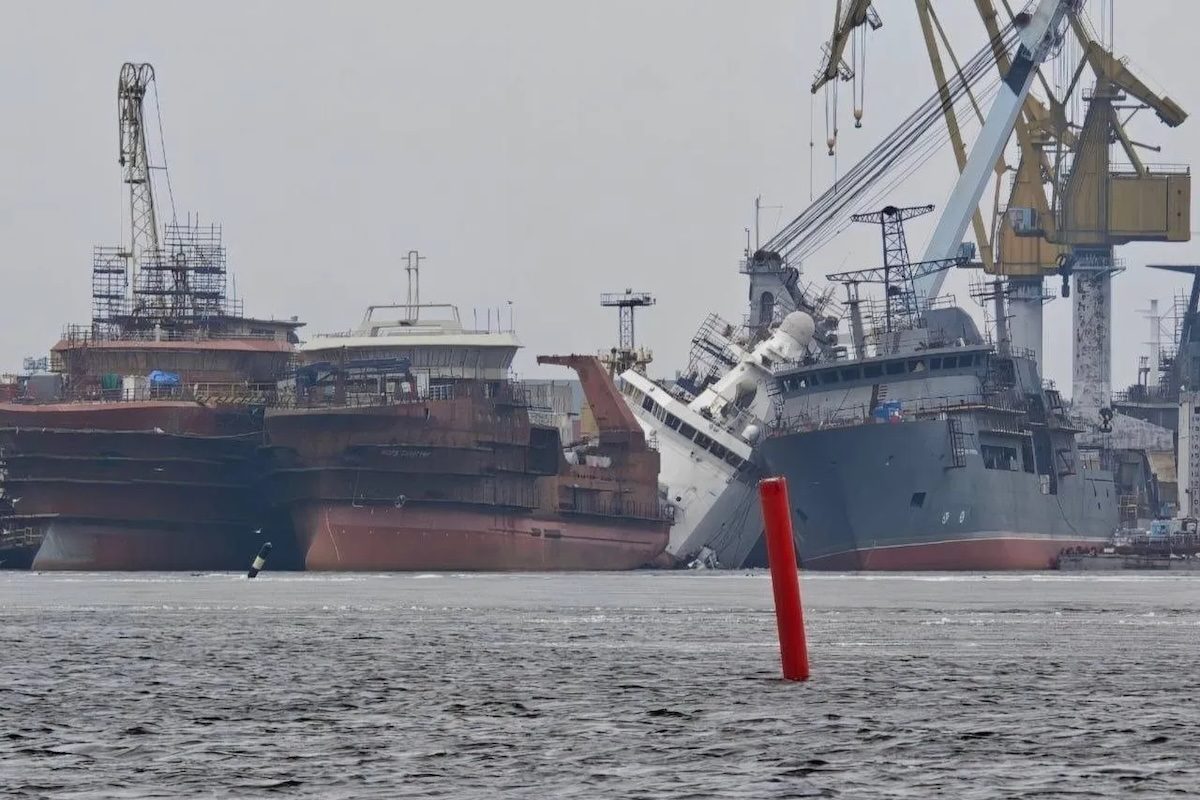
On March 25, during a massive drone attack in the Leningrad region, the Ukrainian General Staff announced that its “joint forces” had damaged the Vyborg Shipbuilding installation. Whoever carried it out and how, the attaack’s success was a huge disaster for the Russians, with significant geopolitical implications.
The Purga, a new, advanced Russian Arctic icebreaking patrol ship built for the FSB Coast Guard, was reported heavily damaged.
At the present time, there is nearly a total news blackout in Russia and the Russian security services have launched an intensive investigation, looking for sabotage or other evidence of insider dealing. Russia’s Federal Security Service (FSB), the KGB successor, has established a “special filtration zone” at the shipyard, interrogating all night shift workers.
They are specifically looking for anyone who had access to the ballast control systems or the hull’s underwater fittings of the Purga, a new, advanced Russian Arctic icebreaking patrol ship built for the FSB Coast Guard that was heavily damaged. An FSB working theory is that the Kingston valves (seawater intakes) were sabotaged.
The Russians have also stepped up diver protection patrols in Vyborg bay, launching frequent anti-sabotage boat patrols (Protivodiversionnye Sily i Sredstva – Counter-Sabotage Forces and Means). Apparently they are hunting for underwater divers and unmanned underwater vehicles. Meanwhile there are extensive interviews of workers at the yard and intensive “scrubbings” of mobile phones.
The Purga was the target
The Purga (Blizzard) is an icebreaker patrol ship dedicated for FSB Border Control work. In the FSB version the ship is optimized for surveillance, icebreaking and sovereignty protection.
In April 2012 the FSB announced that the country was planning to build 20 frontier posts in the Arctic region. Reasons for this development can be found in the increased abilities to explore hydrocarbon deposits in the north. It would also give Russia an ability to patrol and service the Northern Sea Route. The Arctic is a core priority for Russian sovereign identity and economic future. Damaging a vessel specifically built for this environment directly challenges Russia’s ability to police and militarize the opening polar shipping lanes.
The US has been trying to match Russia’s accelerated effort to build icebreakers. The U.S. icebreaker fleet is currently undergoing its most significant expansion in over 50 years. Driven by the ICE Pact—a trilateral agreement between the US, Canada and Finland signed in July 2024—the program has moved from a period of stagnation to an accelerated “warp speed” build phase as of early 2026.
Construction is underway at Bollinger Mississippi Repair (formerly VT Halter). After years of delays due to design complexities – specifically adapting the German Polarstern II design – the first vessel, USCGC Polar Sentinel (WMSP-21), is now expected to enter service by May 2030.
The US and Finland are also building a fleet of medium icebreakers. Bollinger & Davie Defense plans to build 7 vessels domestically. Davie Defense recently invested $1 billion to modernize a shipyard in Port Arthur, Texas, to serve as an “American Icebreaker Factory.”
Dealing a significant setback to Russia’s arctic ambitions appears to be a significant policy objective of both the US government and its northern NATO partners (i.e., Finland, Sweden, Norway, Denmark, Germany).
The Purga after being hit is listing at 40 degrees and leaning on another ship, the Burilichev. There is near certainty that the Purga is not salvageable even if the Russians had equipment capable of stabilizing and refloating the ship, which they do not. The damage to the Burilichev also appears to be consequential, mostly because most of its sensitive topside instrumentation may have been crushed by the listing Purga, including its cranes.
The Vice-Admiral Burilichev (Project 22011) is an important Russian strategic asset and serves as a spy ship. It is a specialized oceanographic research vessel that played a central role in Russia’s “seabed warfare” strategy. While it is officially designated for scientific research, its technical capabilities and institutional affiliation place it at the heart of Russian efforts to monitor and potentially disrupt NATO’s undersea infrastructure.
It deploys deep-diving autonomous underwater vehicles (AUVs), specifically the Rus (Project 16810) and Consul (Project 16811). These submersibles can operate at depths of over 6,000 meters. Technology for these submersibles was originally provided by Finland over the objections of the US.
Initial reports, supported by Ukrainian claims, was that damage to the Purga (and secondary damage to the Burilichev) was caused by drones. The Ukrainians also put out that the damage was possibly caused by a modified “sport” aircraft, either an A-22 or E-200, (something like a Cessna 150) carrying a 500kg bomb. Neither claim makes any sense.
While it is true that the Purga was struck during a massive drone attack in the Leningrad region, the Purga was hit near the waterline, suggesting either it was damaged by a UUV (an underwater suicide vehicle), by limpet-type mines or even possibly by an internal blast or sabotage.
An historical example
On December 19, 1941, the Italian Decima Flottiglia MAS, a six-diver team, led a clandestine raid on the British Mediterranean fleet in Alexandria, Egypt. The Italian team rigged up slow-running torpedoes (Siluro a Lenta Corsa) which they called the Maiale (Pig).
The divers rode the torpedo that was electrically steerable and manned each by two divers wearing wetsuits. They carried a 300 kg warhead that they clamped onto the ships under attack. Two divers, Luigi Durand de la Penne and Emilio Bianchi attacked the HMS Valiant. They had been transported near Alexandra harbor by submarine.
De La Penne was captured. He waited until near the time of the planned detonation to warn the British captain, who evacuated the battleship saving countless lives. The British wanted to give him an award, but after his release and return to Italy, he was hailed as a hero.
Two other divers, Antonio Marceglia and Spartaco Schergat, placed their charge near the engine room of the HMS Queen Elizabeth, leading to massive flooding. Divers Vincenzo Martelotta and Mario Marino, attacked the tanker Sagona. They managed to disable the tanker and a nearby destroyer.
In an interesting footnote, the British tried to deceive the Italians and Germans by pretending the damaged and useless ships still functioned. Admiral Andrew Cunningham ordered the ships to maintain their usual routines in port, flags flying and bands playing, to look as if they were still operational (even though they were half sunk).
The photos of the Purga
The photos show that the hull of the Purga and its white superstructure are unaffected by whatever hit the ship. There is no large visible entry hole or black soot typical of a fire. The fact that the ship is listing at 40 degrees suggests a ship that has lost its center of gravity due to a massive underwater “weight” typical of a compartment that has filled with water.
The first photo was from a Ukrainian-aligned Telegram channel called Exilenova+. It is a grainy, wide angle shot taken from the shipyard side. It is believed to have been taken by a local resident or an insider at the shipyard and sent to the channel to confirm the hit.
Shortly after the Telegram leak, the General Staff of the Armed Forces of Ukraine released its own images on Facebook and X (Twitter). These images are high resolution.
There are no photos in any Russian media and no news stories either.
Sabotage
Ukrainian sabotage inside Russia has been at a high level despite Russian attempts to run down Ukrainian cells and Russians working for the Ukrainian GUR (main directorate of intelligence).
In 2025 and early 2026 Russian courts convicted over 150 individuals for sabotage related to arson and infrastructure attacks and political assassinations of top Russian military and political figures. At least 20 generals and several high-ranking intelligence and naval officers have been assassinated or killed in highly suspicious circumstances over the past two years (2024–2026).
While precise aggregate numbers are often classified or suppressed by Russian authorities, available intelligence and open-source reporting from 2024 to early 2026 suggest that well over 150–200 distinct ground-based incidents have targeted military or dual-use infrastructure within Russia’s borders.
The scale of the “war at sea” has also expanded significantly in 2026. As of March 27, 2026, verifiable data and military reports indicate that at least 35 to 40 Russian naval vessels have been destroyed, severely damaged or neutralized by Ukrainian forces.
While the Black Sea Fleet has borne the brunt of these losses, the theater of operations has recently extended 1,000 kilometers north to the Baltic Sea.
The loss of the Purga is a major strategic setback for Russia and the FSB’s role in Russia’s arctic operations. The damage to the Burilichev also represents a severe loss for Russia’s strategic operations if it turns out that the Burilichev cannot be repaired.
Russia remains mostly incapable of stopping highly consequential attacks on its territory, a major security vulnerability and operational failure.
Stephen Bryen is a former US deputy under secretary of defense. This article originally appeared on his Substack newsletter, Weapons and Strategy, and is republished with permission.
Facts Only
Event: Massive drone attack on Russian vessels in Leningrad region on March 25, 20XX
Targets: Purga (advanced Arctic icebreaking patrol ship), Vice-Admiral Burilichev
Locations: Leningrad region, Russia
Entities involved: Russia, Ukraine, US (indirectly)
Executive Summary
In this article, it is reported that a significant drone attack occurred in the Leningrad region of Russia on March 25, causing damage to two Russian vessels: the Purga, an advanced Arctic icebreaking patrol ship, and the Vice-Admiral Burilichev. The Purga appears to be severely damaged and potentially beyond repair, while the extent of damage to the Burilichev is not clear. The attack has strategic implications for Russia's Arctic ambitions and its ability to police and militarize the opening polar shipping lanes.
The Purga is an icebreaker patrol ship dedicated to FSB border control work in the Arctic region, where Russia plans to build 20 frontier posts due to increased hydrocarbon exploration capabilities. The US has been working on expanding its own icebreaker fleet as part of a trilateral agreement with Canada and Finland.
Ukraine claims responsibility for the attack, suggesting it was carried out by drones or a modified aircraft. However, the exact mechanism of the attack remains unclear, with speculation that it may have involved underwater suicide vehicles, limpet-type mines, or internal sabotage.
Full Take
Analyzing this article from a skeptical perspective, several patterns emerge. First, there is an instance of ARC-0024 Ambiguity, as the exact mechanism of the attack remains unclear. This leaves room for multiple interpretations and potential manipulation. Additionally, there may be elements of ARC-0043 Motte-and-Bailey, as the article presents a strong narrative suggesting Ukraine's responsibility while acknowledging uncertainty about the details of the attack.
In terms of root cause, this event reflects tensions between Russia and Ukraine, with potential implications for global power dynamics in the Arctic region. The strategic importance of this area is highlighted by both countries' efforts to expand their icebreaker fleets.
Questions for further inquiry include understanding more about the specific details of the attack, exploring alternative explanations for the event, and examining the potential long-term effects on geopolitical relations in the Arctic region. A counterstrike analysis suggests that if this were part of a coordinated influence campaign, it would likely involve disinformation tactics to confuse the public about the nature and consequences of the attack.
Sentinel — Human
This analysis indicates that the text is likely to have been written by a human, with no strong indications of AI involvement. The article exhibits human-like writing styles and provides a comprehensive narrative, which suggests it was authored by an experienced journalist.