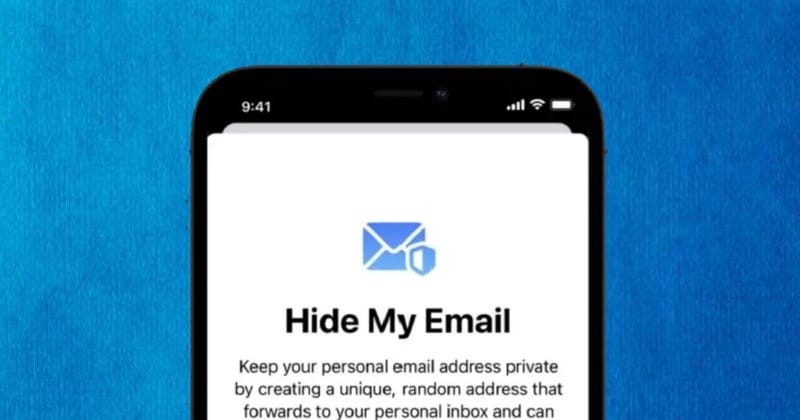
A few days ago, Apple quietly announced what might have seemed like a minor change to one of its most popular privacy features - and has left some users feeling that the company is pulling the rug from underneath them.
Hide My Email is a privacy feature that lets users create unique, random email addresses that forward messages to your real inbox. That means you can sign-up for websites, newsletters, and apps without exposing your personal email address.
The benefit? Well, you can simply delete the alias if a company starts sending you unwanted email - helping to reduce your exposure to spam, marketing lists, and data brokers as well as protecting your privacy.
But now Apple has announced that it plans to move all newly-generated Hide My Email aliases from the familiar "@icloud.com" domain to "@private.icloud.com" instead.
At first sight that may seem fine. The problem is, however, that one of the reasons that Hide My Email worked so well was because its aliases were indistinguishable from regular iCloud email addresses.
When a website or app received a sign-up from an "icloud.com" address it had no way to tell if it was a genuine Apple user or someone using the privacy feature to protect themselves.
However, when Apple makes you use a "@private.icloud.com" address, the ambiguity disappears. All any website or app that wants to block anonymous sign-ups now has to do is to reject any email address ending in "@private.icloud.com".
Existing addresses on the old domains will continue to work and forward mail as before, according to Apple, but all newly-generated aliases will be issued on the new domain from later this summer.
The reaction on Reddit was predictably swift, and unsurprisingly unimpressed. Many Apple users criticised the decision, saying it would make the Hide My Email feature significantly less useful for anyone trying to sign-up anonymously for services that don't want them to.
In what was perhaps a reminder to users that Hide My Email does not guarantee anonymity, it was reported earlier this year that Apple had handed over to US law enforcement the real account details of a Hide My Email user after the account allegedly sent threatening messages to the girlfriend of FBI director Kash Patel.
For now, if you already have existing Hide My Email addresses in use, they should continue to work without any changes on your part. But if you were planning to create new aliases in the future and use them as genuinely anonymous sign-up addresses, things may be about to get more complicated.
tags
Graham Cluley is an award-winning security blogger, researcher and public speaker. He has been working in the computer security industry since the early 1990s.
View all posts
Facts Only
Apple announced a change to its Hide My Email feature, shifting new aliases from "@icloud.com" to "@private.icloud.com."
Hide My Email generates random email addresses that forward messages to a user's real inbox, protecting personal email exposure.
The feature allows users to delete aliases if they receive unwanted emails, reducing spam and data broker exposure.
The new domain makes aliases distinguishable from regular iCloud addresses, potentially enabling websites to block them.
Existing "@icloud.com" aliases will continue to function, but new ones will use the updated domain starting later this summer.
Users on Reddit criticized the change, arguing it reduces the feature's effectiveness for anonymous sign-ups.
Apple previously provided user details to law enforcement for a Hide My Email account involved in alleged threatening messages.
The change does not affect current aliases but may complicate future anonymous sign-ups.
Executive Summary
Apple has announced a change to its Hide My Email privacy feature, which allows users to generate unique, random email aliases to protect their personal inbox from spam and unwanted exposure. Starting later this summer, all newly created aliases will use the domain "@private.icloud.com" instead of the current "@icloud.com." This shift removes the ambiguity that previously made these aliases indistinguishable from regular iCloud email addresses, potentially allowing websites and apps to identify and block users employing the privacy feature. Existing aliases will continue to function as before, but the change has drawn criticism from users who rely on the feature for anonymous sign-ups. The reaction highlights concerns about the effectiveness of privacy tools when their mechanisms become easily detectable. Additionally, a prior incident where Apple provided user details to law enforcement underscores that Hide My Email does not guarantee full anonymity.
The change reflects a tension between privacy protections and the evolving tactics of platforms seeking to limit anonymous or pseudonymous interactions. While Apple frames this as a minor technical adjustment, users perceive it as a reduction in the feature's utility, particularly for those who depend on it to bypass restrictions on anonymous sign-ups. The debate also touches on broader questions about how tech companies balance user privacy with compliance demands and the operational needs of third-party services.
Full Take
The strongest version of this narrative is that Apple's change to Hide My Email reflects a technical adjustment with unintended consequences for user privacy. The feature was designed to blend seamlessly with regular iCloud addresses, offering plausible deniability for those seeking anonymity. By introducing a distinct domain, Apple inadvertently signals which users are employing privacy tools, making it easier for platforms to discriminate against them. This undermines the feature's core value proposition—indistinguishability—and raises questions about whether Apple fully considered the second-order effects on user behavior and platform responses.
Pattern scan: The shift from "@icloud.com" to "@private.icloud.com" creates a clear marker for platforms to identify and potentially block users relying on privacy tools. This could be framed as a form of **ARC-0024 Ambiguity**—where the original design leveraged ambiguity to protect users, and the removal of that ambiguity weakens the tool's effectiveness. Additionally, the user backlash highlights a **ARC-0043 Motte-and-Bailey** dynamic: Apple presents the change as a minor technical update (the motte) while users experience it as a significant erosion of privacy utility (the bailey).
Root cause: The paradigm here is the tension between privacy-by-design and the operational realities of digital platforms. Apple's decision may stem from internal technical or policy considerations, but it reveals an assumption that privacy features should not interfere with platform enforcement mechanisms. This echoes historical patterns where privacy tools are gradually neutralized as they become too effective at circumventing tracking or identification.
Implications: For users, this change reduces agency in managing their digital identity. Platforms that oppose anonymous sign-ups now have a straightforward way to filter out Hide My Email users, potentially limiting access to services or content. The broader implication is that privacy tools are only as strong as their ability to mimic "normal" behavior—once they become detectable, their utility diminishes. This also raises questions about Apple's commitment to privacy when faced with trade-offs between user protection and platform compatibility.
Bridge questions: How might Apple mitigate the loss of ambiguity in Hide My Email while still achieving its technical goals? What alternative designs could preserve the feature's privacy benefits without making aliases easily identifiable? If platforms begin systematically blocking "@private.icloud.com" addresses, how will users adapt—and what does that say about the arms race between privacy tools and identification systems?
Counterstrike scan: If this were part of a coordinated influence campaign, the playbook might involve framing the change as a necessary technical update while downplaying its privacy implications, then leveraging user backlash to paint Apple as hypocritical on privacy. However, the content does not align with this pattern. The criticism appears organic, and Apple's rationale—while potentially shortsighted—does not suggest deliberate deception. The narrative remains within the bounds of legitimate user concern and corporate trade-offs.
Patterns detected: ARC-0024 Ambiguity, ARC-0043 Motte-and-Bailey
Sentinel — Human
This analysis is highly likely human-written journalistic reporting, characterized by synthesized context and an interpretive tone regarding user impact.