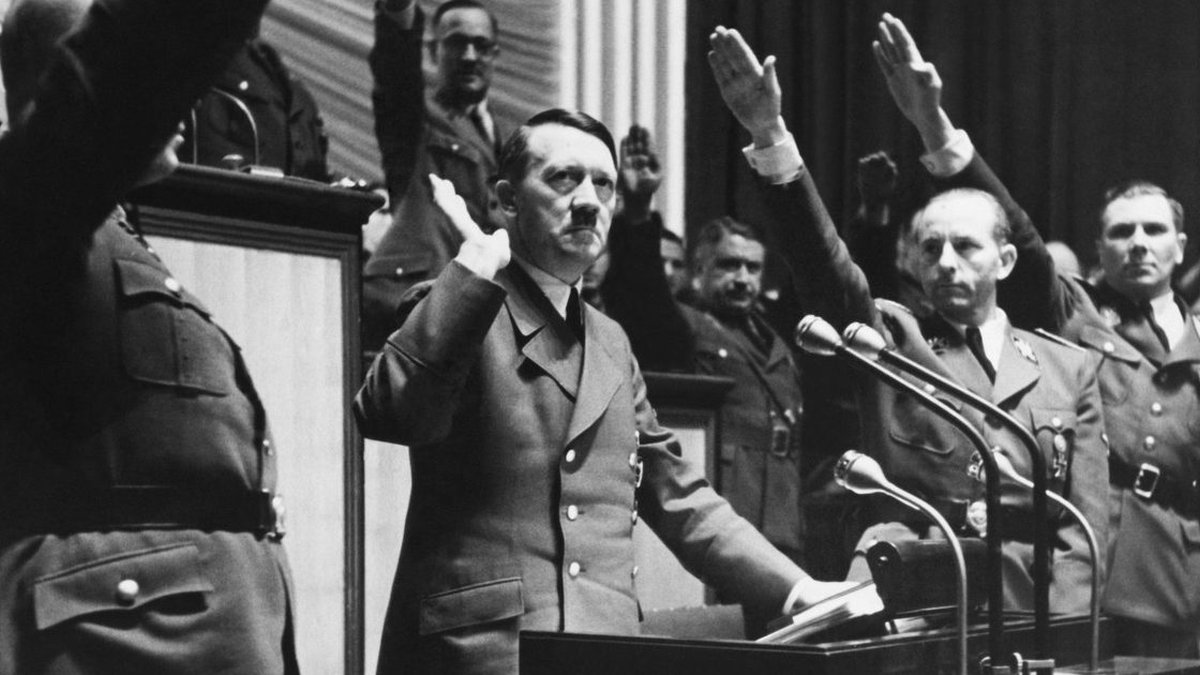
Britain once learned too late that treating Eastern European sovereignty as negotiable can embolden aggressors. As Putin continues to test the West’s resolve over Ukraine, the story of Poland in 1939 shows how wavering commitments can carry catastrophic consequences
On 3 September 1939, Britain declared war on Nazi Germany after having received no reply to an ultimatum that demanded Germany withdraw its troops from Poland. It’s a well-known story.
Britain’s involvement in the Second World War is part of the national psyche, and the beginning of the war is often taken for granted as a precursor to the nation’s heroics in defending Europe against the Nazis, the Blitz spirit, and the liberation of the western continent.
But Britain’s red line on Poland was a curious one.
The British government joined the war in defence of Poland – a nation with which it had limited ties and that was even further away than Czechoslovakia, that “far away country [of] people of whom we know nothing”, as Neville Chamberlain had put it, so unsympathetically, in 1938.
Poland had neither been a historically significant nation to Britain, nor a vital diplomatic partner. It had only become an independent nation in 1918, to the chagrin of numerous British commentators, including the British-American writer TS Eliot. Eliot, and others, did not believe that the newly independent states of Eastern Europe could survive very long at all.
So why did Britain support Poland? And what does this tell us about western support for Eastern Europe – especially Ukraine – today?
How did the First World War leave Eastern Europe exposed?
Britain’s decision to support Poland can be traced to changes in the aftermath of the First World War, during which Poland, along with Czechoslovakia, became a new nation-state as a part of idealistic post-war aims to create a new and peaceful continent. This was not to be.
The new map of Eastern Europe created opportunities for self-determination, but it also created vulnerable states whose security depended on whether the western powers were willing to defend the post-war settlement.
Poland faced a rocky road to independence, with wars on almost all of its new borders and tensions particularly with Germany, which was laid destitute after the punitive Treaty of Versailles.
Germany was immediately critical of Versailles but, surprisingly, many citizens of the Allied nations felt similar. It wasn’t just Germans who viewed the treaty as extremely vindictive and problematic. Leading figures who felt this way included the influential economist John Maynard Keynes.
Sympathy for German grievances made many in Britain less willing to treat German revisionism as inherently dangerous. This was coupled with western criticism of the independence of nation-states in Eastern Europe.
Nazi Germany | A short course from HistoryExtra Academy
Member exclusive | Everything you need to know about Nazi Germany, guided by historian, author and broadcaster Laurence Rees. Explore the course nowOngoing conflicts in the east, as well as political difficulties (Poland cycled through over 10 prime ministers between 1918 and 1926, when a coup d’état by Polish statesman Józef Piłsudski overthrew the government), caused western scepticism.
This was also on top of western reluctance – especially British reluctance – to be involved in future European wars, alongside the limitations of international bodies, like the League of Nations, to resolve conflicts, not least due to America’s reluctance to ratify Versailles or join the League of Nations.
Germany was also being reassimilated into Europe, thanks in large part to the Locarno Treaties of 1925, which the German foreign minister Gustav Stresemann had suggested. The treaties ensured Germany’s western borders and pledged peace.
Yet, crucially, it failed to guarantee the eastern borders. In effect, western Europe was stabilised while eastern Europe remained negotiable. Germany was seen by the west as having political and cultural influence over the east.
These factors, alongside destitution in the Great Depression and its impact on national self-preservation, were vital to the rise of Hitler and his revanchist ideology in the east.
Why did appeasement fail?
By the 1930s Germany was becoming rapidly more aggressive and militaristic, including rearming in defiance of Versailles and promoting the reacquisition of lands lost in the east. Confronted with this, Britain adopted a policy of appeasement – preferring efforts to ensure peace and avoid war, as well as maintain focus on its waning Empire.
In March 1938 Germany annexed Austria in the Anschluss, with the reunification of the countries having been a central tenet of Nazi politics since Hitler achieved power in 1933.
- Read more | Did appeasement cause the Second World War?
Chamberlain was ambivalent about resistance. The established British view was that the Anschluss was simply the unification of two German-speaking nations.
Germany then turned to Czechoslovakia – another target of revanchism. The German aim to govern the Sudetenland on the German border nearly prompted a European crisis, with Czechoslovakia defending its control of the area, and having friendly relations with Britain and France.
Yet despite French commitments to protect the nation and to establish strong stability for the region, both France and Britain ultimately decided they were unable to fight against Germany.
They pursued a diplomatic resolution, with Chamberlain, the French Prime Minister Daladier, Hitler, and the Italian dictator Mussolini holding talks in Munich. The result was the Munich Agreement of September 1938.
This allowed Germany to take control of the Sudetenland, in return for a pledge from Hitler that it would be his last territorial expansion. Munich was a test of whether Hitler would accept a negotiated settlement. His actions the following year provided the answer.
- Read more | When and why did the US get involved in WW2?
In March 1939 Hitler occupied the rest of Czechoslovakia. This was the turning point in British relations to eastern Europe – especially relating to Poland. The country had come under threat from German aims to conquer Danzig (Gdańsk) in the north, which had been made a free city in the Treaty of Versailles, and reunite Germany with East Prussia, which was separated by the Polish Corridor.
As Britons condemned the Nazi occupation of Czechoslovakia there were fears Germany would attempt to move into Romania, which bordered Poland, for its oil resources.
As well as recognition of Polish military strength, a new alliance with Poland seemed like the obvious step.
It still came as a surprise to many in Britain – not least Winston Churchill, who had opposed appeasement and promoted the British defence of Poland, but had not felt a promise would be made.
Still, the decision only promoted the independence, rather than integrity, of Poland, and only if Poland also fought with its national forces. It also made very few other promises, and did not immediately give Poland a loan for military aid.
Lessons on Ukraine
The story of Britain’s support for Poland has parallels today. In the case of Russia’s full-scale invasion of Ukraine in 2022, western support has enabled Ukrainian defence – showing how financial and military aid has a real impact on the battlefield in preventing occupation.
But dwindling western support in recent years, especially from America, mirrors the acquiescence to attacks on eastern Europe in the 1930s, which led to global war.
Poland’s own waning support for Ukraine, as a result of historical tensions, and a new right-wing president also have similarities with the interwar period, when tensions between Eastern European nations allowed larger and militaristic powers to take control. The lessons of the 1930s show that commitments to Eastern Europe need to be quick and sustained to ensure that global escalations in war can be avoided.
Sentinel — Human
This analysis draws a clear line between historical diplomatic failures and current geopolitical dynamics, exhibiting the structure and depth of human-authored political commentary.