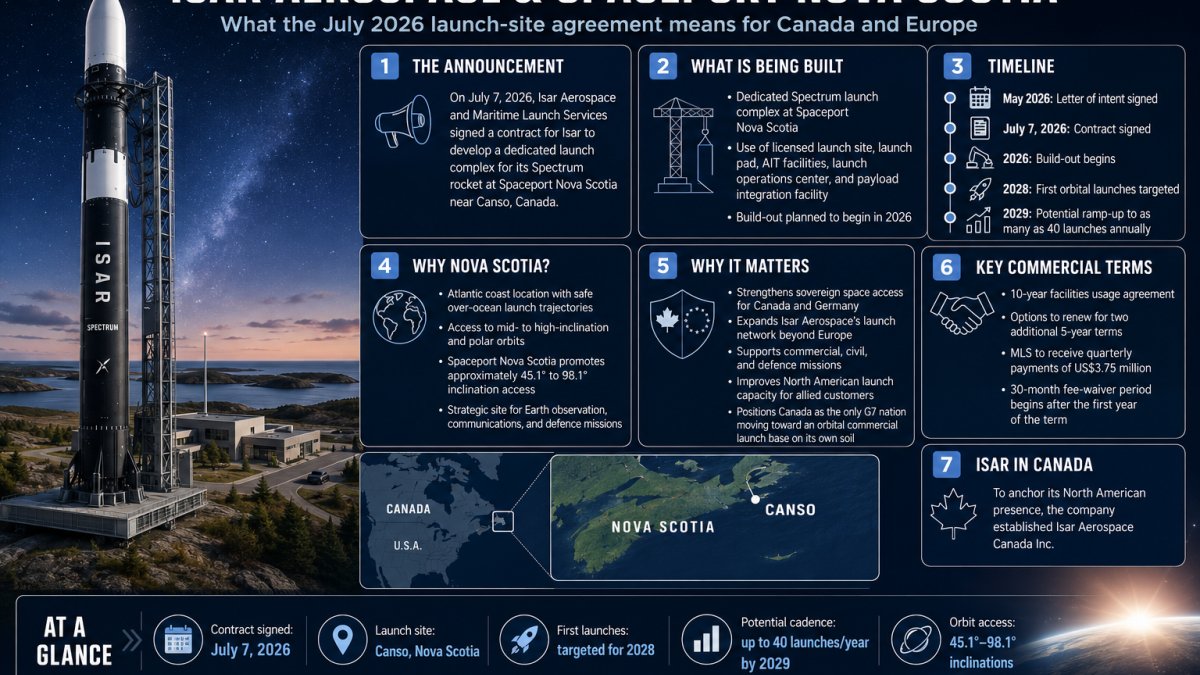
- Key Takeaways
- Isar Nova Scotia Spaceport Deal Turns Intent Into Infrastructure
- What Isar Brings to Nova Scotia
- Why Canso Matters for Orbit Access
- How the Commercial Terms Change the Spaceport Model
- Canada’s Sovereign Launch Push Meets Allied Demand
- What Has to Happen Before Spectrum Flies From Canada
- What the Deal Means for Nova Scotia and Canada’s Space Economy
- Risks That Could Decide the Deal’s Value
- Why the Deal Could Reshape Canada’s Launch Position
- Summary
- Appendix: Useful Books Available on Amazon
- Appendix: Top Questions Answered in This Article
- Appendix: Glossary of Key Terms
Key Takeaways
- Isar will build a dedicated Spectrum launch complex at Spaceport Nova Scotia.
- Initial orbital launches are targeted for 2028, subject to contract milestones.
- Canada gains a stronger launch option, but infrastructure and regulation still carry risk.
Isar Nova Scotia Spaceport Deal Turns Intent Into Infrastructure
On July 7, 2026, Isar Aerospace and Maritime Launch Services signed a contract for a dedicated Spectrum launch complex at Spaceport Nova Scotia near Canso, Canada. The Isar Nova Scotia spaceport deal moved the relationship beyond the letter of intent announced in May 2026 and into a conditional facilities usage agreement tied to specific infrastructure, milestones, and payments.
The agreement gives the German launch company a North American base for its Spectrum rocket, a two-stage vehicle designed for small and medium satellites. Maritime Launch Services, the Canadian spaceport operator, provides the licensed site, a launch pad, assembly, integration and testing facilities, a launch operations center, and a payload integration facility. Isar will develop a dedicated launch complex for Spectrum, giving the company more control over launch operations than a simple customer booking would provide.
The announcement matters because it connects several separate Canadian space policy moves into one commercial event. Canada has been trying to build domestic launch capacity through Spaceport Nova Scotia, the proposed Canadian Space Launch Act, federal defense investment, and regulatory work led by Transport Canada. The Isar agreement adds an international launch provider with its own vehicle, capital base, and European industrial strategy.
For Maritime Launch, the deal supports the multi-user spaceport model. Rather than building a launch site for one rocket, Spaceport Nova Scotia seeks to host several launch providers that share ground infrastructure and specialized services. New Space Economy’s earlier coverage of domestic launch in Canada framed this model as part of a wider Canadian effort to move from satellite manufacturing and operations toward a fuller space industrial base.
The most useful way to read the announcement is neither as a completed launch capability nor as a symbolic press release. It is a conditional infrastructure contract. It creates a pathway to Canadian orbital launch by a foreign-built rocket, but the pathway still depends on engineering completion, regulatory approvals, launch licensing, site readiness, financing, and Isar’s own flight-test progress.
The central terms announced by the companies are compact enough to compare directly.
| Item | Announced Detail | Why It Matters |
|---|---|---|
| Agreement Type | Facilities usage agreement | Turns the May 2026 letter of intent into a conditional contract |
| Term | 10 years, plus two five-year renewal rights | Creates a possible 20-year operating relationship |
| Payments | US$3.75 million quarterly, with a 30-month waiver period | Links revenue timing to the operational phase |
| Launch Timing | Initial orbital launches targeted for 2028 | Sets the earliest commercial operating window |
| Milestones | Program terms, pad handover, and infrastructure completion dates | Keeps the agreement conditional through late 2027 |
| Annual Capacity | Potential support for up to 40 launches by 2029 | Frames the site as a high-cadence launch asset |
What Isar Brings to Nova Scotia
Isar Aerospace gives Spaceport Nova Scotia something more valuable than a general expression of customer interest. It brings a named orbital vehicle, an in-house manufacturing model, a European customer base, and an operating strategy shaped by the search for sovereign access to space. The company was founded in 2018 near Munich and had grown to more than 400 employees across five international locations by the time of the July 2026 announcement.
Spectrum is designed to carry up to 1,000 kilograms to low Earth orbit, meaning an orbit close enough to Earth for many communications, Earth observation, science, and defense payloads. The vehicle is also designed to carry up to 700 kilograms to sun-synchronous orbit, a type of polar orbit that lets satellites pass over locations at roughly consistent local solar times. That orbit is valuable for imaging, climate monitoring, security, mapping, and agricultural applications. Isar’s official Spectrum vehicle page describes the rocket as using nine engines on its lower stage, one engine on its upper stage, and liquid oxygen with propane as propellants.
New Space Economy’s profile of Isar Aerospace placed the company among the best-known European commercial launch challengers. Spectrum’s appeal comes from its middle position in the launch market. It is larger than many micro-launch vehicles but still focused on dedicated missions for payloads too small to need a heavy rocket. That makes it relevant for governments and commercial customers that need mission control, schedule certainty, or orbital placement that rideshare missions may not offer.
The company also brings operational experience from Andøya, Norway. Spectrum’s March 2025 test flight did not reach orbit, but the test helped Isar gather flight data. By September 2025, Isar said it had completed its investigation and identified a vent valve issue that led to loss of vehicle control. For a launch company, that history cuts both ways. It confirms that Spectrum is a real flight vehicle, not a paper rocket. It also shows that Canada is not receiving a mature vehicle with an orbital track record. The Nova Scotia plan depends on further flight progress before Canadian launches can become more than a schedule target.
Several technical and site factors make the pairing understandable.
| Element | Capability | Site Relevance |
|---|---|---|
| Spectrum Payload | Up to 1,000 kg to LEO | Fits small and medium satellite demand |
| SSO Payload | Up to 700 kg to SSO | Supports Earth observation missions |
| Propulsion | Liquid oxygen and propane | Requires specialized ground systems |
| Engine Layout | Nine lower-stage engines, one upper-stage engine | Needs vehicle-specific launch infrastructure |
| Canso Inclinations | About 45.1° to 98.1° | Serves LEO, polar, and SSO missions |
| Launch Corridor | East and south over ocean | Reduces overflight concerns for many missions |
Isar’s presence in Nova Scotia also has a market-signaling function. A spaceport gains credibility when a rocket operator commits to site-specific infrastructure. Customers may still wait for proof of launch performance, but the contract gives Spaceport Nova Scotia a more concrete story for insurers, suppliers, regulators, and potential tenants.
Why Canso Matters for Orbit Access
Canso is not an accidental location. Spaceport Nova Scotia sits on Nova Scotia’s Atlantic coast, where orbital flight paths can head over open ocean rather than densely populated land. Maritime Launch’s site information identifies access to inclinations from roughly 45.1 degrees to 98.1 degrees, covering low Earth orbit, polar orbit, and sun-synchronous orbit profiles. Those orbit families match many of the satellites that now drive demand for dedicated launches.
A low Earth orbit mission may support communications, science, technology demonstration, or commercial data services. A polar or sun-synchronous mission may support imaging, weather data, maritime surveillance, ice monitoring, and national security applications. Canada has particular interest in polar and high-inclination orbits because of Arctic geography, long coastlines, resource monitoring, and northern communications needs. New Space Economy’s coverage of sovereign defense capability argued that launch access becomes more relevant when paired with satellites, ground control, data custody, terminals, and secure operations.
The site also has regulatory history. Nova Scotia’s environmental assessment page for the Canso Spaceport Facility Project shows the project was approved with conditions in June 2019 after the provincial review process. Some details in that older assessment reflected an earlier Ukrainian-vehicle plan, so current readers should not treat the 2019 mission description as a full description of the 2026 Isar arrangement. It remains relevant because it shows that the project has been through a provincial environmental process and carries conditions that shape site development.
Construction remains an important test. Maritime Launch said on July 2, 2026 that civil works had resumed in March and that the initial phase was nearing completion. The same update said the utility hub procurement package was out for tender, with design and planning moving ahead for the launch vehicle integration facility and road extensions to future launch pads. New Space Economy’s article on Nova Scotia’s proposed spaceport had earlier described public concerns about the gap between national ambition and visible site infrastructure. The July construction update reduces, but does not eliminate, that concern.
Canso’s value depends on turning geographic advantage into operational reliability. Good flight paths do not produce launch cadence by themselves. The site needs power, communications, range systems, access control, propellant handling, emergency planning, weather decision processes, payload processing, security, road access, workforce training, and coordination with aviation and marine users. For a small satellite customer, the relevant question is not just whether Canso is a good place on the map. It is whether Spaceport Nova Scotia can offer dependable processing, licensing, scheduling, and mission assurance.
How the Commercial Terms Change the Spaceport Model
The Isar agreement strengthens the landlord-operator model Maritime Launch has been moving toward. In this model, the spaceport provides licensed ground infrastructure, site access, integration support, range coordination, and mission services. Launch companies bring vehicles, customers, engineering teams, and mission-specific hardware. The model resembles an airport more than a vertically integrated rocket company.
The financial terms help explain why the deal drew attention. The facilities usage agreement has a 10-year term and gives Isar the right to renew for two additional five-year periods. Maritime Launch said it will receive quarterly payments of US$3.75 million, except for a 30-month fee waiver period beginning at the end of year one. The agreement also provides for additional cost-plus fees per launch for specified services. SpaceQ described the arrangement as a US$112.5 million deal, based on the announced payment structure.
The fee waiver matters because it shows that both parties expect a build-out period before the dedicated complex reaches its revenue-producing operating phase. For Maritime Launch, the delayed payments reduce near-term cash benefits. For Isar, the waiver gives time for infrastructure readiness, program milestones, and vehicle progress before the full facilities payment obligation matures. That makes the agreement more realistic than a headline-only rent figure, but it also points to execution risk.
New Space Economy’s analysis of commercial spaceport models argued that the economics of launch sites depend on tenant diversity, utilization, and services beyond the pad. That is the frame in which the Isar agreement should be judged. A single anchor customer can validate a site, but it does not solve the whole business model. Spaceport Nova Scotia still needs a mix of government, commercial, and possibly research customers to keep fixed infrastructure productive between launch campaigns.
Maritime Launch’s broader customer picture already includes several named relationships. Reaction Dynamics has been associated with a pathfinder launch plan from Nova Scotia. MDA Space has appeared as a strategic partner and investor. The Government of Canada announced a 10-year, $200 million agreement tied to a dedicated launch pad and national defense needs. Isar now adds a European launch operator with its own dedicated complex. Together, those pieces make the spaceport less dependent on a single vehicle program than it appeared during earlier phases.
The deal also changes the narrative for investors. Maritime Launch trades publicly, so the payment structure, milestone conditions, fee waiver, and launch timing all matter to market expectations. The agreement creates possible future revenue, not guaranteed immediate cash flow. For a project that still needs construction completion and regulatory execution, that distinction is important.
Canada’s Sovereign Launch Push Meets Allied Demand
Canada’s launch ambitions have gained force because space access now sits inside national security, industrial policy, and allied resilience. The federal government’s March 2026 spaceport investment placed Spaceport Nova Scotia inside defense capability planning. That announcement described a 10-year lease agreement requiring a dedicated launch pad and associated services, with initial operational capability by the end of 2026. It also stated that 90% of funds received under the lease must be spent in Canada.
The April 2026 introduction of the Canadian Space Launch Act added a regulatory layer. The bill would amend the Aeronautics Act to create a framework for launches and re-entries from Canadian territory, including site certification, vehicle permits, financial responsibility, liability, indemnification, and emergency authorities. That legislation is central because launch providers and insurers need predictable licensing rules before committing payloads to a Canadian launch campaign.
Isar’s agreement fits the allied-access logic. Germany wants more independent launch capacity for European payloads. Canada wants domestic infrastructure that can support civil, commercial, and defense missions. NATO countries increasingly want launch options that reduce reliance on a small group of foreign launch providers or single spaceports. New Space Economy’s coverage of sovereign launch capability described this trend as a shift from buying launch as a commodity to treating launch access as strategic infrastructure.
Canada’s position is unusual. It has a long record in robotics, satellite communications, Earth observation, science missions, and space operations, yet it has lacked an orbital launch site on Canadian soil. The result has been dependence on foreign launch locations for Canadian payloads. In normal commercial conditions, that may be acceptable. In a period of supply constraints, sanctions, export-control limits, war risk, or national security urgency, dependence can become a vulnerability.
The Isar Nova Scotia spaceport deal does not make Canada fully launch independent. Spectrum is a German vehicle, and commercial launch operations will still depend on international supply chains, insurance markets, payload customers, and regulatory approvals. The deal does expand the set of launch options available from Canadian territory. That alone changes Canada’s position. A domestic site hosting allied vehicles is not the same as an entirely Canadian rocket program, but it can still support Canadian control over timing, site access, infrastructure, and mission coordination.
New Space Economy’s article on space industrial base policy placed Canada’s launch push beside similar industrial-base policies in allied countries. That comparison matters because governments increasingly judge space capability by resilience, procurement speed, supply control, and defense relevance rather than prestige alone.
What Has to Happen Before Spectrum Flies From Canada
The July 2026 announcement contains several dates that should be treated as milestones, not completed facts. The parties must reach agreement by September 1, 2026 on a statement of work and programmatic milestones. The designated launch pad must be handed over to Isar by November 1, 2026. Additional infrastructure must be completed by December 31, 2027. Initial orbital launches are targeted for 2028, with launch operations expected to ramp from there.
Each milestone contains practical work. The statement of work must likely define responsibilities for pad modifications, interfaces, safety systems, integration flow, mission operations, propellant handling, access control, security, environmental controls, communications, and customer services. Pad handover requires a site that Isar can begin adapting to Spectrum rather than a general-purpose civil-works area. Infrastructure completion requires permanent facilities, utilities, internal transportation links, and operational systems.
Regulatory readiness is another path. Canada’s proposed launch law must translate into usable rules for launch permits, certified sites, safety reviews, liability, insurance, and ministerial approvals. Transport Canada and other federal bodies will have to coordinate with aviation, marine, environmental, security, export-control, and emergency-management authorities. Canada’s space launch regime has to be credible enough for international customers and practical enough for launch providers that operate on commercial timelines.
Isar’s vehicle progress is equally important. Spectrum has flown, but it had not established routine orbital success as of July 2026. The company’s continued testing from Andøya, customer agreements, manufacturing scale-up, and failure-correction process will directly influence the credibility of a 2028 Canadian launch target. New Space Economy’s article on European orbital launchers described Spectrum as one of several European vehicles competing to prove a commercial launch model during the same period.
A further requirement sits on the customer side. Launch cadence depends on payload demand. Earth observation companies, government agencies, defense users, technology demonstrators, and constellation operators must see enough advantage in a Nova Scotia launch to book missions. That advantage could include orbit access, schedule control, allied security, proximity to North American customers, or the ability to avoid congested launch locations. It will still have to compete with established providers, rideshare opportunities, and other emerging spaceports.
Weather and range operations will matter. Atlantic coastal locations offer ocean access but also face fog, winds, storms, icing conditions, and seasonal constraints. Those are manageable issues for a properly designed range, but they affect launch availability and customer confidence. High-cadence claims require more than pad availability. They require reliable launch windows, strong ground support, efficient payload flow, and a safety regime that can process repeat missions without excessive delay.
What the Deal Means for Nova Scotia and Canada’s Space Economy
For Nova Scotia, the deal extends the spaceport story from construction and policy into industrial development. The province could gain aerospace jobs, supplier contracts, site-services work, engineering activity, logistics demand, security work, and training needs. The near-term gains will likely sit in construction, utilities, design, access control, and professional services. The larger payoff would come only if launch operations become recurring.
The federal government’s March 2026 announcement emphasized domestic spending requirements under the defense lease. If the Isar complex uses Canadian contractors for civil works, utilities, security, integration support, and site operations, it could reinforce that domestic spending effect. Atlantic Canada already has defense and aerospace activity in shipbuilding, maintenance, training, sonar, cyber, and aircraft services. Spaceport Nova Scotia could add launch infrastructure to that regional base.
For Canada’s national space sector, the deal helps fill a gap between satellite demand and launch access. Canadian companies build satellite components, payloads, robotics, communications systems, Earth observation services, and mission software. A domestic launch site could give those firms a more complete national value chain. It could also help universities and small companies plan missions with more control over timing and location.
New Space Economy’s guide to Canadian space companies described a sector with activity in satellites, robotics, data, communications, lunar systems, and launch-related ventures. The Isar deal does not replace Canadian launch vehicle programs such as Reaction Dynamics or NordSpace. It may help them by strengthening the shared spaceport infrastructure and demonstrating that customers can treat Canadian launch sites as practical venues.
That point should not be overstated. A foreign launch operator with a dedicated complex could crowd attention away from domestic rockets if policymakers treat launch capability as solved. The stronger interpretation is that Canada may need both approaches. A German-built Spectrum flying from Nova Scotia can provide allied launch capacity from Canadian soil. Canadian-built rockets can pursue deeper national control over technology, manufacturing, and supply chains. Those goals overlap, but they are not identical.
The deal also links to data markets. Satellites launched to low Earth orbit or sun-synchronous orbit often support Earth observation, maritime monitoring, agriculture, disaster response, Arctic coverage, communications, and defense missions. The value in those markets does not end at launch. It runs through ground stations, analytics, customer platforms, cloud infrastructure, insurance, cybersecurity, and government procurement. Canada’s gains will be larger if launch activity connects to those downstream markets rather than remaining a narrow transportation service.
Risks That Could Decide the Deal’s Value
The Isar Nova Scotia spaceport deal has several clear risks. The most visible is schedule risk. The contract targets 2028 for initial orbital launches from Spaceport Nova Scotia, but site infrastructure, regulatory approval, pad adaptation, vehicle testing, and customer readiness all have to align. Any one of those elements can slip without implying failure. The issue is whether delays remain manageable or compound into financing and credibility problems.
Vehicle risk sits with Spectrum. Isar’s March 2025 test flight produced data, but the rocket still has to prove orbital performance. Customers buying launch services usually care less about national ambition than about mission assurance, insurance pricing, schedule confidence, and payload safety. If Spectrum reaches orbit reliably before Canadian operations begin, the Nova Scotia plan gains credibility. If flight testing remains troubled, the Canadian site could be ready before the vehicle is.
Infrastructure risk sits with Maritime Launch. The site has made progress, but building an operational orbital spaceport is difficult. Civil works, utilities, propellant systems, environmental compliance, safety systems, security, integration buildings, roads, range equipment, and operations centers must meet launch-provider needs. New Space Economy’s earlier article on Canadian spaceport economics stressed that launch sites carry high fixed costs and need steady utilization to support long-term economics.
Regulatory risk is less visible but just as important. Canada’s new commercial launch rules are still moving through legislative and implementation processes. Launch regulation must protect public safety without creating uncertain approval timelines. The system also has to handle defense-related missions, foreign vehicles, export controls, insurance, liability, environmental duties, and emergency powers. If the rules are clear and workable, they can support investment. If the rules remain uncertain, customers may book elsewhere.
Community and environmental risk also remain. Canso and Guysborough County may gain jobs and investment, but residents and local organizations will continue to watch noise, access, safety, environmental effects, traffic, emergency readiness, and land-use decisions. The spaceport’s long-term license to operate depends on public trust as much as permits. Commercial launch sites can lose momentum when local concerns turn into political or legal friction.
Market risk may be the largest. Small and medium launch has many providers chasing customers who can also use rideshare missions on larger rockets. Dedicated launch offers control, but it usually costs more per kilogram. Spectrum and Spaceport Nova Scotia will have to win customers that value schedule, orbit choice, security, and geographic access enough to pay for dedicated service. The business case improves if governments anchor demand through defense and civil missions, but it weakens if commercial customers delay or consolidate.
Why the Deal Could Reshape Canada’s Launch Position
The Isar agreement gives Canada a chance to move from launch aspiration to launch operations without waiting for every domestic rocket program to mature. That does not make the arrangement a substitute for Canadian vehicle development. It makes Spaceport Nova Scotia a venue where allied launch providers can contribute to Canadian capability as domestic firms continue their own engineering paths.
The most immediate change is reputational. A named European launch company committing to a dedicated Spectrum complex tells customers that Spaceport Nova Scotia is moving toward tenant-specific infrastructure rather than general site promotion. That matters for payload owners, insurers, and public agencies. Spaceports need credible launch providers, and launch providers need credible infrastructure. The July 2026 agreement gives both parties a stronger market story.
The second change is strategic. Canada’s lack of domestic launch access has long been an odd gap in an otherwise capable space sector. The country has deep experience in robotics, science payloads, satellite communications, Earth observation, and mission operations. Launch has remained outside that national capability mix. A working Spaceport Nova Scotia would let Canada host launches for its own payloads, allied payloads, and commercial customers from Canadian territory.
The third change is industrial. Spaceport Nova Scotia could become a concentration point for suppliers, range services, payload processing, data companies, regulatory specialists, security providers, and training organizations. The strongest local benefit would come if launch operations draw firms to Nova Scotia rather than sending one-time construction contracts through the region. That will depend on launch frequency, tenant diversity, and government procurement choices.
New Space Economy’s article Why Every Nation Suddenly Wants Its Own Rocket framed the launch race as a response to disrupted supply chains, security tensions, and the need for independent access to space data. The Canadian case adds a twist. Canada may not need to build every element alone to gain more control. It can combine domestic infrastructure, allied vehicles, Canadian regulation, and targeted defense demand.
The best measure of success will be operational evidence. By late 2027, the most important signs will include completed infrastructure, clear regulatory processes, Spectrum flight progress, customer bookings, community confidence, and credible range operations. By 2028, the focus will narrow to launches. A successful Spectrum flight from Nova Scotia would place Canada in a different category. It would make Canadian soil part of the allied launch network and give Spaceport Nova Scotia a proof point that policy announcements alone cannot provide.
Summary
The Isar Nova Scotia spaceport deal is best understood as a conditional infrastructure agreement with strategic value. It does not mean Canada already has routine orbital launch capability, and it does not mean Spectrum has cleared all vehicle-development risk. It does mean a serious European launch provider has committed to a dedicated Canadian launch complex under commercial terms that define payments, milestones, renewal rights, and operating expectations.
For Isar Aerospace, Nova Scotia adds a North American launch option tied to allied demand, high-inclination orbits, and a spaceport model that can support mission-specific infrastructure. For Maritime Launch Services, Isar adds an anchor tenant that strengthens the multi-user model and supports the argument that Spaceport Nova Scotia can serve more than one customer class. For Canada, the agreement connects launch infrastructure, defense policy, regulatory modernization, and industrial development.
The project’s value will be determined by execution. The site must be built out. Spectrum must prove its launch performance. Canada must put workable launch rules into practice. Customers must decide that Nova Scotia offers enough value to justify dedicated missions. If those pieces align, the July 2026 deal could mark the point at which Canada’s launch ambitions began turning into operational capacity.
Appendix: Useful Books Available on Amazon
Appendix: Top Questions Answered in This Article
What Was Announced in the Isar Nova Scotia Spaceport Deal?
Isar Aerospace and Maritime Launch Services announced a facilities usage agreement on July 7, 2026. Isar will develop a dedicated Spectrum launch complex at Spaceport Nova Scotia near Canso. Maritime Launch provides the licensed site, launch pad, integration facilities, operations center, and payload integration support.
When Could Isar Launch Spectrum From Nova Scotia?
Initial orbital launches from Spaceport Nova Scotia are targeted for 2028. The agreement also states that operations could ramp from there, with potential support for up to 40 launches annually by 2029. Those dates depend on infrastructure completion, regulatory approvals, Spectrum readiness, and customer demand.
Is the Agreement Fully Unconditional?
No. The facilities usage agreement remains tied to several milestones. The parties must agree on a statement of work and programmatic milestones by September 1, 2026. The designated launch pad must be handed over by November 1, 2026, and additional infrastructure must be completed by December 31, 2027.
What Rocket Would Launch From Spaceport Nova Scotia?
The planned vehicle is Isar Aerospace’s Spectrum rocket. Spectrum is designed to carry up to 1,000 kilograms to low Earth orbit and up to 700 kilograms to sun-synchronous orbit. It uses liquid oxygen and propane, with nine engines on the lower stage and one engine on the upper stage.
Why Is Canso a Useful Launch Location?
Canso offers Atlantic Ocean flight paths that can support low Earth orbit, polar orbit, and sun-synchronous orbit missions. Those orbit types are useful for Earth observation, communications, climate monitoring, maritime surveillance, and defense missions. The location gives Canada a domestic site suited to several high-demand mission categories.
Does This Give Canada Sovereign Launch Capability?
It gives Canada a stronger path toward launch capability from Canadian soil, but it does not create full independence by itself. Spectrum is a German vehicle, and launch operations will depend on international supply chains and approvals. Canada gains more control over site access, mission coordination, and allied launch options.
How Does the Deal Affect Maritime Launch Services?
The agreement supports Maritime Launch Services’ multi-user spaceport model. It gives the company a named launch provider for a dedicated complex and creates a potential long-term revenue stream. The value depends on milestone completion, launch cadence, additional customers, and site operating reliability.
How Does the Deal Affect Isar Aerospace?
The agreement gives Isar Aerospace a planned North American launch base for Spectrum. It extends the company’s infrastructure strategy beyond Europe and connects it to Canadian and allied demand. The deal also places pressure on Isar to keep improving Spectrum’s flight record before the Canadian launch window opens.
What Are the Main Risks?
The main risks are schedule delay, vehicle readiness, regulatory uncertainty, infrastructure cost, local acceptance, and market demand. Dedicated small and medium launch providers face strong competition from rideshare missions and established launch companies. Spaceport Nova Scotia must prove reliability as well as location value.
Why Does the Deal Matter for the Space Economy?
The deal connects launch infrastructure to downstream markets such as Earth observation, maritime monitoring, communications, defense, analytics, and ground systems. Launch activity can support suppliers, professional services, construction, operations, and data companies. The larger economic impact depends on recurring launches and tenant diversity.
Appendix: Glossary of Key Terms
Isar Aerospace
Isar Aerospace is a German launch company founded in 2018 near Munich. It develops the Spectrum rocket and markets launch services for small and medium satellites. In the Nova Scotia agreement, Isar becomes the launch provider planning to build and use a dedicated Spectrum complex in Canada.
Maritime Launch Services
Maritime Launch Services is the Canadian company developing Spaceport Nova Scotia near Canso. Its model is to operate a multi-user orbital spaceport that can host different launch providers. In the Isar agreement, it provides the licensed site, facilities, and operational support.
Spaceport Nova Scotia
Spaceport Nova Scotia is a commercial orbital launch site under development on Nova Scotia’s Atlantic coast. The site is designed to support launches over the ocean into low Earth orbit, polar orbit, and sun-synchronous orbit. It is central to Canada’s push for launch activity from Canadian territory.
Spectrum
Spectrum is Isar Aerospace’s two-stage orbital launch vehicle for small and medium satellites. It is designed to carry payloads to low Earth orbit and sun-synchronous orbit. The rocket uses liquid oxygen and propane, with a multi-engine lower stage and a single-engine upper stage.
Low Earth Orbit
Low Earth orbit is a region of space relatively close to Earth, often used for communications, Earth observation, technology demonstration, and scientific satellites. Satellites in this orbit move quickly around the planet and can provide frequent revisits over selected areas.
Sun-Synchronous Orbit
Sun-synchronous orbit is a near-polar orbit that lets a satellite pass over the same area at roughly consistent local solar time. This consistency helps imaging and monitoring missions compare data under similar lighting conditions, which is useful for mapping, agriculture, climate, and security applications.
Facilities Usage Agreement
A facilities usage agreement defines how a customer or tenant may use infrastructure at a site. In the Isar and Maritime Launch case, it sets terms for a dedicated launch complex, payments, renewal rights, milestones, and services tied to Spectrum operations at Spaceport Nova Scotia.
Sovereign Launch
Sovereign launch means a country has reliable access to launch capability that it can influence or control for national needs. It can involve domestic vehicles, domestic sites, allied partnerships, or combinations of these elements. Canada’s strategy appears to blend national infrastructure with allied launch providers.
Assembly, Integration, and Testing
Assembly, integration, and testing describes the process of bringing rocket or payload components together, checking interfaces, and confirming readiness before launch. For a spaceport, these facilities are as important as the pad because they shape schedule reliability and mission safety.
Dual-Use Spaceport
A dual-use spaceport supports both civil or commercial missions and defense-related missions. This does not mean every mission is military. It means the same infrastructure can serve government, research, commercial, and security customers when missions meet regulatory and safety requirements.
Facts Only
* Isar Aerospace and Maritime Launch Services signed a contract on July 7, 2026, for a Spectrum launch complex at Spaceport Nova Scotia.
* The agreement involves a facilities usage agreement tied to infrastructure milestones and payments.
* Isar will develop a dedicated launch complex for the Spectrum rocket.
* Initial orbital launches are targeted for 2028, subject to contract milestones.
* The agreement provides access to licensed sites, launch pads, assembly, integration, testing facilities, and a launch operations center from Maritime Launch.
* The agreement includes a 10-year term plus two five-year renewal rights.
* Payments are structured as US$3.75 million quarterly, with a 30-month waiver period.
* Potential annual capacity supports up to 40 launches by 2029.
* The deal connects Canadian space policy moves with an international launch provider.
* Canso access inclinations range from approximately 45.1° to 98.1°.
Executive Summary
A contract was signed on July 7, 2026, between Isar Aerospace and Maritime Launch Services for a dedicated Spectrum launch complex at Spaceport Nova Scotia near Canso. This agreement establishes a conditional facilities usage arrangement tied to specific infrastructure milestones and payments. The deal grants the German launch company access to Canadian infrastructure, including a launch pad and integration facilities, which will be developed by Isar into a dedicated complex for its Spectrum rocket.
The deal connects Canada's domestic space policy efforts—including Spaceport Nova Scotia development, the proposed Canadian Space Launch Act, and federal defense investment—with an international launch provider possessing an existing vehicle and industrial strategy. The agreement formalizes a multi-user spaceport model where the facility provides licensed ground infrastructure shared by multiple providers. Initial orbital launches are targeted for 2028, contingent upon meeting specified milestones regarding infrastructure completion and flight testing progress.
The commercial terms involve a 10-year term with renewal rights, quarterly payments of US$3.75 million (with a 30-month waiver period), and potential cost-plus fees per launch. This structure acknowledges the necessary build-out time for the facility while setting clear operational timelines. The deal supports the idea that spaceport value depends on tenant diversity beyond a single rocket, suggesting future viability requires a mix of government, commercial, and research customers to maintain operational productivity between launch campaigns.
Full Take
The narrative of the Isar deal centers on transforming a site into infrastructure, shifting value from mere location to operational capability. The inherent tension lies between the conditional nature of the agreement—where launch capability remains dependent on external flight test success and regulatory finalization—and the forward-looking promises regarding Canada's orbital access and industrial base. This structure forces an evaluation of risk: the deal creates a pathway for Canadian launches by a foreign vehicle, but it does not guarantee independence or full sovereignty.
The concept of the spaceport model is tested here: anchoring the site to a single anchor customer (Isar) validates the facility's existence but raises questions about its long-term productivity if demand remains sporadic rather than consistent. The dependency on achieving milestones—including vehicle flight data, regulatory clarity under the Canadian Space Launch Act, and sustained payload demand from diverse sectors—suggests that execution risk is paramount.
The broader context of allied demand framing launch access as strategic infrastructure reveals a pattern where geopolitical necessity overlays commercial negotiation. Canada’s position shifts from seeking mere access to negotiating resilient supply chains and shared defense capabilities in the space domain. The deeper implication is that future success depends not just on building physical assets, but on establishing robust, internationally acceptable regulatory frameworks and ensuring the operational capacity supports diverse mission profiles beyond a single vehicle program.
Bridge Questions: If commercial demand falters before 2028, what mechanisms exist to maintain the infrastructure's viability for other potential tenants? How can Canada ensure that domestic launch coordination remains agile despite reliance on international vehicle operations? What independent metrics should be used to assess whether this arrangement genuinely fosters sovereign capability versus managing external dependencies?
Sentinel — Human
The text functions as a high-level analysis that synthesizes contractual details, technical specifications, and geopolitical context regarding a launch infrastructure deal, demonstrating strong human analytical synthesis.