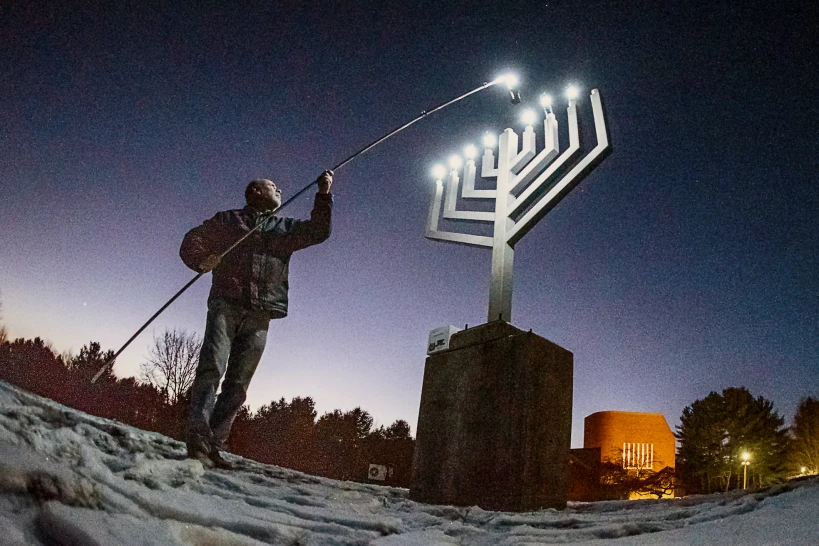
It’s been seven years since Scott Nussinow became the chair of a new safety and security committee at Temple Shalom, a Jewish synagogue in Auburn, and started thinking of ways to make the congregation safer. The committee formally launched after a shooting at a California synagogue on the last day of Passover in 2019, not long after 11 people were killed at the Tree of Life synagogue in Pittsburgh in the deadliest antisemitic attack in American history.
Another such attack occurred last week in Michigan, when a man rammed a car into a synagogue before dying during a gunfire exchange with two security guards inside.
Being Jewish has always come with safety risks, Nussinow said, but he has felt them more intensely since the Israel-Hamas War began in 2023. The new war America and Israel launched with Iran has also increased tensions; shortly after it started, the Jewish Community Alliance of Southern Maine sent a note to its members saying it was strictly enforcing safety protocols “out of an abundance of caution.”
That fear has been accompanied by a push to enhance the security of the group’s building in Portland, a conversation that has occurred at many Jewish organizations across the country in the past decade as antisemitic incidents have been rising. According to the Jewish Federations of North America, the average Jewish organization devotes 14 percent of its budget to security, totaling more than $765 million nationally each year.
The Auburn synagogue is one of dozens of religious organizations in Maine that has received federal funding to improve security measures in recent years, using more than half a million dollars to upgrade its alarm system, surveillance cameras and lighting, as well as install fencing and invest in bullet-resistant glass.
“It forced us into a corner,” Nussinow said. “We had funds that were out for 120 days, 180 days, nobody answering the phones, nobody giving us an update.”
With federal funding in flux, the synagogue has joined forces with other religious organizations across Maine to push for a state-funded alternative to improve safety measures at houses of worship and other nonprofits. In doing so, Maine would join at least 18 other states, including Massachusetts and Connecticut, that have created their own funding streams.
A push for state funding
The bill these groups are pushing for would allocate $1.5 million to establish a state nonprofit security grant program. Rep. Michael Brennan, D-Portland, said he decided to put forward the legislation after hearing from various faith communities that their members have been afraid to attend events out of fear of a terrorist attack or hate crime.
Hate crimes motivated by religious bias have been increasing in recent years, with 42 in Maine over a recent five-year period, according to the FBI.
Jewish people have consistently been victims of more hate crimes than any other religious group nationally, according to the FBI data, with incidents jumping by nearly 60 percent in the year that saw the start of the Israel-Hamas War, from 1,227 in 2022 to more than 2,000 incidents in 2023. Anti-Muslim hate crimes increased by a similar margin that year, from 176 to 283 incidents.
Brennan also cited uncertainty about the future availability of federal funding for security at nonprofit organizations including houses of worship. The Trump administration has cut billions of dollars in grant money for everything from scientific research to education, but the nonprofit security program has not been the target of public disputes.
A pending appropriations bill before Congress would increase available funding for the program to $300 million for the current fiscal year. The total available funding typically fluctuates each year.
Brennan said he anticipates that the Maine House of Representatives will vote on the state measure, which passed out of the Judiciary Committee last month, in the next few weeks.
Zach Schwartz, director of the Jewish Community Relations Council at the Jewish Community Alliance of Southern Maine, has been one of the main voices pushing for the state program, citing death threats that his organization and a Portland synagogue received last summer, along with antisemitic flyers that were hung around Portland and Bethel.
“A lot of Jewish organizations in the state no longer feel comfortable having large gatherings without a security guard present,” Schwartz said. “The choice is, basically, either close our doors and stop gathering, or we’re going to have to find the funds to pay for security guards.”
Making upgrades
The federal Nonprofit Security Grant Program that the proposed state one is modeled after came out of post-9/11 discussions. It was launched in 2004 as a way for nonprofit organizations at “high risk of a terrorist or other extremist” attacks to apply for grants to improve their security. The funding available has fluctuated each year; in 2024, fewer than half of the organizations that applied for funding received grants.
The Maine Emergency Management Agency has received $8.1 million through the program since 2020 and administered funding to more than three dozen organizations, according to a review of grants on USAspending.gov. Most of the state’s recipients have been religious organizations, with synagogues and other Jewish organizations receiving more than a third of the funding.
Since 2020, organizations in Maine have used the federal funding to cover everything from infrastructure improvements to security personnel at events. Temple Shalom, in Auburn, has installed security cameras and concrete bollards, which are meant to deter vehicle attacks such as the one in Michigan last week.
But the federal program places restrictions on hiring public safety personnel, which has prompted Temple Shalom to rely on contracted security instead. Nussinow said that system could be improved, as marked law enforcement vehicles are thought to be a better deterrent. Brennan confirmed that the state program would offer nonprofits the flexibility to hire off-duty police officers.
The Jewish Community Alliance of Southern Maine has also ramped up security at its Portland building in recent years through a mix of both private and federal funding, Schwartz said. Entry into the building requires visitors to go through one set of doors, then ring a doorbell and be let in. The building also has security cameras, fencing and concrete bollards. Staff are trained to use a panic button with a camera that alerts law enforcement of an attack.
While Jewish institutions have received the most funding, other religious organizations have also benefited.
In Bangor, Crosspoint Church and its affiliated organizations have received more than $1 million in federal funding since 2023. Chief Financial Officer Nick Henry said the program has allowed the church to upgrade its exterior doors, install automatic lockdown features, add new security cameras and more.
“It’s so expensive to do,” Henry said. “The funding is allowing us to enhance stuff and/or add stuff that we wouldn’t have been otherwise able to do.”
Muslim institutions in Maine, meanwhile, have received $750,000 in federal funding for security upgrades since 2020.
M. Nasir Shir, a leader in Portland’s Muslim community, said Muslims in Maine have been victims of discrimination and hate crimes, pointing to 9/11 and the war in Iran as events that have heightened religious tension. He said he hopes that state funding could be used to hire full or part-time security for places of worship, similar to school resource officers, which he sees as a more effective deterrent than security cameras.
“No matter what happens — internationally or locally, domestically — the burden comes back on one’s religion, one’s faith or their ethnicity,” Shir said.
The Roman Catholic Diocese of Portland has received more than $500,000 from the federal grant program and testified in support of the state bill. In 2023, St. Thomas Aquinas Catholic Church in Madawaska was vandalized. A spokesperson for the diocese said the vandalism caused up to $300,000 in damage, and the church’s organ has yet to be repaired.
Suzanne Lafreniere, director of public policy for the diocese, described the bill in her legislative testimony as a “prudent, targeted approach” to allow nonprofits to invest in security measures, personnel and training. The diocese could use the funding, if approved, to install secure entry systems at Catholic parishes and schools, improve exterior lighting, install or upgrade camera systems, and establish emergency response protocols and training, Lafreniere wrote.
A multifaith effort
While advocating for the bill, Schwartz connected with leaders from a number of faiths. In the end, 20 organizations — from Omar Mosque to First Parish Unitarian Universalist Church in Portland — signed onto Schwartz’s written testimony in favor of the bill.
Among the groups that signed on was Watt Samaki, a Khmer Buddhist temple in Buxton. Savy Kuch, board secretary for Watt Samaki, said much of the Khmer community in the U.S. fled Cambodia in the late 1970s as the Khmer Rouge regime killed an estimated 2 million people and attempted to eradicate Buddhism in the country, and in the following decades as the country struggled to rebuild.
The Khmer community in Maine has dealt with ignorance, vandalism and hate crimes since coming to the U.S., Kuch said. In recent years, she said, the temple has faced complaints from people trying to use alleged zoning and parking violations to shut down large events. She recalled one time during a service where a person sat in the parking lot for hours, watching the attendees.
“We’d love to upgrade our security system and find more ways to better secure our facility,” Kuch said.
Even if the bill doesn’t pass this session, she said the effort has brought different faith communities together in a positive way.
In the meantime, Nussinow, the chair of Temple Shalom’s security committee, is remaining vigilant.
During the High Holy Days, an important set of holidays observed early each fall, he sits where he can see the parking lot, splitting his attention between the service and scanning for movement outside. In some cases, he has skipped large gatherings altogether.
“Quite frankly, there are some bigger events that I’m just uncomfortable with,” Nussinow said. “I go in now with my eyes open. I’m looking for things. I’m looking around corners. I’m looking at exits.”
This story was originally published by The Maine Monitor and distributed through a partnership with The Associated Press.
Facts Only
* The Temple Shalom security committee launched seven years ago following the 2019 synagogue shooting.
* Another attack occurred last week in Michigan, resulting in casualties.
* Jewish organizations nationally average 14% of their budgets allocated to security.
* Over $765 million is spent nationally annually on security by Jewish organizations.
* Maine has received $535,000 in federal funding for Temple Shalom's security improvements.
* The Nonprofit Security Grant Program was launched in 2004.
* FBI data shows increasing hate crimes motivated by religious bias, particularly against Jewish people.
* Incidents of antisemitic hate crimes jumped by nearly 60% in 2023.
* The Israel-Hamas War began in 2023 and increased community anxiety.
* Maine is exploring state-funded security alternatives due to fluctuating federal funding.
* The bill seeks $1.5 million for a state nonprofit security grant program.
* Rep. Michael Brennan introduced the bill to address community fears.
Executive Summary
Full Take
Sentinel — Likely Human
This article presents a detailed account of rising security concerns within Jewish and other faith communities in Maine, driven by recent antisemitic incidents and broader anxieties about funding uncertainties. While the structure and language lean towards a polished, informative style, the inclusion of firsthand accounts and specific instances of vulnerability suggest a genuinely human-written report.