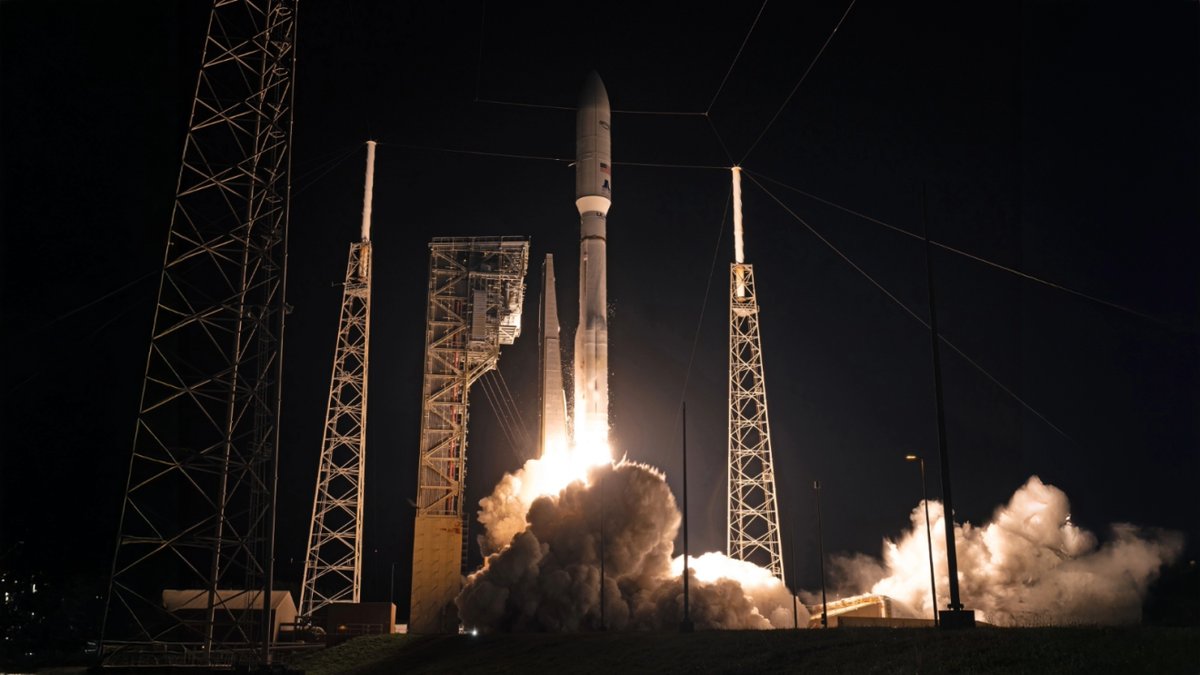
- Amazon Leo has sent another 29 LEO satellites into orbit
- But the company keeps pushing out the deadline for its commercial broadband service
- Launch capacity is definitely one of the reasons for the delays
Amazon Leo has successfully deployed 29 more satellites into low-Earth-orbit (LEO), using United Launch Alliance’s (ULA’s) Atlas V rocket. It was Amazon Leo’s 14th mission, bringing its total number of LEO satellites in orbit to 396.
Amazon Leo said via it’s update page that the recent launch was its final mission in its Atlas launch campaign. In the future it will use ULA’s new, heavy-lift Vulcan rocket, which will carry up to 40 LEO satellites per launch.
Interestingly, Melissa Wuerl, Amazon Leo’s director of Launch Systems, seemed to push the company’s commercial service deadline out further.
Previously, Amazon’s CEO Andy Jassy said the company was on the verge of launching commercial Amazon Leo broadband service in mid-2026.
But on July 2, Wuerl said, ‘With hundreds of flight-ready satellites standing by at the Cape and a new, dedicated vertical integration facility ready to support Leo Vulcan 1 and subsequent missions, we have a clear path to increase launch and deployment cadence, helping us quickly expand network coverage following an initial service rollout later this year."
Chris Weber, VP for Amazon Leo Business, said on X that the 396 satellites deployed are enough to support continuous service across initial latitudes. “Still, lots of work ahead – including raising all these new satellites to their assigned altitude – but we’ve completed enough launches for initial service this year, and future missions just add coverage and capacity.”
Rocket capacity analysis
A blog by CCS Insight analyst Joe Gardiner notes that launch capacity is highly constrained, and this is a problem particularly for newer satellite operators such as Amazon Leo.
“Currently, there are approximately 15,000 LEO satellites in orbit, and about 10,000 of them belong to Starlink,” wrote Gardiner. “The company has launched them using a steady cadence of SpaceX rockets over the past five years or so, most notably the Falcon 9 and the Falcon Heavy.”
Obviously, Starlink has a huge head start when it comes to enough capacity to provide satellite-based broadband. And it has the advantage of using its own rocket company.
Amazon Leo’s parent Amazon also owns its own rocket company — Blue Origin. “But the Jeff Bezos-owned company has suffered a series of setbacks in recent weeks,” wrote Gardiner. “It failed to deploy an AST SpaceMobile satellite to the correct height, meaning the satellite was de-orbited. Then a major explosion engulfed the launch site in fire, leading to significant damage to the launch pad and several months of further delays while it’s repaired.”
Gardiner said the lack of large-scale, independent launch suppliers is being felt throughout the industry.
Read up on Amazon Leo
Amazon Leo promises commercial LEO service by mid-2026
Amazon Leo jolted after rocket blast
FCC waives Amazon Leo’s July 2026 satellite launch deadline
Contrivian orchestrates LEO satellite service across Starlink and Amazon Leo
Sentinel — Human
The text is primarily human-written, functioning as a synthesized report that effectively weaves company updates with external capacity analysis.