Last May, EFF reported that a sheriff’s office in Texas searched data from more than 83,000 automated license plate reader (ALPR) cameras to track down a woman suspected of self-managing an abortion. ALPRs are promoted as tools for keeping communities safe by finding missing persons and locating stolen vehicles, but this case showed how ALPRS can be weaponized to investigate people’s private healthcare decisions. And these aren’t the only tools in the surveillance arsenal: others include location tracking tools like Locate X, which can show a person’s visit to an abortion clinic, or search histories which might be used as evidence of a person’s interest in obtaining abortion pills. Taken together, these tools create a dangerous surveillance pipeline that threatens everyone’s health privacy.
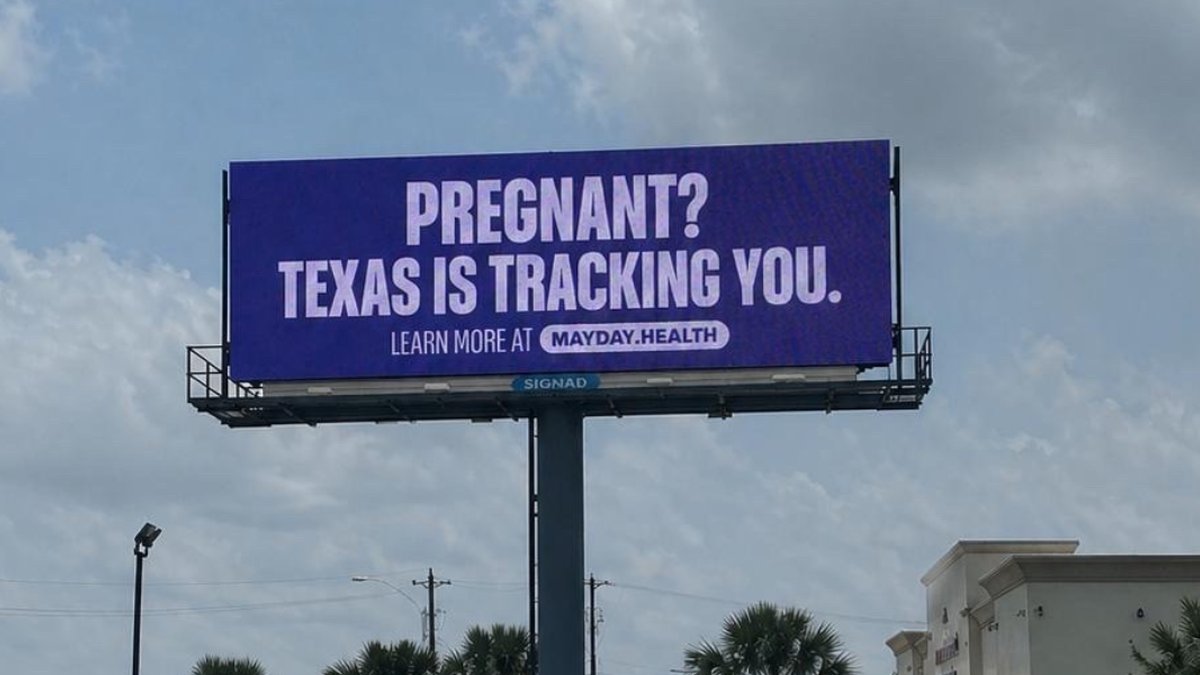
Too often, though, the public is unaware of the threat, and one nonprofit is working to change that. Following EFF and 404 Media’s report on Texas’s use of Flock cameras, eye-catching billboards popped up in Houston, warning drivers that if they’re pregnant, the state of Texas could be tracking them.
Photo provided by Mayday Health
These billboards came from Mayday Health, a nonprofit dedicated to sharing information about abortion pills, birth control, and gender-affirming care. We spoke with Leo Raisner, Executive Director of Mayday Health, about the billboards to learn more about the campaign and organization and to discuss how surveillance affects reproductive freedom.
***
THOMAS: Why did Mayday Health start this campaign in Texas?
RAISNER: Well, we read the incredible reporting coming from EFF about Texas's surveillance. We want Texans to know their rights, to know their options, and to know that there are organizations and people who have their back. So we decided to put up a few billboards around the Houston area to remind people that they still have options.
Digital advertising in the space, as I know you're well aware of, faces enormous platform restrictions from Meta and Google, whereas billboards reach people in the physical world without algorithmic gatekeeping and without requiring anyone to search for information. So at the very least, if a driver's passing by the billboard, we’re spreading information that they should be careful that they might be surveilled, and also there are different options. There's a website where they can come learn more about those options.
THOMAS: And how have the billboards been received so far? Have you heard anything from folks in the Houston area yet?
RAISNER: Yeah, we've heard some messages of support on social media DMs. We're just thrilled about how many drivers these messages are going to reach. They'll be up for 4 weeks, and are expected to hit over 1,000,000 drivers during that 4-week campaign period.
THOMAS: Are there other ways that Mayday Health has seen surveillance systems impact people seeking healthcare?
RAISNER: You know, we go all over the country and talk to folks who are seeking reproductive healthcare options in states where clinics are banned, and we direct folks to our website where they can learn more about abortion pills. We make privacy very central to how we operate. Privacy is not just an afterthought for us. When people arrive at our website, we direct them to the Digital Defense Fund, which offers people privacy and security resources as they're navigating reproductive healthcare in states where they might be being surveilled. We don't collect cookies, we don't collect identifying information from visitors to our site. We want people to know their options, and we don't have any interest in knowing who they are.
THOMAS: Why do you think the work of the digital rights movement is so important to the work of the reproductive health rights and justice movement?
RAISNER: I mean, those two movements are inextricably linked. The anti-abortion movement is using every tool in their toolbox to prevent people from getting the healthcare access they need, whether that's surveilling people online or closing down brick-and-mortar clinics, but we encourage people to visit Mayday Health and learn that they still have options no matter where they live.
THOMAS: Is there anything else that you would like the readers of our blog to know about Mayday Health?
RAISNER: I'd love for people to know that abortion pills are FDA approved. They're safe, they're effective, and they're available through the mail.
***
EFF has said it time and time again – surveillance and reproductive freedom cannot coexist. Whether the tracking occurs over the internet or through license plate reader systems with over 83,000 cameras, it is an invasion of privacy. Protecting our digital privacy is more critical now than ever. Help EFF fight back against this digital dragnet and protect reproductive freedom for all by making a donation.
Facts Only
* A sheriff’s office in Texas searched data from more than 83,000 Automated License Plate Reader (ALPR) cameras.
* Location tracking tools like Locate X can show a person's visit to an abortion clinic.
* Search histories might be used as evidence of interest in obtaining abortion pills.
* Mayday Health placed billboards in the Houston area warning drivers that Texas could be tracking them if they are pregnant.
* The billboards were funded by Mayday Health, a nonprofit dedicated to sharing information about abortion pills, birth control, and gender-affirming care.
* The campaign was part of efforts to inform Texans about their rights and options regarding reproductive healthcare.
* Mayday Health directs users to the Digital Defense Fund for privacy resources when navigating reproductive healthcare in surveilled states.
* Abortion pills are FDA approved, safe, effective, and available through the mail.
Executive Summary
Full Take
Sentinel — Human
The text reads like a synthesized piece combining journalistic reporting with direct advocacy interviews, exhibiting human narrative structure rather than purely synthetic exposition.