My morning train WFH reads:
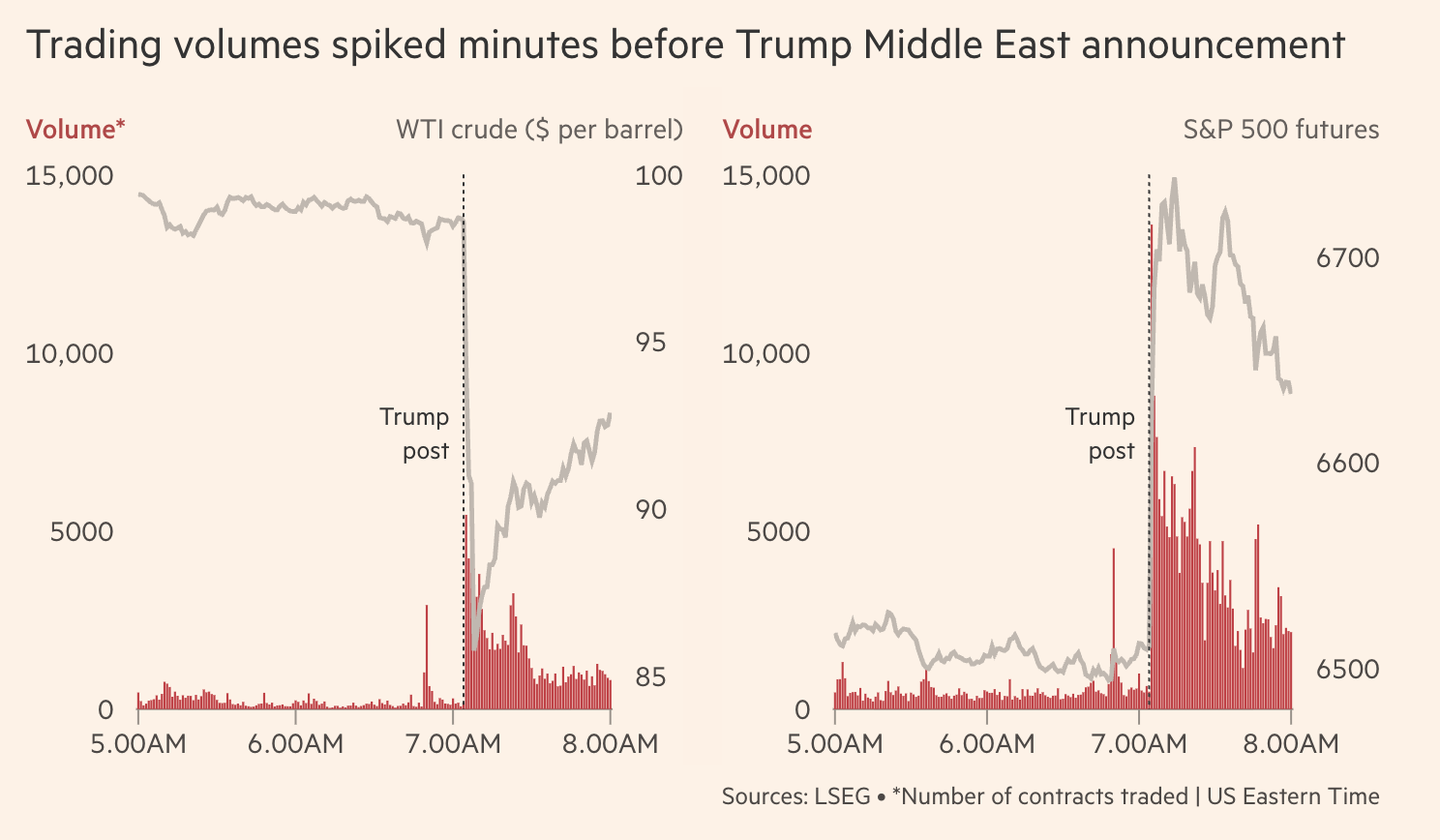
• Traders Placed $580mn in Oil Bets Ahead of Donald Trump’s Social Media Post on Iran Talks: Someone placed enormous oil bets right before Trump’s Iran post moved the market. Coincidence is one explanation, but not the most obvious one. (Financial Times)
• Maybe Turning War Into a Casino Was a Bad Idea? A disturbing new low in the Polymarket era (The Atlantic) see also Prediction Markets Promised Better Information. Instead They’re Creating Powerful Incentives to Corrupt Information. (TechDirt)
• Millions of Americans May Be Owed a Tax Refund from COVID. How to Get It.: Turns out a lot of people never claimed pandemic-era tax credits. If you’re one of them, there’s still time—but the clock is ticking. (USA Today)
• See which jobs are most threatened by AI and who may be able to adapt: It’s the most urgent question about artificial intelligence — and one of the hardest to answer. (Washington Post)
• The Accidental Moat-Killer: How a Mission to Accelerate Cancer Research via Idle Devices Is Now Upending AI’s Inference Economics (Super Genius Chronicles)
• How the Iran Conflict Is Widening, in Maps: So far the conflagration has hit more than a dozen other countries, eight bases with a U.S. presence and a number of commercial ships (Wall Street Journal)
• Afroman Wins Lawsuit Filed By The Cops Who Raided His Home: After police stormed the rapper’s Ohio home, he turned the experience into an album and set of videos. Claiming defamation and invasion of privacy, seven deputies from the raid sued. (Vanity Fair)
• Iran Built a Vast Camera Network to Control Dissent. Israel Turned It Into a Targeting Tool: Iran’s domestic surveillance infrastructure—built to monitor its own citizens—was reportedly co-opted by Israeli intelligence for military targeting. Orwellian doesn’t begin to cover it. (Yahoo)
• A Billionaire, a Scientist, and a Secret in the Florida Everglades: A yearslong battle between a celebrated hydrologist and a respected environmental juggernaut led to accusations about political motivations and stealing trade secrets (Rolling Stone)
• Remembering Robert Mueller: A reflection on the man who ran the most consequential investigation of the Trump era, and what his legacy looks like now that the rule of law is under renewed assault. (Doomsday Scenario)
Be sure to check out our Masters in Business next week with Judd Kessler, the Howard Marks Endowed Professor at the Wharton School of the University of Pennsylvania. The winner of the Vernon L. Smith Ascending Scholar Prize,he is the author of is Lucky by Design The Hidden Economics You Need to Get More of What You Want.
Traders placed $580mn in oil bets ahead of Donald Trump’s social media post on Iran talks
Source: Financial Times
Sign up for our reads-only mailing list here.
Facts Only
Actors: traders, Donald Trump
Events: oil bets placement, social media post on Iran talks
Timeline: Unspecified
Location: Global
Executive Summary
Full Take
In the SKEPTICAL MODE analysis:
1. STEELMAN: The article presents a narrative of possible market manipulation through substantial oil bets made before Trump's Iran post. It does not claim definitive proof but raises questions about the correlation between the two events.
2. PATTERN SCAN: None detected
3. ROOT CAUSE: The root cause lies in the intersection of global politics, finance, and social media. This situation can be seen as a symptom of the increasing role of speculation and financial markets in geopolitical affairs.
4. IMPLICATIONS: If proven to be intentional, this incident could lead to stricter regulations on financial betting during sensitive political periods. It also raises concerns about the potential for corruption and undue influence in information and decision-making processes.
5. BRIDGE QUESTIONS: How can we ensure fairness and transparency in global financial markets, especially during politically sensitive periods? What measures should be taken to prevent potential conflicts of interest between political leaders and financial speculators?