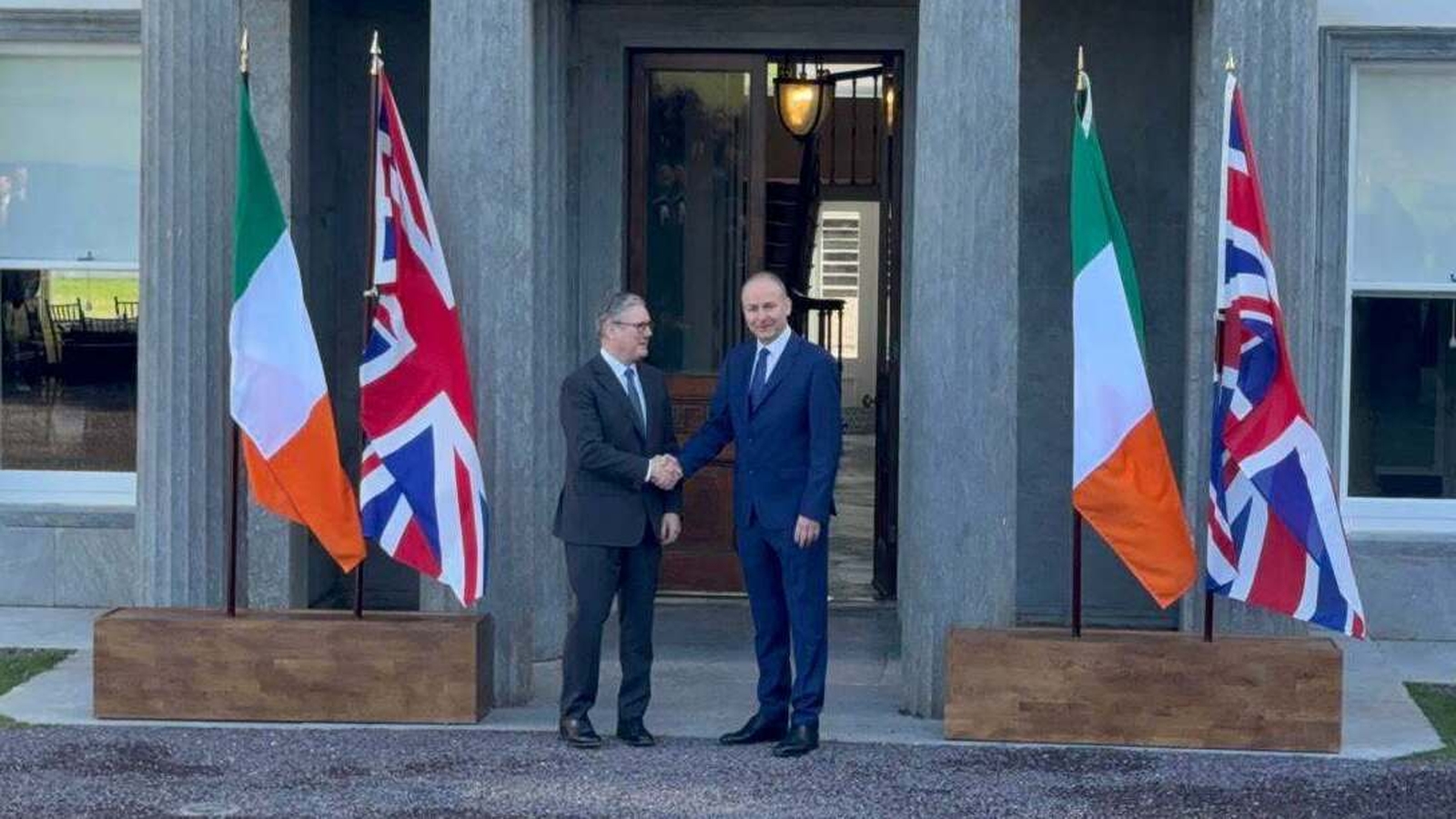
British Prime Minister Keir Starmer has arrived at Fota House in East Cork for a meeting with Taoiseach Micheál Martin.
It is the key political event of Mr Starmer's two-day visit to Cork, which is part of the second annual UK-Ireland summit.
Both leaders have committed to closer working relationships on maritime security, trade, energy and culture.
They are joined at this morning's meeting by senior Irish and British Cabinet Ministers.
The Irish Government summit delegation comprises: Taoiseach Micheál Martin; Tánaiste and Minister for Finance Simon Harris; Minister for Foreign Affairs and Trade and Minister for Defence Helen McEntee; Minister for Climate, Energy and Environment, and Minister for Transport, Darragh O'Brien; and Minister for Justice, Home Affairs and Migration Jim O’Callaghan.
The UK Government delegation comprises: Prime Minister Keir Starmer; Secretary of State for Energy Security and Net Zero Ed Miliband; Secretary of State for Northern Ireland Hilary Benn; Secretary of State for Environment, Food and Rural Affairs Emma Reynolds; and Secretary of State for Business and Trade Peter Kyle.
The meeting is scheduled to last around 90 minutes and a communique is expected to be issued once it ends.
Ireland, UK agree to work together on maritime security
The Irish and British governments have agreed to work more closely to strengthen the resilience of the subsea fibre optic cable network which runs between the two countries.
It is one of a number of agreements that will be formally announced following the meeting at Fota House.
Downing Street has said both governments have agreed to work more closely to strengthen the resilience of the extensive network of subsea fibre optic cables that run between the UK and Ireland.
Downing Street said that both countries have also committed to completing a series of joint exercises to rigorously test their responses to a major cable incident.
A UK-Ireland memorandum of understanding on defence has also been given, what is being described as a "refresh", which brings it up-to-date with the current security landscape.
The UK government said the new agreement includes a focus on maritime, cyber and joint procurement initiatives so that, amid increasing hostile state activity, the UK and Ireland are enhancing information‑sharing, coordination and planning, to better detect, deter and respond to threats across the Irish Sea and north-east Atlantic.
Mr Starmer will also announce later today investments of more than €900 million by 15 Irish companies in the UK.
The investments are expected to lead to the creation of 850 new jobs in the UK.
The investments, many of which are supported by Enterprise Ireland, are in areas such as AI-powered corporate services, renewal energy and telecommunications companies.
Read more: €5m funding for 12 Ireland-UK cultural projects announced
Progress will also be announced on work to complete two new energy interconnectors.
One of these, which will connect Wales and Ireland, will provide enough power for more than half a million homes.
It represents an investment of more than €850 million in the two countries.
The second interconnector will be between Northern Ireland and Ireland.
Mr Starmer said the investments would make both the UK and Ireland better off and more secure.
"The UK's close friendship with Ireland is going from strength to strength and I am pleased that we are going further in working together on growth, energy, security and more," Mr Starmer said.
"This new Irish investment coming into the UK is one part of a much bigger picture of our flourishing cultural, commercial and security ties.
"The action this [UK] government has taken to reset relationships and deepen partnerships with our closest allies is paying off. It will help us withstand global challenges and protect money in the pockets of families up and down the country."
Facts Only
British Prime Minister Keir Starmer and Irish Taoiseach Micheál Martin met at Fota House in East Cork.
The meeting is part of the second annual UK-Ireland summit.
Senior ministers from both governments attended, including UK Secretary of State for Energy Security Ed Miliband and Irish Minister for Foreign Affairs Helen McEntee.
Agreements include closer cooperation on maritime security, trade, energy, and culture.
Both governments committed to strengthening the resilience of subsea fibre optic cables between the UK and Ireland.
Joint exercises will test responses to major cable incidents.
A memorandum of understanding on defence was updated to address maritime, cyber, and joint procurement initiatives.
Starmer announced over €900 million in investments by 15 Irish companies in the UK, expected to create 850 jobs.
Investments are supported by Enterprise Ireland and focus on AI, renewable energy, and telecommunications.
Two new energy interconnectors are in development: one between Wales and Ireland (€850 million investment) and another between Northern Ireland and Ireland.
€5 million in funding was announced for 12 Ireland-UK cultural projects.
The meeting lasted approximately 90 minutes, with a communique expected afterward.
Executive Summary
British Prime Minister Keir Starmer and Irish Taoiseach Micheál Martin met at Fota House in East Cork as part of the second annual UK-Ireland summit. The meeting focused on strengthening cooperation in maritime security, trade, energy, and culture, with senior ministers from both governments in attendance. Key agreements include enhanced protection for subsea fibre optic cables between the UK and Ireland, joint defence exercises, and updated defence cooperation protocols. Additionally, Starmer announced over €900 million in investments by Irish companies in the UK, expected to create 850 jobs, alongside progress on two new energy interconnectors linking Wales and Ireland, and Northern Ireland and Ireland. The summit underscores a commitment to deeper bilateral ties, with both leaders emphasizing mutual benefits in security, economic growth, and energy resilience.
The investments span sectors like AI, renewable energy, and telecommunications, supported by Enterprise Ireland. Cultural projects and energy infrastructure, including a €850 million interconnector, were also highlighted. Starmer framed the collaboration as part of a broader effort to reset UK relationships with allies, positioning it as a response to global challenges and economic pressures. While the meeting’s outcomes reflect shared priorities, the long-term impact of these agreements—particularly in security and energy—will depend on implementation and geopolitical stability.
Full Take
The strongest version of this narrative presents a robust case for UK-Ireland cooperation as a pragmatic response to shared challenges—subsea cable vulnerabilities, energy security, and economic growth. The focus on tangible outcomes (investments, infrastructure, defence updates) lends credibility, and the inclusion of specific figures (€900 million, 850 jobs) grounds the claims in measurable commitments. The framing of "resetting relationships" aligns with Starmer’s broader diplomatic strategy, positioning the UK as a collaborative partner post-Brexit. However, the narrative leans heavily on economic and security benefits without addressing potential friction points, such as Northern Ireland’s status or divergent EU-UK regulatory frameworks.
Patterns detected: none. The content avoids emotional exploitation or distortion, focusing on verifiable agreements and statements. The absence of adversarial framing or exaggerated claims suggests a straightforward diplomatic update rather than a manipulative narrative.
Root cause: The paradigm here is post-Brexit realignment, where both nations seek to mitigate disruptions by deepening bilateral ties. The unstated assumption is that economic interdependence and security cooperation can outweigh political tensions—a bet on mutual self-interest over ideological divides. Historically, this echoes Cold War-era alliances where proximity and shared threats (e.g., subsea cable risks) forced collaboration despite broader disagreements.
Implications: For human agency, the emphasis on joint exercises and infrastructure projects could enhance resilience against cyber threats and energy shortages, benefiting citizens in both countries. However, the costs—such as regulatory alignment challenges or dependency risks—are glossed over. Second-order consequences might include increased UK reliance on Irish energy corridors or heightened scrutiny of foreign investments in critical infrastructure.
Bridge questions: How might Northern Ireland’s unique position complicate these agreements? What safeguards exist to prevent these interconnectors from becoming geopolitical leverage points? Would a shift in UK or Irish leadership alter the trajectory of this cooperation?
Counterstrike scan: A coordinated influence campaign would likely amplify the economic benefits while downplaying risks (e.g., "This proves Brexit hasn’t harmed UK-Ireland ties!"). The actual content avoids such spin, presenting a balanced account of commitments without overpromising. No structural alignment with manipulative playbooks is evident.
Sentinel — Human
The article exhibits strong human characteristics, including specific attributions, varied sentence structure, and direct quotes, with no significant stylometric or coherence red flags.