Programming Note:
Tomorrow’s Rapid Read will publish late. I am a volunteer pilot for Angel Flight East as such I am flying an early morning mission transporting a one year old cancer patient and his family to CHOP for specialized treatment. Angel Flight East is a nonprofit that coordinates free air transportation for patients and families facing serious medical needs far from home. Volunteer pilots donate their time, aircraft, and expenses to make these lifesaving flights possible, and I fly these missions about once per week. 100% of paid subscription proceeds from this Substack funds fuel for these flights forever. Please subscribe to help sustain them.
This is Christine who I transported to Cleveland Clinic for her cancer treatment last week. Let’s wish Christine and all those fighting cancer all the best. Let’s fight cancer together.
Shock Line
Iran operationalizes Hormuz de-mining monopoly as commercial traffic returns and secondary powers accelerate unrelated hardware and regulatory moves.
What Changed (Last 24 Hours)
Iran resumed scheduled commercial flights between Tehran and Dubai with the first departure on Monday after reopening measures were completed.
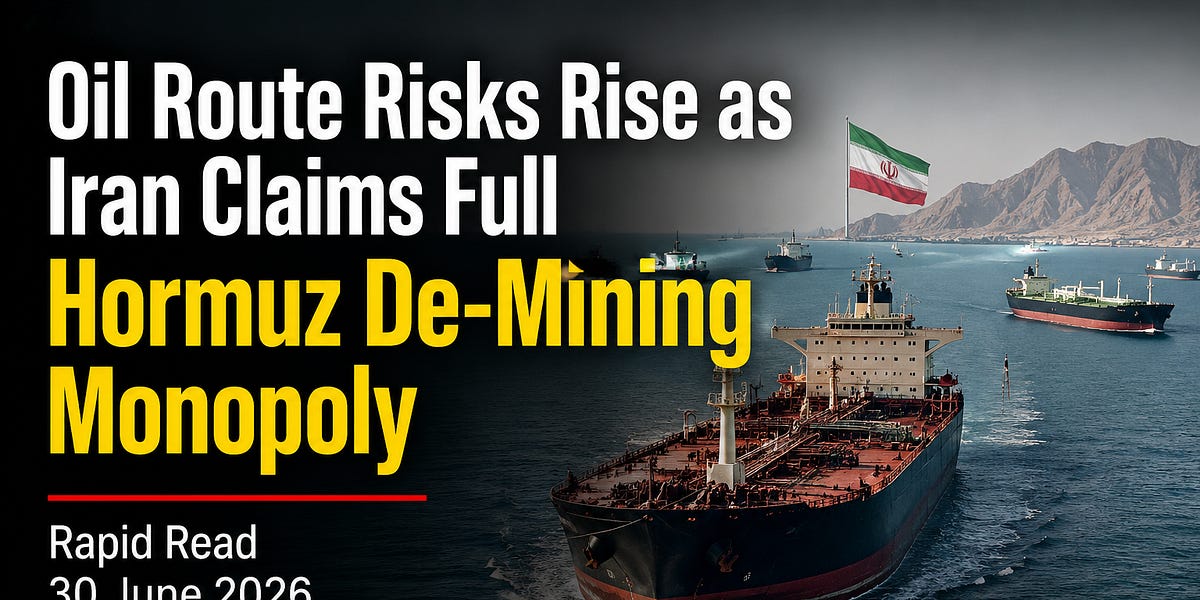
Iran’s deputy foreign minister stated that de-mining operations in the Strait of Hormuz will be conducted solely by Iran under the Islamabad memorandum of understanding.
Poland finalized a $4.8 billion contract with Sweden’s Saab for three A26 Blekinge-class submarines.
The Trump administration initiated a formal evaluation of the California Coastal Commission’s implementation of its federally approved coastal management program.
The Democratic Republic of Congo directed cobalt miners to surrender unused export quotas for the first half of the year to a government regulator.
Rocket Lab announced an $8 billion acquisition of Iridium to integrate launch services with an operational satellite communications network.
Why This Matters (The System)
Fragmented Chokepoint Authority Regime
Iran converted its de-mining claim into an operational procedure through the new Joint Hormuz Committee with Oman while tanker loadings continued and commercial flights resumed in the waterway.
Poland locked in a multi-year submarine construction program that shifts Baltic naval timelines outside US force rotation schedules.
US federal review of California coastal authority and Congo quota reallocation both tightened physical constraints on land access and critical mineral export licensing inside one day.
Hard anchor: Tehran-Dubai commercial air service restored for the first time since February; Polish contract commits three hulls on Saab production schedule extending into the 2030s.
What Breaks Next (Forward Risk)
If Iran enforces de-mining operations without third-party verification, war risk insurance for Hormuz transits rises and compliant VLCC availability falls, forcing Asian refiners onto longer Cape routing inside current 30-60 day cargo cycles.
If Swedish submarine production for Poland slips on yard or certification timelines, Russian surface and submarine activity in the Baltic retains extended freedom against NATO resupply to the Baltic states.
If the California Coastal Commission evaluation triggers federal preemption findings, offshore wind and spaceport permitting timelines compress while state environmental litigation capacity contracts through preemption challenges.
If Congo reallocates surrendered cobalt quotas to active exporters, near-term physical volumes increase but battery supply chains lose volume certainty on existing multi-year offtake contracts tied to 2026-2027 deliveries.
If the Rocket Lab Iridium integration proceeds on schedule, competing LEO operators lose priority access to ground stations and spectrum in high-growth coverage regions.
If early elections follow the Serbian president’s announced resignation, Russian energy transit leverage through Serbia and EU accession conditionality both operate under maximum political uncertainty for the full government formation period.
Signal vs. Noise
Signal:
Tehran-Dubai flight resumption (restores concrete scheduled air corridor after months of suspension)
Iran de-mining monopoly assertion (establishes new enforcement rule applicable to every future transit)
Poland-Sweden submarine contract finalization (binds multi-year physical naval platform delivery)
Congo cobalt quota surrender order (immediately reallocates export licenses and affects physical shipment flows)
Rocket Lab Iridium acquisition (transfers ownership of operational LEO assets and ground infrastructure)
Noise:
Hormuz management statements and warnings that deploy no new physical assets or change existing transit procedures
Moscow rhetoric on Ukraine operations without new infrastructure strikes or force movements inside the window
Korean semiconductor capacity expansion pledges (long-horizon capital plans with no operational shift today)
Commodity price movements without tied changes in fixture volumes, inventory, or contract renegotiations in the last 24 hours
The Line to Remember
Corridor control now fragments into technical enforcement monopolies and parallel hardware commitments on unrelated fronts, locking secondary powers into long-lead decisions before primary settlements form.
Community Notes:
We are very happy to announce that we have a new YouTube page.
PLEASE go to www.YouTube.com/@GeopoliticsUnpluggedRapidRead and SUBSCRIBE.
Why You Should Upgrade to Paid:
This edition of Rapid Read cuts through the visible resumption of commercial flights between Tehran and Dubai and renewed tanker loadings in the Gulf to reveal the operationalization of Iran’s de-mining monopoly in the Strait of Hormuz alongside accelerated long-lead commitments by secondary powers in unrelated domains. These parallel developments are fragmenting authority over critical corridors and supply chains even as primary diplomatic channels remain active. Paid subscribers receive the exclusive full Our Take synthesis, including the complete Geopolitical Risk Board with its scored risk evaluations and the contrarian assessment that separates surface stabilization from underlying structural constraints. You also gain the integrated shipping rates, inventory signals, and commodity market analysis that provide leading visibility into the adjustments ahead for energy costs and contract reliability.
With an upgrade you get:
Access to the full forward risk framework and scored Geopolitical Risk Board that quantifies exposure across enforcement procedures, production timelines, quota reallocations, and infrastructure shifts.
The contrarian point of view that evaluates whether current traffic recovery and technical talks indicate durable de-escalation or tactical pauses over persistent fragmentation.
Detailed market and shipping summaries that connect fixture activity and inventory movements to upcoming volatility in delivered costs and supply chain buffers.
The synthesized implications mapping how layered constraints will affect insurance exposure, routing options, and downstream contract stability in the weeks ahead.
This edition summarizes 62 news stories and 8 Substack articles of note.
Sentinel — Human
The text is primarily human-written, blending specific geopolitical data with an urgent, personalized narrative voice to construct a complex argument about systemic fragmentation and risk.