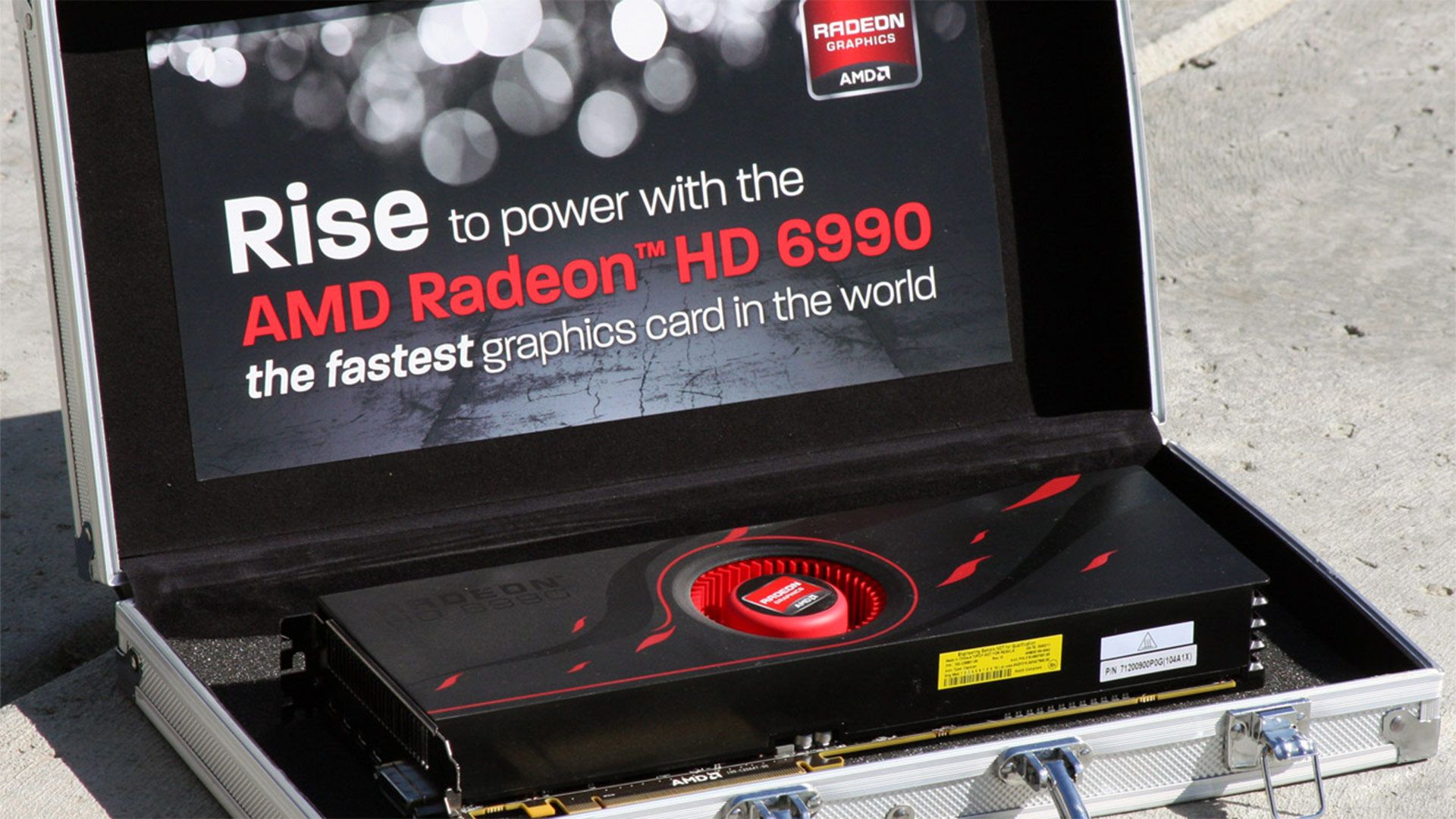
At the time, we were concerned about AMD’s pursuit of speed at any cost.
Get Tom's Hardware's best news and in-depth reviews, straight to your inbox.
You are now subscribed
Your newsletter sign-up was successful
15 years ago, AMD released its powerful Radeon HD 6990 graphics card (review link). This flagship dual-GPU hot rod, codenamed Antilles, was several months late in March 2011 and poked its head out only a couple of weeks before Nvidia’s reply. Nevertheless, the dual-Cayman XT GPU board, with a majestic-for-the-era 4GB of VRAM, became the world’s fastest graphics card (though that was an honor AMD already held with the Radeon HD 5970 2GB). To reach this PC performance pinnacle, AMD perhaps pushed the silicon a little too hard, though, with reviews of the time complaining about heat, noise, and power consumption.
The specs and performance of the Radeon HD 6990 were spectacular to behold at the time. Two fully-fledged Cayman XT GPUs were shoehorned onto a single PCB and connected via AMD’s CrossFireX. Essentially delivering two HD 6970 graphics cards on one board, albeit slightly downclocked, the HD 6990 thus delivered:
- Dual Cayman XT 40nm GPUs, packing 3072 stream processors and 5.28bn transistors combined
- Standard GPU clock of 830 MHz, OC up to 880 MHz
- 4GB GDDR5 (2GB per GPU)
- Five-display support
- Massive 375 W TDP, with OC modes pushing 450W (dual BIOS switch innovation)
- Dual-slot 12-inch PCB with two 8-pin connectors
- Flagship pricing at $699
If you want some in-depth analysis of what AMD’s Antilles represented at the time, please check out our 16-page review from March 2011.
Article continues belowOur test suite would embrace a slew of DirectX 11 titles. Most readers will be familiar with the F1, Battlefield, and Metro franchises, which featured in our tests. If you still play any of these classics, compare the results from the HD 6990 with what you can achieve using your modern GPU. Bonus points: Can your iGPU beat the Quad-CrossFire configuration of the HD 6990 in Crysis?
Above, Tom's Hardware’s Editor Emeritus, Chris Angelini, performs an AMD Radeon HD 6990 4GB noise test.
As we have already hinted, Tom’s Hardware wasn’t impressed by the heat, power consumption, and noise during the Radeon HD 6990 tests. Moreover, we thought, as an alternative, that a pair of Radeon HD 6970s sacrificed nothing except space in your case.
A couple of weeks later, Nvidia replied with its noticeably quieter dual-GPU GeForce GTX 590, but it couldn’t quite manage to usurp the Radeon HD 6990.
Get Tom's Hardware's best news and in-depth reviews, straight to your inbox.
Follow Tom's Hardware on Google News, or add us as a preferred source, to get our latest news, analysis, & reviews in your feeds.
Mark Tyson is a news editor at Tom's Hardware. He enjoys covering the full breadth of PC tech; from business and semiconductor design to products approaching the edge of reason.
-
PSUpower Ah, the good old days; when you didn't have to sell your kidneys, in order to buy a good GPU, and AMD was still competitive at the high-end.Reply -
leclod Reply
It costed 700usd in 2011, wouldn't that be 1000usd today ? (back then the US dollar was higher)PSUpower said:Ah, the good old days; when you didn't have to sell your kidneys, in order to buy a good GPU, and AMD was still competitive at the high-end.
AMD is competitive at the high-end (9700XT is high end to me at least). -
PSUpower Replyleclod said:It costed 700usd in 2011, wouldn't that be 1000usd today ? (back then the US dollar was higher)
I wasn't necessarily referring to 6990, but still; good luck buying a flagship GPU today, for "just" $1,000. -
Notton It's actually 2 GPUs for $700 in 2011.Reply
So you would have to double the price of a 5090 or whatever.
And you wouldn't even be getting the whole deal, as 2x 5090's don't include a PCIe switch. -
ezst036 Back in the day when AMD actually tried to compete, wanted to compete, and sought to compete with Nvidia.Reply -
PSUpower Replyezst036 said:Back in the day when AMD actually tried to compete, wanted to compete, and sought to compete with Nvidia.
Nowadays, it's all about data centers sales, for both of them. -
thestryker Enjoying the retrospective pieces popping up and look forward to more.Reply
The biggest problem with AMD for Crossfire and dual GPU cards is that their frame pacing was a lot worse than nvidia's. So even though the 6990 was faster than the 590 it typically was a worse experience.
Currently I don't think there's any reason for anyone to target the x90 tier nvidia cards, but it would be nice to see competition for everything below it. I know it wouldn't be likely to help pricing a whole lot, but it might loosen the vice grip nvidia has on the discrete market. -
leclod ReplyPSUpower said:I wasn't necessarily referring to 6990, but still; good luck buying a flagship GPU today, for "just" $1,000.
to me 5090 is at least 6990 level or Titan or...Notton said:So you would have to double the price of a 5090 or whatever.
Couldn't you think the 5080 is the current flagship at a decent price ?
(the 5090 being a cherry on top because people are ready to pay for that)
The 5080 launch price was $1,000 -
Notton 5080 going for anywhere between US$1300~1900, so $2600~$3000 + whatever a PCIe switch costs these daysReply
Facts Only
Actor: AMD
Event: Launched Radeon HD 6990 graphics card
Date: March 2011
Location: Unspecified
GPU Type: Dual-GPU (Cayman XT)
VRAM: 4GB GDDR5 (2GB per GPU)
Clock Speed: 830 MHz, OC up to 880 MHz
TDP: 375W
Form Factor: Dual-slot, 12-inch PCB with two 8-pin connectors
Pricing: $699
Executive Summary
Full Take
Patterns detected: ARC-0024 Ambiguity (The article suggests that the Radeon HD 6990 was the world's fastest graphics card, but it does not clarify what specific benchmarks or tests were used to make this determination).
This retrospective piece serves as a reminder of the arms race between AMD and Nvidia for high-end graphics cards. The Radeon HD 6990, though powerful, was criticized for its heat, noise, and power consumption, highlighting the trade-offs that often accompany pursuit of top performance in consumer technology. Today's flagship GPUs face similar concerns regarding their cost and impact on PC system performance, as demonstrated by the $1300-$1900 price range for the Nvidia GeForce RTX 5080.
Questions for further inquiry: How have the design priorities of graphics card manufacturers evolved over time? What factors drive the costs and performance characteristics of high-end GPUs today, and what impact do these trends have on the broader consumer electronics market?
Sentinel — Human
The analyzed text is likely human-written, as it includes personal anecdotes, reader interaction, and emotional responses, and shows variation in sentence length and hedging density.