Yves here. Note that this article originally had the unduly anodyne headline, “Housing affordability is reshaping Europe’s social fabric.” What is surprising is that that authors tell us that few studies have been made of how unduly costly housing hurts the public. So this analysis is more important that it might seem.
By Jean-Jacques Hallaert, Senior Economist International Monetary Fund, and Iglika Vassileva, Senior Economist International Monetary Fund. Originally published at VoxEU
Housing affordability has moved to the forefront of Europe’s policy debate. While the economic literature has mostly focused on the drivers of housing unaffordability, this column examines its consequences in the EU. The authors find that increases in housing cost burdens have large adverse impacts on housing adequacy, with noticeable impacts on poverty and health. The effects on fertility and labour force participation are smaller.
Housing affordability has moved to the forefront of Europe’s policy debate. Surveys, press reports, and protests across the EU suggest that housing is increasingly seen not only as an economic concern, but also as a threat to social cohesion. For example, in its European Affordable Housing Plan, the European Commission states: “What Europe is facing is more than a housing crisis. It is a social crisis” (European Commission 2025a).
Yet, most economic research has focused on why housing has become less affordable and on its distributional impacts across groups and regions, and much less attention has been paid to its consequences (European Commission 2025b).1 In recent work (Hallaert and Vassileva 2026), we show that rising housing cost burdens are not merely a symptom of broader pressures; they also have important consequences for individual wellbeing as well as for the economic, demographic, and social situation.2 Importantly, our analysis considers the impact of housing affordability on multiple outcomes for the same period (2010-2023) and the same geographical area (the EU27 countries).
Three Channels Through Which Housing Costs Matter
We estimate how high housing costs affect individuals and societies through three main mechanisms.
First, high housing costs reduce housing adequacy, forcing households into smaller, lower-quality, or poorly located dwellings. This is an issue that is particularly severe for the young (European Commission 2025b, Eurofound 2023). We capture this mechanism by estimating the impact of rising housing cost burdens on housing overcrowding and severe housing deprivation rates.3
Second, high housing costs results in lost opportunities. They make it difficult for individuals to move closer to employment and education opportunities. Turning down opportunities may increase poverty and contribute to lower labour force participation and inefficient spatial allocation of labour, which all affect wellbeing as well as productivity and economic growth (Glaeser and Gyourko 2018, Nguyen et al. 2026). We assess the importance of this mechanism by estimating the impact of an increase in housing cost burdens on the at-risk-of-poverty rate and labour force participation.4
Third, high housing costs constrain non-housing consumption. When a larger share of income is devoted to housing, some households may need to cut other spending. This can reduce access to healthcare, nutrition, and education, and affect childbearing decisions. We illustrate this mechanism by estimating the impact of housing affordability on fertility.
The impact on health shows that the channels can be interconnected: poor housing conditions can affect physical and mental health directly, but health status may also deteriorate if an individual reduces healthcare spending.
Using Machine Learning to Estimate the Consequences of Housing Affordability
Measuring the consequences of housing cost burdens is challenging because the forces that shape housing affordability also drive the outcomes we care about. In a relatively short panel, the list of factors that could plausibly matter is long relative to the number of years available. A textbook two-stage least squares approach struggles in this setting. We therefore adopt a double machine-learning approach with instrumental variables (DML-IV),5 which allows us to include a rich set of controls, while letting the relationships be non-linear and allowing the impact of housing costs to differ across countries and over time.
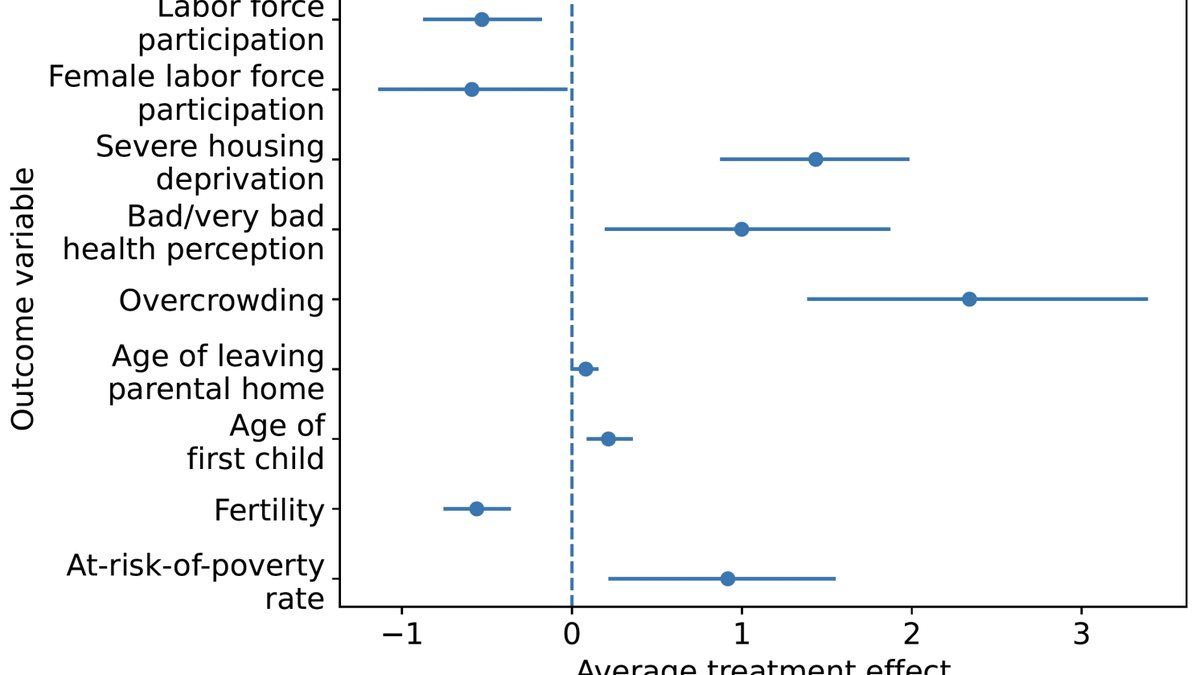
Figure 1 summarises the results.6 Each coefficient is best interpreted as an elasticity. For example, a coefficient of 2.3 on the overcrowding rate implies that a country where housing costs as a share of disposable income are 1% above the EU average tends to have an overcrowding rate about 2.3% above the EU average, all else equal.
Figure 1 Estimated impact and significance of a 1% deviation in housing costs (as a share of disposable income) from the EU average
Note: The whiskers report statistical significance at the 10% threshold.
Source: Author’s calculations.
The Largest Impact of Housing Affordability Is on Housing Conditions
Higher housing costs quickly translate into a tangible decline in living standards. Figure 2 shows that even a small increase of 1% in the share of housing costs in disposable income relative to the EU average triggers a 2.3% increase in the overcrowding rate and a 1.4% increase in the severe housing deprivation rate relative to the EU average. We do not find evidence that the inability to find affordable independent housing delays young people’s departure from the parental house. Therefore, it is not a meaningful channel for the deterioration of housing conditions or other dimensions.
Broader Economic and Social Consequences: Jobs, Poverty, Demographics, and Health
We estimate that when the housing cost burden is 1% higher than the EU average, labour force participation is lower than the EU average by about 0.55% (0.4 percentage points) for both overall and female population (Figure 2).
Lower labour force participation along with forgone job or education opportunities due to housing costs reduce individual income and can thereby increase the poverty rate. We estimate that a 1% higher housing cost burden than the EU average increases the at-risk-of-poverty rate by 0.9% (equivalent to 0.15 percentage points) relative to the EU average of 16.8% (Figure 2). Thus, housing affordability problems do not merely reflect poverty; they also contribute to it (Desmond, 2016)
The impact on fertility is present but small, operating in part through delayed parenthood (Kearney and Levine 2025, van Doornik et al. 2025). We estimate that when housing cost burdens are 1% higher than the EU average, women would have their first child on average less than a month later than the EU average and that the fertility rate would be 0.1 lower than the EU average of 1.51 (Figure 2).
Consistent with the medical literature, we find that housing costs also affect health outcomes. A housing cost in disposable income ratio 1% higher than the EU average is associated with a 1% increase in the share of population reporting “bad” or “very bad” health relative to the EU average of 9.17%. This is another channel through which housing affordability affects the well-being of individuals (including children’s physical and emotional development; see Hallaert et al. 2023) and, by affecting a key component of human capital, again impacts productivity and potential growth.
Figure 2 Estimated impact of a 1% deviation of the housing costs in disposable impact from the EU average
<
Note: The EU average housing cost in disposable income was 20.8% during the period considered. The chart reports the impact of a ratio 1 percent higher (21.0%) on all the variables on the horizontal axis. EU27 reports the average value of each variable during the period.
Source: Author’s calculations.
Conclusion
By influencing where and how people live, their access to work and education, their consumption choices, and even their decisions to have children, housing affordability is reshaping Europe’s social fabric and affecting economic prospects. While we have presented average effects across the EU, the DML-IV framework also produces country- and year-specific estimates, revealing substantial cross-country variations and that the adverse impacts of housing affordability eased after the pandemic. This may in part reflect the expansion of remote work, which can alleviate housing-related constraints, but this warrants further investigation.
Authors’ note: The views expressed herein are those of the authors and should not be attributed to the IMF, its Executive Board, or its management.
See the original post for references
Housing affordability or the lack thereof is yet another transfer of wealth from the young to the already much better off older generations. Sadly, the young do not vote and the old do, so they will keep getting policies that pander to them instituted.
Spot on. The so-called “housing affordability crisis” or “cost of living crisis” is a feature, not a bug.
Surely it’s a lack of affordable housing (material), rather than a “lack of housing affordability” (numbers on charts), that is the problem.
Its hardly a surprise that housing cost/availability is a major source of stress for people and has all sorts of knock on economic impacts. However, I’m a bit dubious that you can really apply a study like this to all of Europe, given the highly varied range of issues across the continent and even within countries. For those interested in a moderately deep dive in national and city comparisons, the Deloitte annual property index has lots of states. Once you do a deep dive into the situation in individual cities or regions, you will find any number of unique issues relating to the local economy, quantity/quality of housing stock, cultural expectations, availability of mortgages, tenant/landlord protections, etc. Housing policy is always a very knotty problem.
Though I agree with what you say I also believe that the extreme financialization of housing is quite a general phenomenon which results in lack of affordability in, let’s say, Paris, Milano, Madrid or Dublin (correct me if I am wrong) even if these cities have, each of them, their own peculiarities which may, or may not include, measures to more or less mend or alleviate the problem somehow. I believe there is a problem at European level and the root causes should possibly be treated there. ECB being called there. Something that I dislike a lot is how some players like BlackRock have been allowed to play a significant role in at least certain markets and I miss this being mentioned here.
See for instance in Deloitte’s report how they expect housing price increases in most of Europe. A general phenomenon there.
Ireland have some unusual taxes. The first is they tax your house, based on a totally confusing method. Secondly that have started taxing my pension. I hope this does not catch on.
Major issue (I’m a sufferer, among many many others) that is not nearly new (it’s been going on since the 90s and never fixed, only worsened) and that does not only affect the working class, incl. the worker aristocracy, liberal professions, etc. but also harms the socio-economy overall in two dramatic aspects:
1. It makes raising a family extremely difficult if not impossible, being thus the major driver of the demographic crisis.
2. It pushes salaries up as workers can’t work without being paid enough to afford at least the very basics, dramatically driving competitivity down as result (also harms demand of other stuff).
Spain is one of the worst affected areas, as it’s been for long closely following the Anglosaxon housing-chaos “strategy”, has extremely low salaries for EU standards and near zero public housing policy. On top of all that tourism (this is the 2nd most visited country on Earth, barely behind nearby France) has brutally encroached on homes and building space, let alone public space like parks (I often say that “I’m going tourist-spotting”, when I go for a stroll).
Hope that it is true that the issue of housing is coming to the forefront of the debate… but more importantly of actual housing policy in terms “for real”, because talking is definitely not anywhere near enough.
I’d like to see (probably non existent) data about effect of housing costs on educational outcomes of kids born into such homes. It’s well known that (on average) kids from wealthy backgrounds do better in school. That’s to some extent puzzling since (small) kids don’t know anything about money, don’t care about cheap vs expensive food, etc. So there’s a notion that a significant factor is basically the amount of noise and hassle in the childhood environment. It gets baked into people’s brains brains so much they can’t think straight if they didn’t have enough quiet when they were kids.
https://neurosciencenews.com/socioeconomics-child-brain-development-iq-30870/
See also “why rich people love quiet”:
https://www.theatlantic.com/magazine/archive/2022/09/let-brooklyn-be-loud/670600/
Also:
Early life adversity leaves a lasting molecular imprint across the body, primate study reveals
https://medicalxpress.com/news/2026-06-early-life-adversity-molecular-imprint.html
A macacque study, findings of DNA methylation etc.
Kids from wealthy backgrounds do better in school because wealthy people are smarter than the population at large. It is not complicated.