Amid White House Push on Drug Prices, the Democratic Party Holds a 10-Percentage Point Advantage Over the GOP to Address the Issue
As the Trump administration promotes its new TrumpRx website and other efforts to lower prescription drug prices, a growing majority of the public worries about being able to afford prescription drugs, and large majorities across parties want the government to do more to regulate prices, a new KFF Health Tracking Poll finds.
The new poll finds 59% of the public now say they are at least somewhat worried about being able to afford prescription drugs for themselves and their families, the largest share since KFF first polled on this question in 2018. This includes about one in five (22%) who are “very worried” about affording prescription drug costs.
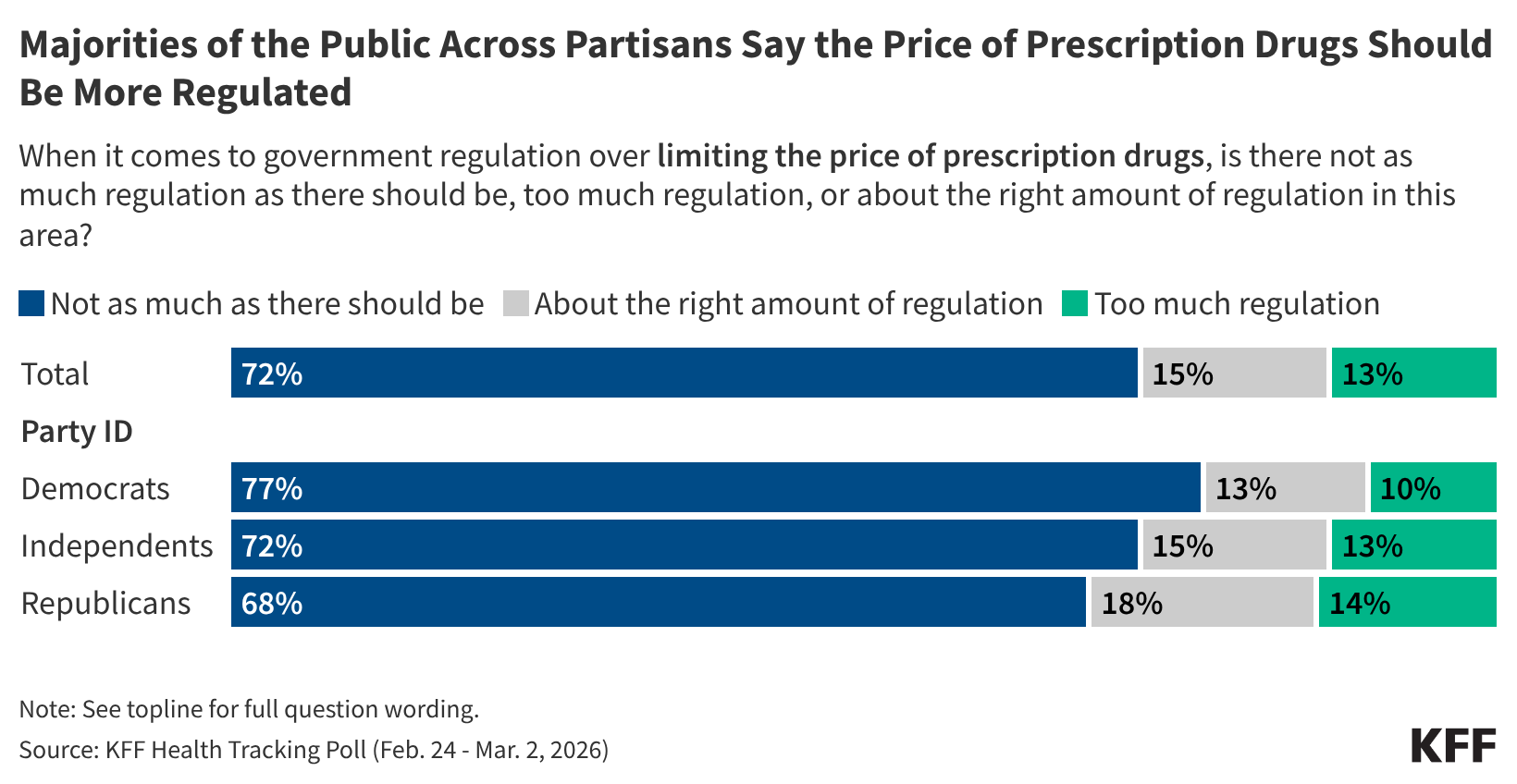
About seven in 10 (72%) say that there is not as much government regulation as there should be when it comes to limiting drug prices, five times the share (13%) that says there is too much regulation of drug prices. In a rare moment of bipartisan agreement, at least two-thirds of Republicans (68%), independents (72%), and Democrats (77%) favor more government regulation of prices.
Fielded after the Feb. 5 launch of TrumpRx, a website that allows consumers to search for discounts on brand-name drugs, the poll finds a third (35%) of people who take prescription drugs say that they have heard at least “some” about it. Seven percent say that they have visited the website to compare prices on drugs, though the share is larger among people who take or have taken GLP-1 medications (16%), one of the categories of medications available on the site.
Prior to the launch of TrumpRx, drug discounts have been available through third-party platforms and directly from drug manufacturers. The poll finds that about four in 10 (42%) people who take prescription drugs say that they have used such a discount card or coupon in the past year. A similar share (39%) say they compared drug prices online to find the lowest price. Fewer say they purchased a lower-cost drug from an online pharmacy without using insurance (15%) or purchased a drug directly from a manufacturer’s website (8%).
Most of the public, including most independents, are skeptical that the Trump administration will lower drug prices for people like them, but President Trump’s base is more optimistic.
Most (59%) of the public says that it is “not too likely” or “not at all likely” that the Trump administration’s policies will lower drug costs for people like them, compared to about four in 10 (41%) who say it is “very” or “somewhat” likely.
Large majorities of Republicans (79%) and supporters of President Trump’s “Make America Great Again” movement (88%) say that they expect the administration’s policies to lower drug costs. Far smaller shares of independents (35%) and Democrats (11%) say the same.
Looking ahead to November’s midterm elections, more voters say they trust the Democratic Party (38%) than the Republican Party (28%) to do a better job addressing the cost of prescription drugs, though a quarter (27%) of voters say they don’t trust either party. Democrats hold a similar trust advantage on addressing health costs in general.
Independent voters are also more likely to trust the Democratic Party than the Republican Party to address drug costs (31% vs. 18%), though a larger share trusts neither party (41%).
Designed and analyzed by public opinion researchers at KFF, this survey was conducted February 24-March 2, 2026, online and by telephone among a nationally representative sample of 1,343 U.S. adults in English and in Spanish. The margin of sampling error is plus or minus three percentage points for the full sample. For results based on other subgroups, the margin of sampling error may be higher.
Facts Only
59% of the public is at least somewhat worried about affording prescription drugs, the highest share since 2018.
22% of the public is "very worried" about prescription drug costs.
72% believe there is not enough government regulation to limit drug prices.
13% say there is too much regulation of drug prices.
68% of Republicans, 72% of independents, and 77% of Democrats support more government regulation of drug prices.
The Trump administration launched TrumpRx on February 5, 2026, a website for comparing brand-name drug discounts.
35% of prescription drug users have heard at least "some" about TrumpRx.
7% of prescription drug users have visited TrumpRx to compare prices.
16% of users of GLP-1 medications have visited TrumpRx.
42% of prescription drug users have used a discount card or coupon in the past year.
39% have compared drug prices online to find the lowest price.
15% have purchased a lower-cost drug from an online pharmacy without insurance.
8% have purchased a drug directly from a manufacturer’s website.
59% of the public believes it is "not too likely" or "not at all likely" that the Trump administration’s policies will lower drug costs for them.
41% believe it is "very" or "somewhat" likely.
79% of Republicans and 88% of Trump’s MAGA supporters expect the administration’s policies to lower drug costs.
35% of independents and 11% of Democrats share this expectation.
38% of voters trust the Democratic Party to address prescription drug costs, compared to 28% for the Republican Party.
27% of voters trust neither party on this issue.
The poll was conducted February 24–March 2, 2026, among 1,343 U.S. adults, with a margin of error of ±3 percentage points.
Executive Summary
Full Take
The strongest version of this narrative highlights a rare bipartisan consensus: Americans across the political spectrum are deeply concerned about prescription drug costs and want more government intervention. The poll underscores a tangible policy gap—public demand for regulation clashes with skepticism about the Trump administration’s ability to deliver, despite its TrumpRx initiative. The data also reveals a trust deficit for Republicans on healthcare costs, with Democrats holding a clear advantage, even among independents. This aligns with historical patterns where healthcare affordability becomes a wedge issue, particularly in election years.
Patterns detected: ARC-0024 Ambiguity (the framing of "government regulation" as a monolithic solution without specifying mechanisms), ARC-0043 Motte-and-Bailey (broad support for "regulation" could retreat to narrower, less effective policies when challenged).
Root cause: The narrative assumes that government regulation is the primary lever for lowering drug prices, but it sidesteps deeper systemic questions—such as the role of pharmaceutical patents, insurance negotiation dynamics, or international price comparisons. The focus on partisan trust also obscures structural barriers, like lobbying influence, that transcend party lines.
Implications: If regulation is pursued without addressing underlying market distortions, costs may shift rather than shrink, burdening taxpayers or limiting innovation. The trust gap favors Democrats but risks oversimplifying complex policy trade-offs. Second-order consequences could include accelerated partisan polarization on healthcare or a backlash if expectations for quick fixes go unmet.
Bridge questions: What specific regulatory mechanisms do respondents envision, and would they accept trade-offs like longer drug approval times? How might pharmaceutical companies adapt to price controls, and what unintended consequences could arise? If neither party fully delivers on drug pricing, what alternative solutions might emerge from civil society or state-level experiments?
Counterstrike scan: A coordinated influence campaign would amplify bipartisan frustration to erode trust in both parties, then position a third-party or populist solution as the only "real" fix. The actual content doesn’t match this—it presents genuine public opinion data without pushing a predetermined outcome. The partisan trust metrics are transparent, and the poll’s methodology is disclosed, reducing manipulation risks. No structural alignment with a hypothetical attack playbook is detected.
Sentinel — Human
This article shows strong signs of human authorship, with natural variability in structure, specific sourcing, and nuanced partisan analysis that resists AI-generated uniformity.