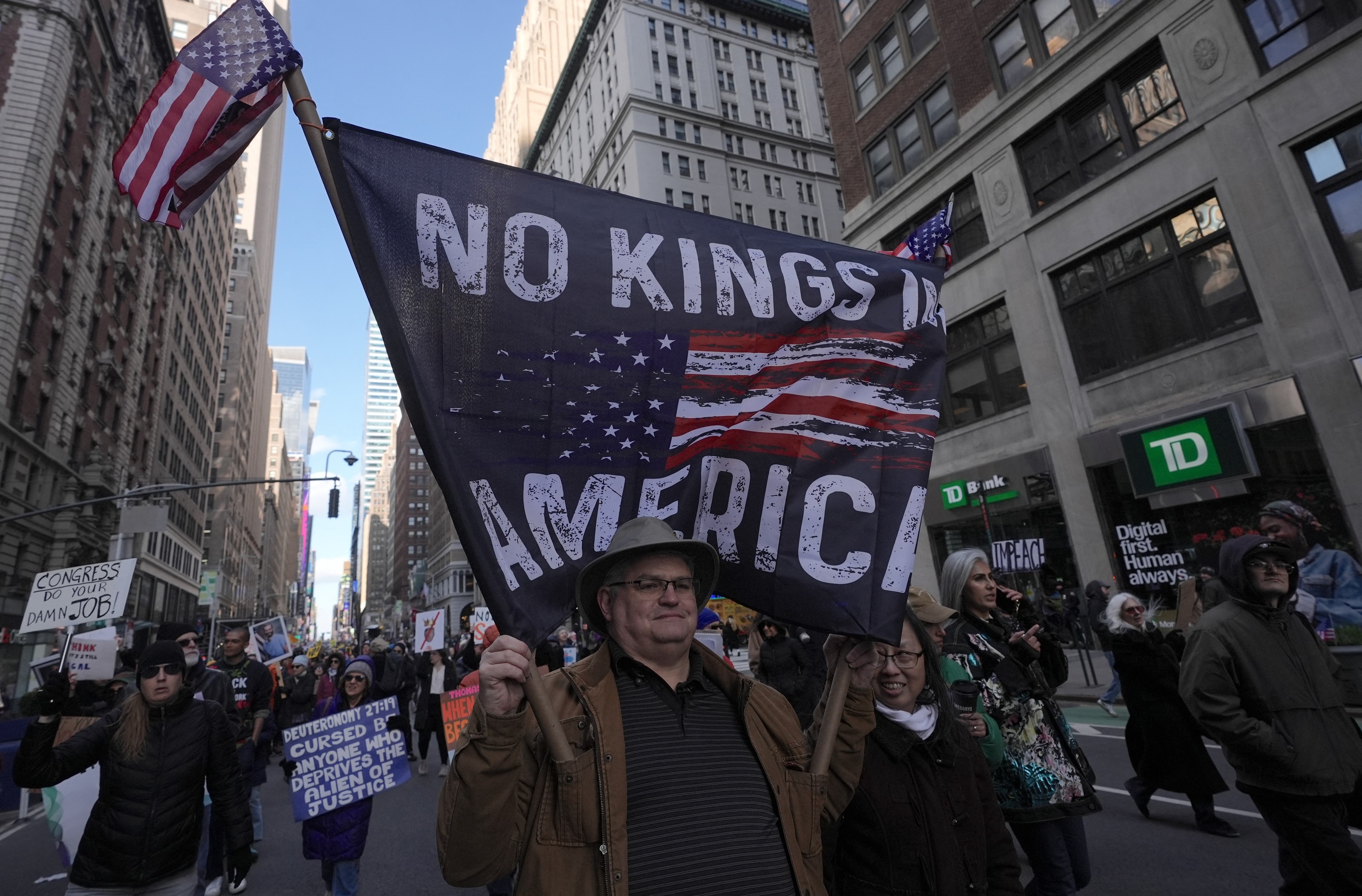
Cel puţin opt milioane de persoane au participat sâmbătă la marşurile „No Kings” (Fără Regi) împotriva administraţiei Donald Trump, potrivit organizatorilor, relatează duminică EFE şi AFP, preluate de Agerpres.
Mişcarea, care cuprinde zeci de organizaţii şi activişti democraţi, a organizat peste 3.300 de proteste în toate cele 50 de state americane pentru a denunţa ceea ce numeşte „autoritarismul” preşedintelui Trump.
Protestul de sâmbătă reprezintă o creştere estimată de un milion de participanţi şi 600 de marşuri suplimentare faţă de protestul din octombrie anul trecut.
Această mişcare s-a impus ca cel mai mare protest unificator de la revenirea miliardarului republican la Casa Albă.
În această demonstraţie, protestatarii au denunţat „războiul ilegal” pe care preşedintele Donald Trump l-a lansat împotriva Iranului, care a dus la creşterea preţurilor la combustibili şi la inflaţie, şi şi-au reiterat criticile la adresa „abuzurilor” Serviciului de Imigrare şi Control Vamal (ICE).
Principala demonstraţie a avut loc în faţa a zeci de mii de persoane în Minneapolis, cel mai mare oraş din Minnesota, epicentrul indignării naţionale împotriva ICE şi a Patrulei de Frontieră după ce agenţii acestora i-au ucis acolo pe cetăţenii americani Renee Good şi Alex Pretti în luna ianuarie.
A massive No Kings crowd turns out in Minneapolis, Minnesota pic.twitter.com/WAzXJFtG5L
— Headquarters (@HQNewsNow) March 28, 2026
Minneapolis, epicentrul ofensivei anti-imigraţie a guvernului american de la începutul acestui an, a fost ales drept punct central al mobilizării de sâmbătă, alături de oraşul său înfrăţit, Saint Paul, unde au manifestat 200.000 de persoane, potrivit organizatorilor.
Legenda rock Bruce Springsteen a interpretat piesa sa „Streets of Minneapolis”, scrisă ca un omagiu pentru Renee Good şi Alex Pretti.
Bruce Springsteen speaks at No Kings:
— Headquarters (@HQNewsNow) March 28, 2026
"Federal troops brought death and terror to the streets of Minneapolis. They picked the wrong city. The power and the solidarity of the people of Minneapolis and of Minnesota was an inspiration to the entire country. Your strength and your… pic.twitter.com/lgtvjnPohZ
Vorbind în acest oraş cu înclinaţii democrate din Midwest, guvernatorul statului Minnesota, Tim Walz, le-a mulţumit locuitorilor pentru că s-au opus unui „războinic în devenire” precum Donald Trump.
„Nu vom accepta niciodată un preşedinte care este un mincinos patologic, un cleptocrat şi un narcisist care subminează Constituţia Statelor Unite şi statul de drept în fiecare zi”, a adăugat Bernie Sanders, fost candidat democrat la preşedinţia SUA.
Alte zeci de mii de persoane au mărşăluit pe străzile din New York, în frunte cu actorul Robert De Niro, un critic acerb al preşedintelui Donald Trump.
ABD’nin New York kentinde bulunan Manhattan bölgesinde on binlerce kişi, ABD Başkanı Donald Trump ve yönetimini protesto etmek amacıyla düzenlenen "No Kings" (Krallara Hayır) gösterisinde bir araya geldi.
— Yedi23haber (@Yedi23haber) March 29, 2026
Trump’ın ikinci kez başkanlık görevine gelmesinin ardından ülke genelinde… pic.twitter.com/pSGedSWzcv
„Alţi preşedinţi şi-au testat deja limitele constituţionale ale puterii, dar niciunul nu a reprezentat o asemenea ameninţare existenţială pentru libertăţile şi securitatea noastră. (…) Trebuie oprit”, a îndemnat el.
De cealaltă parte a Atlanticului, la Roma, Amsterdam, Madrid şi Atena, au avut loc, de asemenea, mitinguri împotriva preşedintelui american.
Casa Albă a respins protestele, numindu-le „şedinţe de terapie” pentru „tulburarea Trump”, un termen folosit de preşedintele Trump şi susţinătorii săi pentru a ironiza opoziţia.
Protestele din Statele Unite au loc în timp ce rata de dezaprobare a preşedintelui Trump atinge cel mai înalt nivel din cele două mandate ale sale, 59% dintre americani dezaprobându-i prestaţia, potrivit unui sondaj publicat miercuri de Fox News.
Facts Only
At least eight million people participated in "No Kings" protests on March 28, 2026.
Over 3,300 marches were organized across all 50 U.S. states.
The protests were led by a coalition of democratic activists and organizations.
The largest protest occurred in Minneapolis, Minnesota, with tens of thousands in attendance.
The Minneapolis protest followed the deaths of Renee Good and Alex Pretti, killed by ICE and Border Patrol agents in January 2026.
200,000 people protested in Saint Paul, Minnesota.
Actor Robert De Niro led a protest in New York City.
Solidarity protests were held in Rome, Amsterdam, Madrid, and Athens.
The White House dismissed the protests as "therapy sessions" for "Trump derangement."
A Fox News poll showed Trump’s disapproval rating at 59%, the highest of his presidency.
Protesters criticized Trump’s policies on Iran, immigration, and alleged authoritarianism.
Bruce Springsteen performed "Streets of Minneapolis" at the protest.
Executive Summary
Full Take
The "No Kings" protests represent a significant escalation in organized opposition to Trump’s second term, framing his administration as an existential threat to democratic norms. The narrative’s strongest version is its ability to unify disparate grievances—from immigration enforcement to foreign policy—under a single banner of resistance, leveraging emotional triggers like the deaths of Good and Pretti to galvanize public outrage. However, the White House’s dismissal of the protests as "therapy sessions" reveals a classic ARC-0024 Ambiguity tactic, reducing complex political dissent to a psychological diagnosis, which both trivializes the concerns and avoids substantive engagement.
Historically, this echoes the pattern of mass protests during polarizing presidencies, where opposition movements coalesce around symbolic events (e.g., the deaths in Minneapolis) to challenge perceived overreach. The international solidarity protests suggest a broader narrative of Trump as a global symbol of authoritarianism, though the article does not explore counter-perspectives from Trump supporters or independent analysts. The Fox News poll’s 59% disapproval rating adds quantitative weight to the protest’s claims, but polls are snapshots, not predictions—what matters is whether this translates into sustained political action.
Root cause: The paradigm here is a clash between populist nationalism and institutional liberalism, with both sides weaponizing moral urgency. The protests assume Trump’s policies are uniquely destabilizing, while his supporters likely view them as necessary corrections to perceived systemic failures. The missing perspective is the silent plurality—those who neither protest nor approve of Trump but are exhausted by the polarization.
Implications: If this movement sustains momentum, it could pressure Congress or influence the 2028 elections. However, if it remains reactive rather than propositional, it risks reinforcing the very polarization it seeks to combat. The second-order consequence is the normalization of mass protests as a primary political tool, which could erode trust in electoral processes over time.
Bridge questions: What would it take for this movement to articulate a positive vision beyond opposition? How do the protesters’ demands align with the concerns of Americans who disapprove of Trump but also distrust the Democratic establishment? What evidence would change your mind about whether Trump’s policies are uniquely authoritarian versus a continuation of past trends?
Counterstrike scan: A coordinated influence campaign would amplify the most extreme rhetoric from both sides—portraying protesters as anarchists and Trump as a dictator—to deepen division. The actual content here leans heavily on protester narratives but includes the White House’s rebuttal, avoiding a one-sided Gish gallop. No structural alignment with a hypothetical attack playbook is detected.
Patterns detected: ARC-0024 Ambiguity (White House’s "therapy sessions" framing), ARC-0043 Motte-and-Bailey (protesters framing Trump as an existential threat while focusing on specific policy grievances).