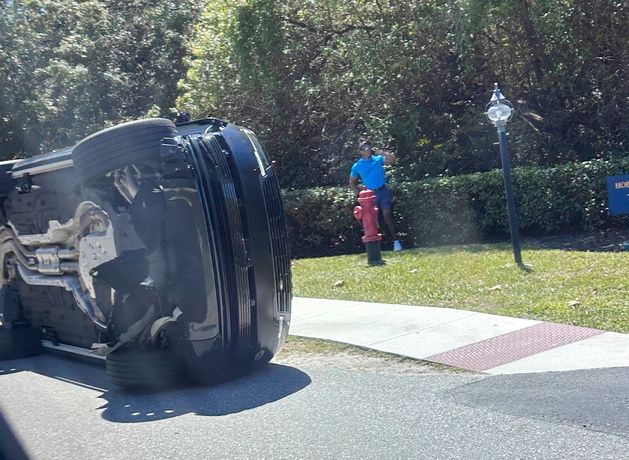
Tiger Woods has been charged with driving under the influence after being involved in a car crash in Florida, police have confirmed.
The 15-time major winner was taken to jail after rolling his vehicle attempting to overtake another that was towing a trailer.
Woods, 50, crawled out of the passenger door before law enforcement officers arrived.
Woods walked away from the incident and did not appear injured but was questioned by police and later refused to submit to a urine test.
Sheriff John Budensiek from the Martin County Sheriff’s Office told reporters Woods had also been charged with property damage and refusal to submit to a lawful test.
Budensiek said: “The DUI investigators came to the scene and Mr Woods did exemplify signs of impairment.
“They did several tests on him. He did explain the injuries and surgeries that he’s had and we did take that into account, but they did so some in-depth roadside tests.
“When it was determined, he was placed under arrest and taken to the Martin County jail.
“At the Martin County jail, and even on scene, we were really not suspicious of alcohol being involved in this case and that proved to be true.
“Mr Woods did a breathalyser test with triple zeros, but when it came time for us to ask for a urinary analysis test, he refused and so he has been charged with DUI, property damage and refusal to submit to a lawful test.”
Budensiek added that Woods had been driving at “high speed” and his vehicle tipped on to its side and then “slid for a pretty decent space before he came to a stop”.
The speed limit on the road in question was 30mph.
When investigators arrived, Woods appeared “lethargic” at the scene and police believe he was “impaired on medication”.
He will be kept in jail for at least eight hours before being eligible for release on bond. The offences are not felonies.
The driver of the other vehicle was also unhurt.
Woods underwent emergency surgery after suffering multiple leg injuries following a serious car accident in California in February 2021.
He was sidelined for 15 months and his appearances since have been sporadic due to numerous other injury setbacks.
This latest accident comes after Woods returned to competitive action for the first time in over a year on the final night of play in the indoor TGL competition on Tuesday.
Woods had said afterwards that he hoped he would be fit enough to play at the US Masters next month.
Speaking to reporters elsewhere, United States president Donald Trump said: “I feel so badly. He’s got some difficulty. There was an accident. That’s all I know. He’s a very close friend of mine, he’s an amazing person, an amazing man.”
Under Florida law, he must remain in jail for at least eight hours before being released on bond.
It was the second time Woods has faced DUI charges, having been arrested in 2017 in Jupiter, Florida, later pleading guilty to reckless driving.
Woods was also involved in a serious car crash in February 2021, suffering severe leg fractures.
His injury history spans more than two decades and includes multiple back surgeries, ACL reconstruction, Achilles tendon ruptures and chronic knee issues, all of which have significantly limited his competitive schedule in recent years.
Woods had only just returned to competitive action, representing his Jupiter Links Golf Club in a TGL Finals match on Tuesday, his first appearance since missing the cut at the 2024 British Open.
He had not confirmed whether he planned to compete at this year's Masters, which starts on April 9 in Augusta.
Facts Only
Actor: Tiger Woods, law enforcement officers in Martin County, Florida
Event: Car crash resulting in charges of driving under the influence, property damage, and refusal to submit to a lawful test
Location: Florida
Time: Monday night
Executive Summary
Full Take
This incident raises concerns about Woods' health and wellbeing, given his extensive history of injuries and surgeries. Additionally, the fact that he was driving at "high speed" and appeared "lethargic" at the scene suggests that he may have been impaired by medication or other substances. It is worth noting that this is not Woods' first encounter with the law regarding DUI charges, which could have implications for his public image and career.
Patterns detected: ARC-0024 Ambiguity (The article does not specify the nature of the medications that Woods was taking at the time of the accident)
This incident highlights the need for a holistic approach to understanding the complexities surrounding athletes' health, wellbeing, and legal issues. It is important to consider not only the immediate consequences of such incidents but also their long-term impacts on the individual and those around them.
Question 1: What factors contributed to Woods' impairment during this incident?
Question 2: How will this latest accident affect Woods' competitive schedule in upcoming tournaments, including the US Masters?
Question 3: Given his history of injuries and surgeries, what steps can be taken to ensure Woods' safety and wellbeing moving forward?
Sentinel — Human
The article appears to be human-written, as indicated by varied sentence lengths, a personal tone, and lack of fabricated information.