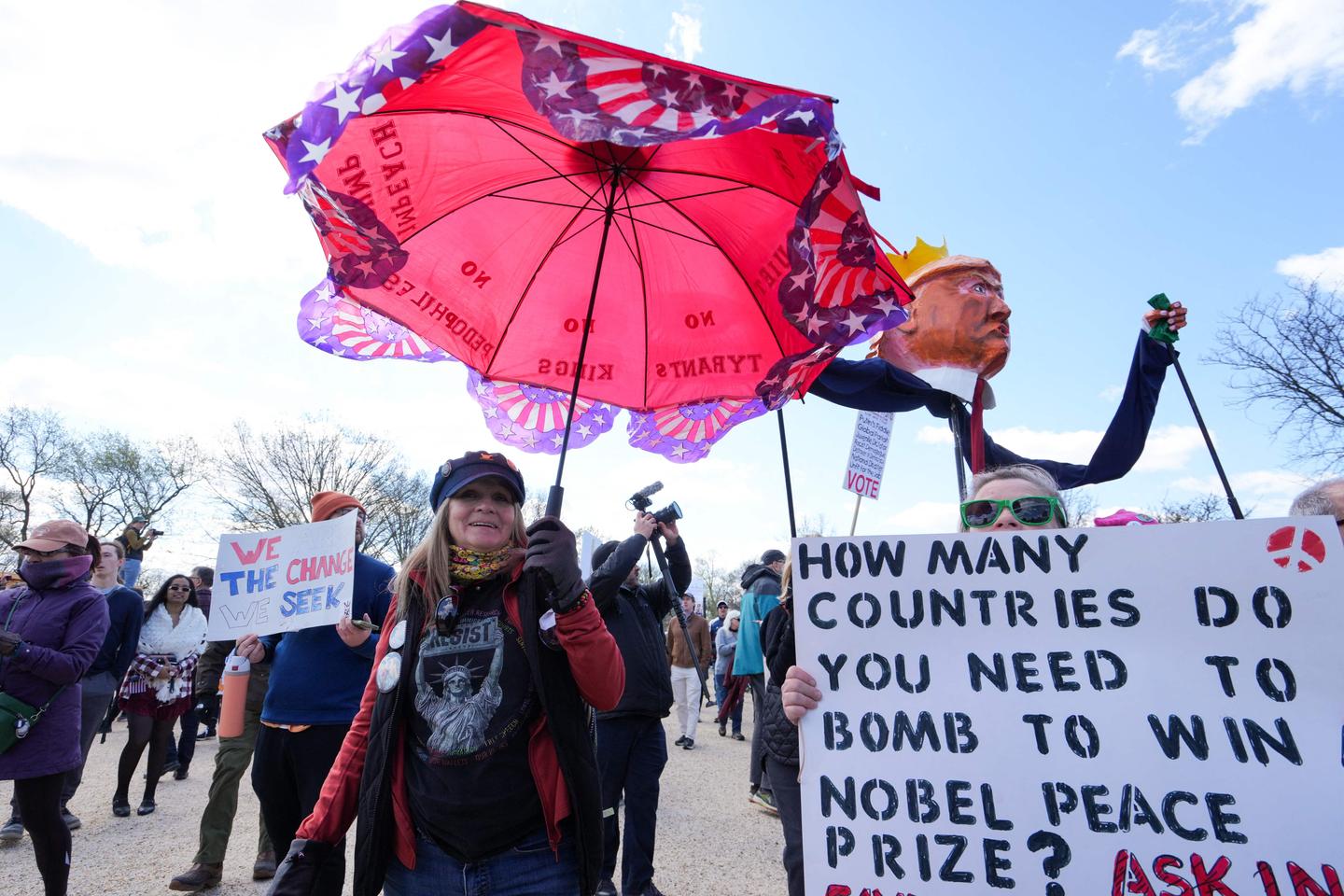
Massive protests against President Donald Trump began Saturday, March 28 across the United States and beyond, as millions of people vent fury over what they see as his authoritarian bent and other forms of cruel, law-trampling governance.
It is the third time in less than a year that Americans have taken to the streets as part of a grassroots movement called "No Kings," the most vocal and visual conduit for opposition to Trump since he began his second term in January 2025.
Now they have something new to fume over – the war against Iran that Trump launched alongside Israel, with ever-shifting goals and timelines for completion. The anti-Trump mood has spilled beyond US borders, with rallies Saturday in European cities including Amsterdam, Madrid and Rome.
US protests began in several cities including Atlanta, where thousands of people gathered in a park to decry authoritarianism. One man at the rally held a sign that read: "We Are Losing Our Democracy."
In the Michigan town of West Bloomfield, near Detroit, people braved below-freezing temperatures to protest. And in the capital Washington, marchers – including people with banners that blared "Trump Must Go Now!" and "Fight Fascism" – walked across a bridge over the Potomac River to the Lincoln Memorial, site of historic civil rights demonstrations of years past.
Record numbers expected
The first "No Kings" nationwide protest day came last June on Trump's 79th birthday and coincided with a military parade he organized in Washington. Several million people turned out, from New York to San Francisco. The second such protest, in October, drew an estimated seven million protesters, according to organizers.
The goal now is to bring out even more people Saturday, as Trump's approval rating sinks below 40% and midterm elections loom in November, when Trump's Republicans could lose control of both chambers of Congress.
Just as Trump is worshipped by many in his "Make America Great Again" (MAGA) movement, he is disliked with equal passion on the other side of America's wide political chasm. Foes bemoan his penchant for ruling by executive decree, his use of the Justice Department to prosecute opponents, his apparent obsession with fossil fuels and climate change denial.
They also dislike his gutting of racial and gender diversity programs, and his taste for flexing US military power after campaigning as a man of peace.
"Since the last time we marched, this administration has dragged us deeper into war," said Naveed Shah of Common Defense, a veterans association connected to the "No Kings" movement. "At home, we've watched citizens killed in the streets by militarized forces. We've seen families torn apart and immigrant communities targeted. All of it done in the name of one man trying to rule like a king."
Springsteen in Minneapolis
Organizers say more than 3,000 rallies are planned, in major cities and in suburbs and rural areas – even in the Alaskan town of Kotzebue, above the Arctic circle. Minnesota is a key focal point, months after becoming ground zero for the national debate over Trump's violent immigration crackdown.
Legendary rocker Bruce Springsteen, a fierce critic of the president, is scheduled to perform his song "Streets of Minneapolis" in the twin city of St. Paul, the capital of the northern state. Springsteen wrote and recorded the protest ballad in just 24 hours in memory of Renee Good and Alex Pretti, two US citizens shot dead by federal agents during January protests against Trump's immigration offensive.
What began in 2025 as a simple day of defiance has mushroomed into a "No Kings" movement of national resistance to Trump. Organizers say two-thirds of those who plan to rally Saturday do not live in big cities, which in America are often Democratic strongholds – a data point that is up sharply since the last protest.
Facts Only
Massive protests against President Donald Trump occurred on March 28, 2025, across the U.S. and in European cities like Amsterdam, Madrid, and Rome.
The protests are part of the "No Kings" movement, the third such demonstration in less than a year.
Previous protests took place in June 2024 (Trump’s 79th birthday) and October 2024, drawing millions of participants.
The March 28 protests focus on Trump’s war against Iran, launched with Israel, and domestic policies perceived as authoritarian.
Protests occurred in Atlanta, Washington D.C. (including a march to the Lincoln Memorial), and West Bloomfield, Michigan.
Organizers claim over 3,000 rallies are planned, including in rural areas like Kotzebue, Alaska.
Bruce Springsteen performed a protest song in St. Paul, Minnesota, honoring two citizens killed by federal agents during January 2025 immigration protests.
Trump’s approval rating is below 40%, with midterm elections scheduled for November 2025.
The "No Kings" movement criticizes Trump’s use of executive decrees, prosecution of opponents, climate policies, and military interventions.
Protesters accuse Trump of gutting racial and gender diversity programs and targeting immigrant communities.
The movement began in 2025 and has grown to include participants from non-urban areas, a shift from earlier protests.
Naveed Shah of Common Defense, a veterans group, stated the administration has deepened military involvement and domestic repression.
Executive Summary
Massive protests erupted across the United States and parts of Europe on March 28, 2025, as millions demonstrated against President Donald Trump’s administration, which critics accuse of authoritarianism and law-trampling governance. The protests, organized under the "No Kings" movement, mark the third major demonstration in less than a year, with previous rallies in June and October 2024 drawing millions. The latest wave of dissent is fueled by Trump’s military campaign against Iran, launched alongside Israel, as well as domestic policies perceived as oppressive, including immigration crackdowns and the use of militarized forces against civilians. Protests occurred in cities like Atlanta, Washington D.C., and West Bloomfield, Michigan, with international solidarity rallies in Amsterdam, Madrid, and Rome. Organizers claim over 3,000 events are planned, including in rural areas, signaling broad opposition beyond traditional Democratic strongholds. The movement’s momentum coincides with Trump’s declining approval ratings and upcoming midterm elections, where Republicans risk losing control of Congress. High-profile figures like Bruce Springsteen have joined the cause, performing protest songs in Minnesota, a state central to debates over Trump’s immigration policies.
The "No Kings" movement frames its resistance around Trump’s executive overreach, climate denial, and erosion of diversity programs, contrasting sharply with his base’s unwavering support. While the protests reflect deep political polarization, their scale and geographic diversity suggest a growing, decentralized opposition. The movement’s evolution from a single day of defiance to a sustained campaign underscores the intensity of public discontent, though its long-term impact remains uncertain.
Full Take
The strongest version of this narrative presents a compelling case for widespread, grassroots resistance to an administration perceived as increasingly authoritarian. The "No Kings" movement is framed as a principled, decentralized response to Trump’s policies, with credible evidence of its scale—millions of participants, international solidarity, and high-profile endorsements like Springsteen’s. The movement’s evolution from sporadic protests to a sustained campaign suggests genuine public alarm, not merely partisan opposition. The inclusion of rural and suburban participants, traditionally less active in such demonstrations, adds weight to the claim of broad discontent.
However, the narrative also employs patterns of emotional exploitation and potential distortion. The phrase "cruel, law-trampling governance" is a value-laden framing that could be seen as rage bait, designed to provoke moral outrage rather than foster nuanced debate. The claim that Trump is ruling "like a king" invokes a strawman—exaggerating his actions to fit a preconceived authoritarian archetype. While the protests are real, the language risks conflating policy disagreements with existential threats to democracy, a tactic that can polarize rather than clarify. The focus on Trump’s "obsession with fossil fuels" and "climate change denial" may oversimplify complex policy trade-offs, though these are legitimate points of contention.
Rooted in America’s deep political divide, this narrative echoes historical patterns of populist backlash against perceived executive overreach, from the anti-Vietnam War movement to the Tea Party. The unstated assumption is that Trump’s presidency represents an aberration rather than a symptom of systemic dysfunction—a framing that may obscure deeper structural issues. The movement’s reliance on moral urgency ("Fight Fascism") could inadvertently mirror the very tribalism it seeks to combat.
The implications for human agency are significant: mass mobilization can pressure institutions, but it also risks entrenching polarization. The beneficiaries of this narrative are likely opposition groups and media outlets amplifying dissent, while the costs fall on those seeking compromise or nuanced policy solutions. Second-order consequences could include further erosion of trust in government, regardless of the protest’s immediate goals.
Bridge questions: What policy alternatives does the "No Kings" movement propose beyond opposition? How might Trump’s supporters interpret these protests differently, and what valid concerns might they raise? Would the movement’s energy persist under a different administration, or is it uniquely tied to Trump’s persona?
Counterstrike scan: If this were a coordinated influence campaign, the playbook would involve amplifying emotional triggers (e.g., "losing our democracy"), leveraging celebrity endorsements for credibility, and framing the opposition as a moral crusade to suppress dissenting views. The actual content aligns with this pattern in its rhetorical intensity but stops short of outright manipulation—it presents verifiable events and quotes, even if selectively framed. The risk lies in the potential for such narratives to escalate rather than resolve conflict.
Patterns detected: ARC-0043 Motte-and-Bailey (invoking "fascism" as an extreme claim while retreating to policy critiques), ARC-0024 Ambiguity (vague terms like "law-trampling governance" open to interpretation).