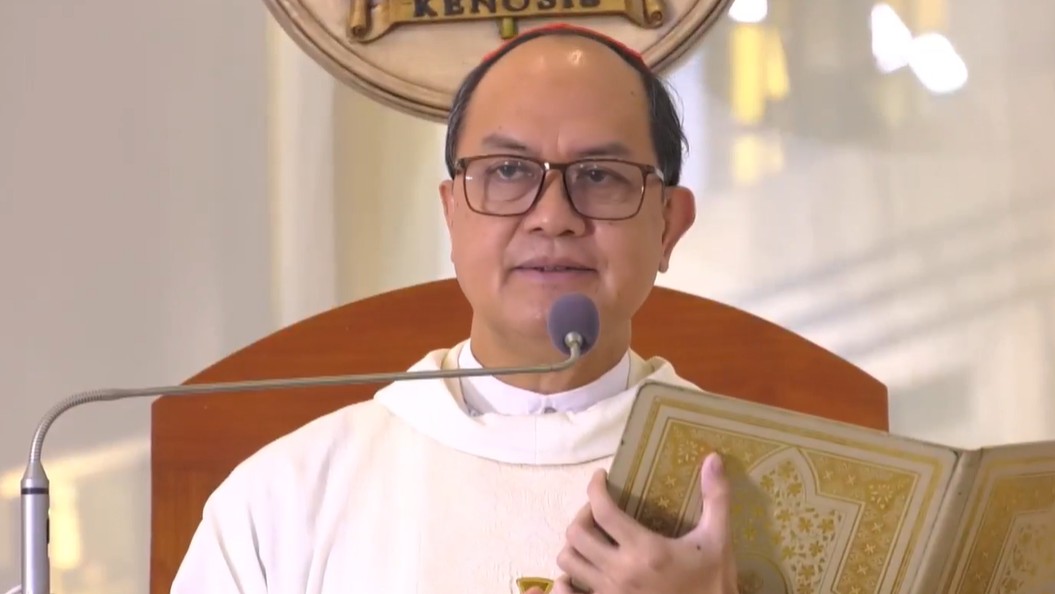
Kalookan Bishop Pablo Virgilio Cardinal David called on the faithful to pray for peace in the Middle East, as they spend time in adoration before the Blessed Sacrament on Maundy Thursday.
David made the call during the Transfer of the Blessed Sacrament from the main altar to the Altar of Repose, following the Mass of the Last Supper at the San Roque Cathedral Parish in Caloocan City.
“Sa ating pagtatanod sa gabing ito, dumulog tayo sa Kanyang awa at habag. Sa natatanging paraan, maglaan tayo ng sandali ng tahimik na panalangin para sa kasalukuyang krisis sa Gitnang Silangan at sa iba pang bahagi ng mundo na kararanas ng lagim ng digmaan,” David said.
(As we keep vigil tonight, let us turn to His mercy and compassion. In a special way, let us take a moment of solemn prayer for the current crisis in the Middle East and for other parts of the world experiencing the terrors of war.)
“Hilingin natin sa Panginoong Hesus Kristo na gisingin ang mga konsensya ng mga namumuno na kalingain ang mga sibilyang babalot ng takot at hilumin ang mga sugat na dulot ng paglalabanan. Matugunan nawa ang mga daing ng mga nagdurusa at mamayani na rin ang kapayapaan sa buong daigdig,” he added.
(Let us ask the Lord Jesus Christ to awaken the conscience of world leaders to care for the affected civilians who are in fear and to heal their wounds caused by the conflict. May the cries of the suffering be answered, and may peace prevail throughout the world.)
Over 3,000 people have reportedly been killed in the ongoing Middle East conflict, which began when the United States and Israel launched coordinated strikes against Iran on February?28.
After the Mass of the Lord’s Supper, the Blessed Sacrament is removed from the tabernacle and placed on an altar at one side of the church, marking the traditional beginning of the Visita Iglesia.
During this time, the faithful are invited to remain in the church and keep vigil for an hour, from 6 p.m. during the Mass of the Lord’s Supper, until 12 a.m. at the seventh church.
Love, serve the marginalized, enemy
During the Mass of the Last Supper in the same church, Cotabato Archbishop Emeritus Orlando Quevedo urged Catholics to serve the poor and sick and to pray for one’s enemies.
Citing the account of Jesus Christ washing the feet of the apostles, Quevedo said that the Lord gave a commandment to love one another, which must be demonstrated in concrete actions.
“To love one another is to serve one another,” Quvedo said during his homily. “To serve one another is to help one another in the common journey to the kingdom. That's the utmost meaning, depth of serving.”
"You serve even those who do not know you, whom you do not know, who might consider themselves your enemies. Because Jesus himself said, 'Love your enemies, pray for those who hate you, pray for those who persecute you.' The deepest kind of love would be to love one's enemy," he added.
This year, members of the San Roque Parish Pastoral Council executive committee and Parish Finance Council participated in the reenactment of the washing of the feet.
Commemorating Jesus Christ’s meal with his disciples before his suffering, death, and resurrection, the Catholic Church observed the evening Mass of the Lord’s Supper on Maundy Thursday. —RF, GMA News
Facts Only
Kalookan Bishop Pablo Virgilio Cardinal David made a call to prayer for peace in the Middle East on Maundy Thursday.
Over 3,000 people have been reportedly killed in the ongoing Middle East conflict.
The conflict began when the United States and Israel launched coordinated strikes against Iran on February 28.
The event took place at San Roque Cathedral Parish in Caloocan City, Philippines.
Archbishop Emeritus Orlando Quevedo urged Catholics to serve the poor and sick and pray for enemies during the same Mass of the Last Supper.
Executive Summary
Full Take
Patterns detected: ARC-0043 Motte-and-Bailey, ARC-0024 Ambiguity
The article presents a narrative of religious leaders calling for peace in the Middle East during Maundy Thursday Mass. However, it is important to acknowledge the complexity of such situations and recognize that while religious leaders can play a role in advocating for peace, their influence may be limited. The article does not provide context about the underlying causes of the conflict or discuss potential solutions beyond prayer.
The "Motte-and-Bailey" pattern is evident as the article focuses on the call for peace as the main point (the bailey), while the actual conflict and its intricacies (the motte) are only briefly mentioned. The ambiguity lies in not fully explaining the nature of the conflict or the role of world leaders in causing or alleviating it.
In terms of root cause, the article does not explicitly address this but implies a desire for peace rooted in religious beliefs and moral values. However, a more comprehensive analysis would consider geopolitical factors, historical tensions, and other influences that contribute to the ongoing conflict.
The implications of this narrative are that it emphasizes the need for compassion and prayer during times of crisis, but does not provide concrete actions or solutions to address the underlying issues causing suffering in the Middle East. It is essential for readers to question whose interests are being served by such narratives and consider alternative perspectives that may offer more effective paths toward peace.
Bridge questions:
What factors contribute to the ongoing conflict in the Middle East, and how can these be addressed?
How does prayer and religious leadership play a role in promoting peace in times of crisis?
Are there other actions or solutions beyond prayer that can help alleviate suffering in the region?