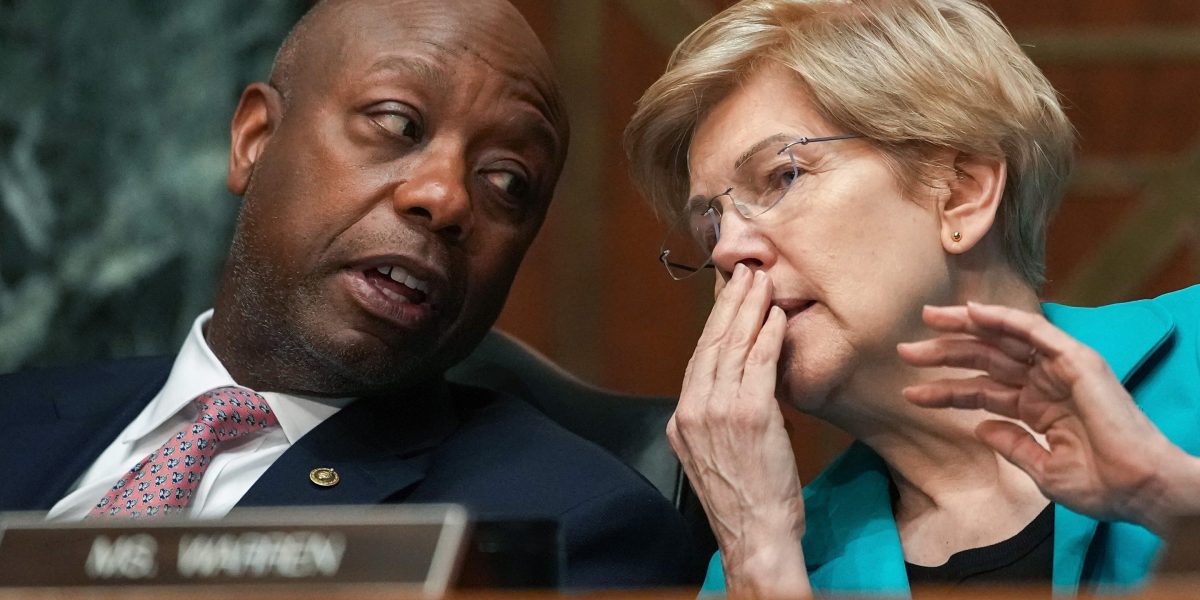
The Clarity Act, a landmark bill that would create a U.S. regulatory framework for the crypto industry, is set to undergo a Senate committee markup starting Thursday. The prospect of its passage has buoyed investors, but significant obstacles remain before the bill is ready for Congress to send to President Trump’s desk.
Clarity, short for Digital Asset Market Clarity Act, passed the House of Representatives last year but has faced setbacks in the Senate Banking Committee as banks and stablecoin companies squabble over the question of how and when rewards can be paid on stablecoin balances. Now, as Senators convene to introduce amendments, Democrats are pushing for ethics guardrails related to the Trump family’s crypto involvement.
Members of the Senate Banking committee have filed over 130 proposed amendments ahead of Thursday’s markup, with 44 coming from Sen. Elizabeth Warren (D-Mass.) alone, according to a copy of the proposed amendments reviewed by Fortune.
While some of the proposed amendments are minor, others seek to advance the position of opponents to the bill, which include banking interests who fear stablecoins could denude bank deposits, and those who fear crypto’s expansion is fraught with ethical and national security implications.
“I think it’s going to pass, based on all the great progress that has been made on both sides of Congress, and the support this bill is getting from the White House,” Steve Yelderman, general counsel of Ethereum-focused advocacy organization Etherealize, told Fortune. “That said, it’s Washington, and anything could happen.”
Clarity nearly reached a Senate Banking markup earlier this year before Coinbase pulled its support from the bill over a proposed ban on stablecoin rewards. Sens. Thom Tillis (R-N.C.) and Angela Alsobrooks (D-Md.) have since reached a deal on stablecoin yield, but bank lobbying groups are now grousing that the compromise is too friendly to stablecoin companies. Members of the American Bankers Association have reportedly sent more than 8,000 letters to Senate offices criticizing the yield compromise.
In tomorrow’s markup, Senate Banking Committee Chairman Tim Scott (R-S.C.) is expected to highlight protecting “Main Street” and national security while keeping crypto innovation in the U.S. as Clarity’s major goals, a Senate aide told Fortune. Democrats are expected to zero in on ethical concerns related to President Trump’s many crypto entanglements, a different Senate aide said.
“There are growing concerns amongst Democrats that if ethics is not included in the bill that is marked up in the Banking Committee, it will not be included at all,” the staffer said, adding that Democrats are focused on addressing the Trump family’s profiting off of crypto in market structure legislation. Republicans and Democrats have met multiple times this week to address adding ethics into Clarity.
As things stand, the bill has a good chance of making it to the Senate floor. Sen. John Kennedy (R-La.), a key Republican Clarity holdout on the Banking Committee, told Semafor that he plans to support the bill. But as time ticks down toward summer recess and the midterm elections, the Clarity Act still has an uncomfortably thin margin for error. Traders on Polymarket have grown less optimistic on the Clarity Act’s chances throughout the week. The prediction market now gives the bill a 60% chance of passing this year.
Facts Only
* The Clarity Act is set to undergo a Senate committee markup starting Thursday.
* The bill seeks to create a U.S. regulatory framework for the crypto industry.
* The process has faced setbacks in the Senate Banking Committee due to squabbles over paying rewards on stablecoin balances.
* Democrats are pushing for ethics guardrails related to the Trump family’s crypto involvement.
* Members of the Senate Banking committee have filed over 130 proposed amendments.
* Banking interests fear stablecoins could denude bank deposits.
* Some amendments seek to advance the position of opponents, including banking interests and those fearing ethical/national security implications.
* A compromise was reached on stablecoin yield between Senators Thom Tillis and Angela Alsobrooks.
* The bill is expected to focus on protecting "Main Street" and national security while keeping crypto innovation in the U.S.
* Traders on Polymarket predict a 60% chance of the bill passing this year.
Executive Summary
The Clarity Act, a bill designed to establish a U.S. regulatory framework for the crypto industry, is currently proceeding through the Senate Banking Committee markup. The process has been complicated by disputes between banks and stablecoin companies regarding how rewards can be paid on stablecoin balances. Political dynamics are also influencing the process, with Democrats advocating for ethics guardrails concerning the Trump family’s crypto involvement.
Senate Banking Committee members have introduced over 130 proposed amendments, including 44 from Senator Elizabeth Warren. These amendments reflect divergent interests, ranging from banking fears that stablecoins could devalue deposits to concerns over the ethical and national security implications of crypto expansion.
A key point of contention arose when Coinbase pulled support for the bill over a proposed ban on stablecoin rewards. While a compromise was reached regarding stablecoin yield between Senators Tillis and Alsobrooks, this deal generated criticism from banking groups. The bill is expected to focus on protecting "Main Street" and national security while maintaining crypto innovation, but the inclusion of ethical considerations related to political figures remains a central political battle. Current market predictions indicate a 60% chance of the Act passing this year, though uncertainty remains regarding the final outcome.
Full Take
The negotiation over the Clarity Act illustrates a fundamental tension between regulatory necessity, economic stability, and political identity. The core conflict is not merely about finance or technology, but about whose values should define the boundaries of a novel market. Banking interests frame the debate through a lens of systemic risk—fear that stablecoins will destabilize deposits—which serves as a powerful moral panic. Conversely, political actors frame the debate around ethical accountability, particularly concerning the Trump family’s involvement, attempting to insert political identity into what is intended to be a technical legislative framework.
The pattern observed is the use of the process of regulation (the Clarity Act) as a vehicle to address deeper, often conflicting, socio-political and economic anxieties. Opposition groups employ moral and security concerns to halt innovation, while proponents attempt to frame the legislation around national security and economic protection of established institutions. This dynamic highlights how complex issues are managed not through pure logic, but through the strategic insertion of emotional and ethical arguments into legislative processes.
The implication is that the success of the Clarity Act hinges less on the technical details of crypto regulation and more on which ideological priorities—market freedom, institutional safety, or ethical oversight—are prioritized by the stakeholders engaged in the markup. This struggle demonstrates that legislative outcomes are frequently determined by the successful mobilization of opposing moral narratives rather than purely objective economic analysis.
Sentinel — Human
The text exhibits the granular detail and complex socio-political context typical of high-quality journalistic reporting, making it highly likely to be human-written.