Thank you for visiting nature.com. You are using a browser version with limited support for CSS. To obtain
the best experience, we recommend you use a more up to date browser (or turn off compatibility mode in
Internet Explorer). In the meantime, to ensure continued support, we are displaying the site without styles
and JavaScript.
Cancer Research UK bets on Manchester with £6-million funding boost
The investment provides a ‘special opportunity’ to establish the Cancer Research UK Manchester Institute as a world leader in emerging oncology therapies.
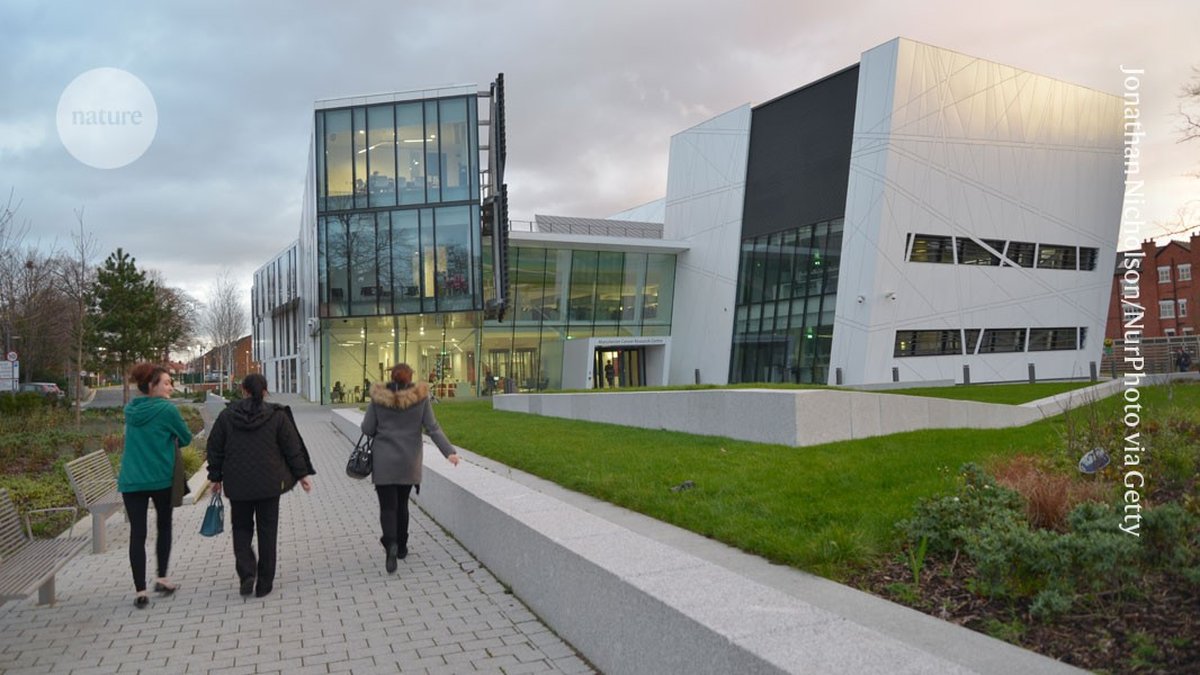
Cancer Research UK (CRUK) is set to boost annual investment for its Manchester cancer-research institute by more than 50% — from £11 million (US$14.5 million) to more than £17 million — in a move that will increase research capacity, ensure long-term competitiveness and attract talent, according to Samra Turajlić, director of the CRUK Manchester Institute, UK.
The investment will generate up to 100 new research jobs at the Manchester Institute, which is part of the University of Manchester, including 8 senior scientists who will work across areas such as artificial intelligence, computational biology and immunology. Two clinician-scientist positions will also be created at the Christie NHS Foundation Trust as part of the funding package.
The extra funding is also expected to strengthen the institute’s AI and computational research. For Magnus Rattray, a computational and systems biologist at the University of Manchester, the timing is significant: the Christie has extensive clinical data and advances in AI are creating fresh ways to analyse them. “It’s going to be transformational all the way from prevention through to early detection, treatment in the clinic and designing the best possible treatment programmes,” he says.
Immunology will also be another area of focus. Turajlić says Manchester has “a very special opportunity” to build the field, which remains underdeveloped in the United Kingdom. Although there are established cancer-immunology centres in the country, including Southampton’s Centre for Cancer Immunology, she argues that the United Kingdom lacks a coordinated hub similar to that proposed for Manchester. By combining the institute’s developing research base with the university’s pre-existing immunology expertise and the Christie’s clinical reach, Turajlić says, Manchester will emerge as a world leader in cancer immunotherapy.
Beyond the ‘golden triangle’
The move highlights the growing importance of regional research hubs in the UK’s cancer-research ecosystem, in which a large proportion of research funding goes to the universities and institutions in the Oxford, Cambridge and London regions, often referred to as the golden triangle. The increased funding for the Manchester Institute is substantial, but it is well below the £31.5 million that CRUK awarded in the 2024–25 financial year to the Institute of Cancer Research in London.
These numbers call attention to a wider debate about whether the United Kingdom can develop research capacity beyond its conventional powerhouses and compete on a global stage. The budgets of Europe’s largest stand-alone cancer centres can run into the hundreds of millions of euros — the German Cancer Research Center (DKFZ) in Heidelberg has a €515 million (US$586 million) annual budget and France’s Gustave Roussy has a €592 million annual budget. A UK House of Commons Science, Innovation and Technology Committee report published in March warned that despite the country’s world-class research hubs, there remains “untapped potential for innovation-driven activity across the regions”.
Enjoying our latest content?
Log in or create an account to continue
Access the most recent journalism from Nature's award-winning team
Explore the latest features & opinion covering groundbreaking research
Sentinel — Human
This text functions as a typical human-written journalistic report, synthesizing specific institutional funding details with a wider commentary on UK regional research equity.