Listen to this essay
21 minute listen
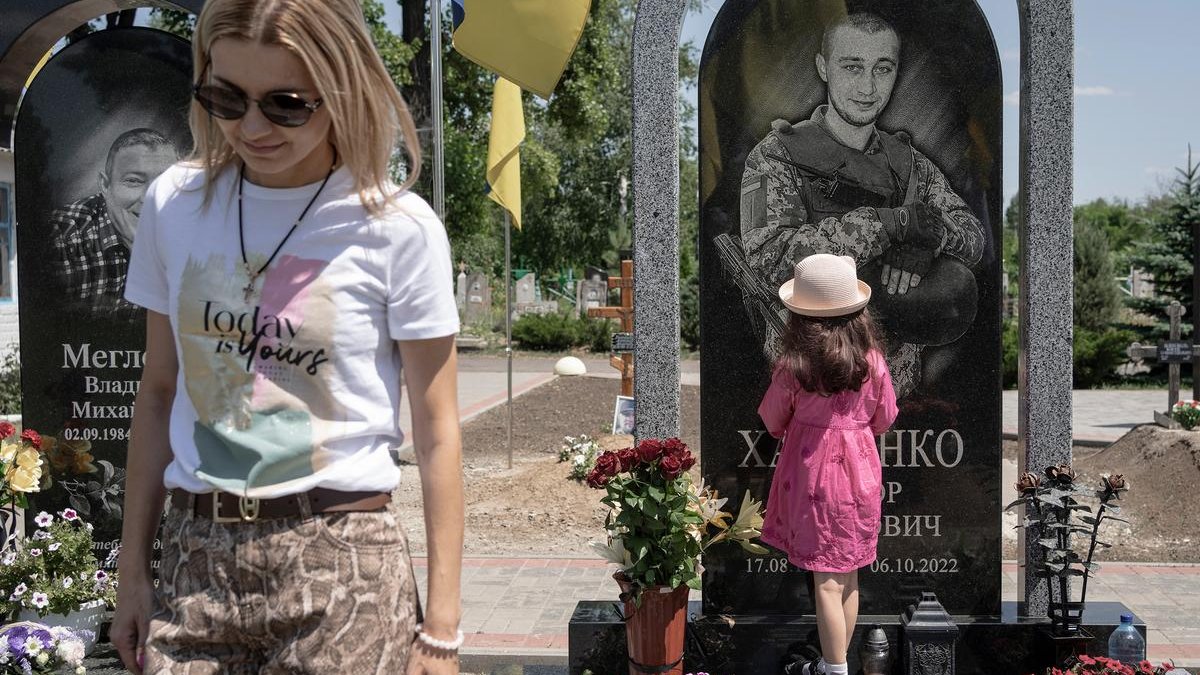
‘I died along with him in Huliaipole.’ This is how Tetiana Vatsenko-Bondareva, a Ukrainian widow, describes the day her husband was killed on the battlefield. ‘At first, you don’t understand anything – just an abyss, no time, no space, nothing at all. There is just some kind of existence,’ explained another war widow, Oleksandra Kolestyk.
I first heard these words as figures of speech, the language of grief stretching beyond the limits of ordinary expression. Little did I know how thoroughly the widows’ voices would change this perception, how their words would tear me apart, turn my world upside down and undermine everything I thought I knew about myself, society and existence.
Since the start of Russia’s full-scale invasion, I have been speaking with Ukrainian widows and collecting their testimonies. It was an attempt to be of some use: to listen and bear witness to stories of loss, suffering and the trauma of war. Looking back now, I see the fiction I was living inside. I imagined myself as someone who helps, the one who does the decent thing. It is still uncomfortable to recognise how naive that posture was. Without admitting it to myself, I had placed myself in the larger position, the one who remains intact while others speak from devastation.
As I stayed with the widows and their stories, that imagined position began to loosen, then collapse. The contrast between us reversed itself: my attempt to help shrank to something pitiful, while the widows turned out to be immense, larger than the world I had brought with me. The place from which I had been listening gave way beneath me. I was no longer the one who understood, who accompanied, who could offer anything. I became small in the face of what they carried – the knowledge that death is inseparable from love, that love risks literal dying, that trauma does not distort reality but exposes it. To hear them is to be dismantled by what they know.
Partly as a result of my own depression and partly because I’m a philosopher, I already understood our society as therapeutic; it operates by stigmatising and diminishing the negative aspects of existence while normalising the positive and imposing it as the only legitimate state of being. This commonsense, thoroughly psychologised outlook casts trauma or depression as deviations from how we are meant to be – happy and positive, radiating wellbeing. Even compassion becomes problematic in this context since it arrives not as genuine recognition but as a gentle pressure to return to the norm – the sympathetic hand on the shoulder that already contains, within it, the assumption that you will recover, that you should recover, that the goal is recovery.
Widows and others who carry the trauma of lost love appear, within this framework, as psychologically damaged, in need of diagnosis and compassion to help them return to the norm. Meanwhile, those on the other side of trauma take it upon themselves to bring them back. As one widow put it: ‘Everyone expresses condolences – but no one wants to simply listen.’ Instead, what arrives are well-worn scripts to get over it: ‘You still have your life ahead of you,’ ‘You’ll meet someone else,’ ‘Stop grieving, life goes on.’ Alongside these responses, there is also a turning away. As Vatsenko-Bondareva puts it: ‘Society tries not to see us, as if afraid of being infected by our pain.’
If the traumatised are seen to report the truth, the whole order of truth and distortion reverses
We remain largely immune to their desperation because, when trauma speaks, when depression talks, we assume that’s not the real, happy you. You are presumed to be exaggerating, misreporting your own experience. Even when we do listen in therapeutic settings, the aim is to target the inadequacy, the disturbance that must eventually disappear: the insanity, the excessive horror that must be spoken out until it fades away, like a devil expelled from the body, with the holy water of therapy driving it out.
But what if we allowed the voice of trauma to disclose what it alone can? If the traumatised are seen to report the truth, then the therapeutic apparatus, with its classifications and its protocols of healing, becomes not the path to clarity but the thing that obscures it. The whole order of truth and distortion reverses.
Once the widow is placed at the centre of the picture, she is no longer a deviation from how a human life should unfold. She becomes someone who reveals the hidden structure of existence itself. From that point onward, the world appears altered: less protected, less coherent, and much darker than before.
My encounters with Ukrainian widows revealed what I had previously dismissed as rhetorical: the possibility of dying while still alive. A human being can remain standing, breathing, speaking, while something essential in them has already perished. What remains in place of the intact self moving forward through grief is a body surviving the destruction of the person who once inhabited it.
Vatsenko-Bondareva’s statement about her own death on the day her husband was killed echoes through many widows’ testimonies. Again and again, one hears the same formulation: ‘I died that day.’ And yet the statement continues to resist comprehension as a factual claim.
If taken literally, it unsettles a long philosophical understanding that the self endures for as long as biological life continues. It may suffer damage, even severe damage, yet the core of the person remains somewhere underneath the distortions. The self is assumed to be coherent, its life capable of being told as a continuous story. This assumes that we remain, in some essential sense, the same person over time: that our past memories, present awareness and imagined future belong to a single, unbroken narrative. Even when damaged, the true self is seen as fundamentally indestructible and waiting to be restored.
Yet this is not what the widows describe. When someone declares their own death while still alive, the possibility emerges that the self itself may be mortal. A person can remain biologically alive while the one who lived that life is already gone.
What if life and death are not opposing states, but conditions that can inhabit each other?
The widows speak of death while standing before us alive, breathing, capable of recounting the event. The testimony itself seems to contradict the assertion of death it describes. Yet the insistence of the claim gives it a disturbing weight. This strange coexistence destabilises the conventional meaning of both life and death.
What if life and death are not opposing states, where one replaces the other, but conditions that can inhabit each other? Death may occur within life. Living would then mean undergoing death while still alive, carrying it within existence rather than escaping it. It is from within this that the widows speak. One of them described her entire existence as chornyi bil – a black pain. Others speak of continuing to live through death itself.
Much of what we take for granted about grief, trauma and identity come through psychoanalysis, which asks how the mind absorbs loss, conflict and change. Sigmund Freud believed that, underneath trauma, one could discover a self capable of repair. But the French philosopher Catherine Malabou argues that trauma sometimes undoes the self altogether. She calls this destructive plasticity: a form of change that does not merely reshape a person’s identity, but destroys it and forces something new to emerge in its place. What appears on the other side is a different self, formed in rupture. In Ontology of the Accident (2009), Malabou names those shaped by such ruptures the ‘living dead’. The widows named themselves that first.
The widows reveal something about the rest of us, too. We are each, in a sense, already among the living dead. Life does not move toward death as toward a distant event; it unfolds through it. Death does not arrive one day; it takes place in stages, threaded through the whole of existence. It marks both the direction in which we move and the condition under which everything we have remains exposed to loss.
What emerges just as strikingly is the entanglement of love and death. In Rivne, the young widow Maryana Yupatkina continues to go on dates with her partner. She walks to the central square, to the memorial where his portrait stands among others. She brings two coffees. One for herself, and one for Nazar, who was killed at 23. They last saw each other there, in that same city centre, drinking coffee together. Nothing in this gesture suggests that their relationship has ended. It has just shifted into another form that includes death within it. If anything, his absence seems to hold him there even more insistently. He can no longer leave, no longer be lost in any ordinary way.
Love carries a radical risk. To attach oneself to another is to entrust one’s life to that connection
Love persists as memory and as ritual: an appointment that death has interrupted without cancelling. The same persistence appears in smaller, almost absurdly ordinary moments. Olga Slyshyk describes standing in her kitchen, unable to open a tin can, crying out in frustration: ‘Misha, I’m not even able to do this’ – and then, suddenly, it opens. The dead beloved remains woven into the practical texture of life, invoked not only in mourning rituals but in the most banal emergencies of domestic existence. And sometimes love projects itself beyond death in the other direction too, as a command handed down by the dying to the living: ‘Please promise me that no matter what happens to me, you will be happy.’ Even here, at the edge of catastrophe, love persists, and in persisting, it constitutes the life that remains.
This is why the death these widows describe cannot be understood as a purely private event, something sealed within the boundaries of one individual psyche. It unfolds in the space between two lives. The bond itself – the attachment, the shared routines, the mutual orientation through which each life took shape – becomes the site of destruction. The husband dies, and the world that joined them dies with him. In this sense, it can feel to widows as though their husbands have taken a part of them into death as well.
The self appears here as fragile and relational, formed through bonds with others. A life does not unfold in isolation, however much our cultural imagination prefers to picture it that way. Love therefore carries a radical risk. To attach oneself to another is to entrust one’s life to that connection.
This dismantles another fantasy, shared by Western philosophy and common sense, of an individual who is autonomous at her core, separate from others. Relationships may wound or damage, yet the inner self is assumed to remain intact somewhere beneath the surface, available to be restored.
Yet the widows stand as living evidence against the taken-for-granted solidity of the autonomous self. ‘Plans, ideas – everything was shared. And then – suddenly! – there is no person. So what is the point of anything?’ one widow asks. Such words reveal how deeply we live and die through each other. The radical idea is that the self does not precede its bonds but emerges from them. Interconnection forms the ground from which the self takes shape, while autonomy appears as a later mask that conceals this dependency.
Here we arrive at one final element of the widows’ impact – an understanding of trauma as a form of initiation rather than a distortion of reality. If we truly listen to widows, without reducing their words to symptoms, attending to what they say rather than to what we think must be corrected, trauma becomes a form of disclosure, revealing the inevitability of loss and the extent to which one life depends on another, so closely that it becomes unbearable. In this sense, trauma exposes what ordinarily remains concealed.
Oksana Borkun describes this transformation: ‘When this happens, the picture deepens, and you gain another experience of truth … You begin to see and feel much more. This opens a different path in life toward understanding the whole world.’ What comes into view here exceeds any one life and any personal tragedy; it opens onto a tragedy of the world, in which loss is built into existence. ‘I found myself filled with immense compassion in the wake of the loss,’ Borkun adds. It draws one into proximity to suffering beyond one’s own loss, a closeness to the tragedy of existence itself, compassion for the world.
The moment of trauma is a glimpse into the underside of reality from which ordinary existence is normally protected
When describing the very moment when the news of death arrived, widows often speak of the ground disappearing beneath them, what Olexandra Kolestyk called an abyss. No description seems capable of matching the event itself. Language falters here, yet the testimonies return again and again to the same sense of collapse of the world that once held together meaning. While such statements are easily heard as exaggerations, this way of hearing them may itself be a way of dismissing what they describe. It took many testimonies before I began to hear them differently.
I now understand the moment of trauma as a glimpse into the underside of reality from which ordinary existence is normally protected. In this sense, trauma can be thought of as an initiation, though not in the mystical sense of access to a hidden truth or privileged knowledge of reality. It is, rather, the opposite of such knowledge: an initiation into the point at which words lose their hold and meaning collapses.
To love is already to accept the possibility of losing. Marriage rituals capture this truth more clearly than philosophical theory often does. In the traditional wedding vow, two people symbolically hand their lives to one another. The gesture contains an implicit acknowledgment that love exposes each life to the mortality of the other.
The common advice that one should eventually overcome loss and move forward assumes that the self survives intact beneath the devastation. What widows embody instead is the possibility, even the certainty, that something may truly die with the beloved. Love, in this sense, involves the risk of dying several times across a lifetime. To love someone is to entrust part of one’s life to their mortality.
One widow said that what supports her existence after her husband’s death is living in a way that wouldn’t shame her in his eyes, nor faced with what his death stands for: ‘The best thing is to do good. So that when you wake up in the morning, you are not ashamed to look into your own eyes, or at your husband’s photograph on the wall.’ The dead remain, as memory, as a wound, and in the way life is carried on.
‘Time does not heal. You just get used to it. You accept it. And that pain just becomes a part of you’
Still, we often protect ourselves by treating such grief as a private tragedy and nothing more. Even when we recognise that the survivor of trauma has been profoundly altered, the experience remains contained within the boundaries of that individual tragedy. Listening to the widows, a catastrophe that first appears singular opens outward, no longer confined to the one who bears it. The loss of a beloved spreads beyond the life in which it occurs, touching something shared, something that runs through all lives. It exposes the condition under which existence unfolds. We have each other only temporarily, and each day brings us closer to losing one another. Loss is the underlying condition of connection, always lurking beneath every moment. It is what makes us precious to one another, what makes love possible at all.
We tend to imagine eternity in terms of bliss, while pain is treated as temporary. If taken seriously, the widows’ testimonies suggest a different experience of time, one in which pain persists, as if it were what touches eternity. Many insist that it will never disappear. ‘Time does not heal,’ Daria Mazur says. ‘You just get used to it. You accept it. You learn to live with it. And that pain just becomes a part of you.’ Another widow puts the same truth more bluntly: ‘This pain will never go away.’ These words do not describe grief as something to overcome. They describe it as something to be incorporated and carried. This suggests a different relation to pain than the therapeutic impulse to reduce or eliminate it. Pain becomes what one learns to live with, wearing the heart thin, extending it until it can carry its weight.
Taken together, the widows’ testimonies open onto death and loss as conditions of human life. To live is to move toward death, to love is to move toward loss. This is the underlying reality of both life and attachment, not an unfortunate outcome from which one might be spared.
The widows, therefore, glimpse something the rest of us remain protected from: the vulnerability of existence and the inevitability of loss. They have encountered what awaits everyone. Those who have not yet undergone such loss remain protected by the illusions that make ordinary life possible. Their turn has not yet come. The widows’ sacred knowledge therefore circulates through the world, waiting for the moment when each life, in its own time, will come to recognise it.