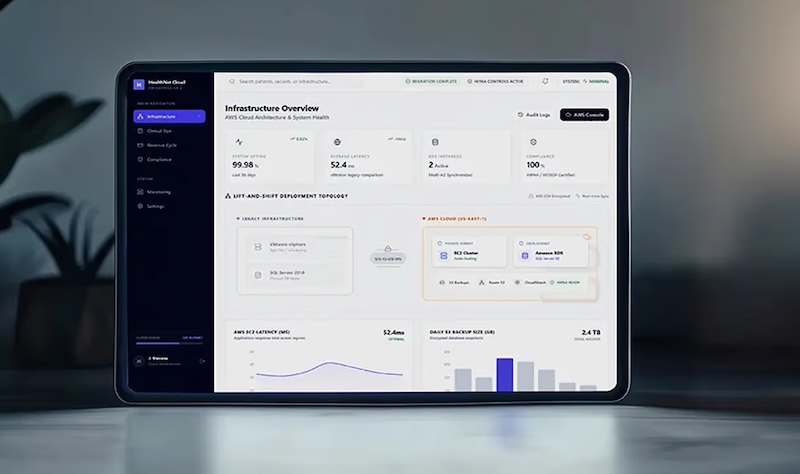
Many companies still depend on legacy systems for their work. But they were designed decades ago to support fixed workloads and on-premise environments.
These platforms once provided stability, but not anymore. Now they often limit scalability, innovation, and operational efficiency.
To overcome these challenges, businesses increasingly rely on cloud migration service providers. That’s how they receive professional guidance, when modernizing outdated infrastructure and transforming legacy applications into flexible, high-performance digital platforms.
Modernization isn’t simply about moving old systems into new hosting environments.
It’s a strategic process that changes how software is not only built, but also deployed, and scaled to support business demands, no matter how much they increase.
The Business Impact of Outdated Infrastructure
Legacy systems often require steady maintenance spending while offering progressively less flexibility. Applications respond more slowly, integrations become harder to implement, and software releases take longer than teams would like. Over time, what once felt stable begins to slow overall progress.
As infrastructure ages, technical debt builds in subtle ways. Routine updates demand more coordination, security patches take longer to deploy, and small issues can escalate into broader disruptions. IT departments gradually shift their focus from improvement to preservation.
These limitations restrict the ability to introduce automation, expand data capabilities, or roll out new digital services. Instead of supporting innovation, older environments tend to delay it.
In an environment where digital initiatives move quickly, infrastructure choices influence how efficiently organizations can adapt. Modernization becomes a practical step toward maintaining operational stability rather than simply pursuing change.
Modernization Strategies Enabled by Cloud Migration
When a company decides it is time to modernize, the first question is – where do we start and how? There is no universal answer for everyone.
Some systems move without much trouble. Others quickly show hidden problems.
An older monolithic application might run fine on dedicated hardware but struggle when expected to scale in dynamic.
The choice of strategy depends on practical factors.
- How many users rely on the system?
- How often does traffic spike?
- How tightly is it connected to other tools?
A public website works differently from an internal reporting solution, and the migration plan has to reflect that difference.
Modernization is actually not about following a fixed method. It’s about understanding what really works for every different case.
Rehosting and Replatforming for Immediate Gains
In some cases, the fastest step is simply to move the application as it is. The code stays mostly untouched. The environment changes. Instead of running on aging hardware, the system runs in the cloud and immediately benefits from more stable infrastructure.
Replatforming adds small adjustments along the way.
A database might be tuned. Storage might be reconfigured. Certain services are adapted so that the application performs better without rewriting it from scratch.
This option usually fits systems that still do their job but struggle under heavier traffic or rising maintenance costs. Rather than replacing them entirely, teams improve what already works and gain breathing room for future changes.
Refactoring for Cloud-Native Architecture
When modernizing old systems, breaking monolithic applications into microservices and containerized components is a good idea. The change enables, at the same time:
- faster development cycles
- improved system resilience
- easier updates
Cloud-native designs allow teams to work more efficiently. It allows them to scale individual services independently, optimize resource usage, and automate deployment pipelines. That dramatically improves operational agility.
Rebuilding Critical Business Applications
In cases where legacy software no longer meets operational requirements, rebuilding systems from the ground up delivers the highest long-term value.
When aiming for automation, performance monitoring, and future expansion- oriented platforms, cloud native structures are the most flexible choice.
Even if rebuilding requires a bigger upfront investment, it eliminates technical debt and creates flexibility, and allows the system to grow alongside the business.
How Modernized Cloud Environments Drive Business Growth
Modern infrastructure unlocks significant operational improvements. It grants faster deployment times, reduced downtime, and improved application reliability.
Automated scaling keeps system performance consistent during peak demand without wasting resources.
Cloud platforms also enable:
- advanced analytics
- real-time data processing
- seamless integration with digital services such as CRM systems, AI tools, and customer engagement platforms
That’s how decision-making becomes more adequate, and innovations across departments happen faster.
Additionally, modern systems lower long-term operational costs by reducing manual maintenance, simplifying updates, and minimizing unplanned outages.
Managing Risk During Legacy Transformation
Modernizing legacy systems involves change, and change needs control. Mapping dependencies before migration helps teams understand what might be affected.
Instead of replacing everything at once, systems are moved step by step. Each stage is checked before moving forward, which keeps core services stable.
Partnering for Successful Modernization
Legacy transformation changes more than infrastructure. System structure, security settings, and even daily workflows are affected.
When environments are complex, external support can make the process more manageable. A provider such as the leader Crunch-IS brings experience from similar transitions, from having worked with big companies. That’s how mistakes are avoided.
The focus is not on abstract goals, but on making systems stable, easier to support, and ready for future updates.
Facts Only
Many companies depend on legacy systems designed decades ago for fixed workloads and on-premise environments.
Legacy systems now limit scalability, innovation, and operational efficiency.
Businesses increasingly rely on cloud migration service providers for professional guidance in modernizing outdated infrastructure.
Modernization involves changing how software is built, deployed, and scaled to support business demands.
Legacy systems require steady maintenance spending while offering less flexibility over time.
Applications on legacy systems respond more slowly, integrations become harder, and software releases take longer.
Technical debt builds as routine updates demand more coordination, security patches take longer, and small issues escalate.
Modernization strategies include rehosting, replatforming, refactoring, and rebuilding systems.
Rehosting moves applications to the cloud without changing the code, benefiting from more stable infrastructure.
Replatforming involves small adjustments like database tuning or storage reconfiguration for better performance.
Refactoring breaks monolithic applications into microservices for faster development cycles and improved resilience.
Rebuilding systems from the ground up eliminates technical debt and provides long-term flexibility.
Modernized cloud environments enable faster deployment, reduced downtime, and improved reliability.
Cloud platforms support advanced analytics, real-time data processing, and seamless integration with digital services.
Modernization involves risks, requiring careful planning, dependency mapping, and step-by-step migration.
External support from experienced providers can help manage complex transitions.
Executive Summary
Many businesses rely on legacy systems designed decades ago for fixed workloads and on-premise environments. While these systems once provided stability, they now limit scalability, innovation, and operational efficiency. To address these challenges, companies are turning to cloud migration service providers for professional guidance in modernizing outdated infrastructure. Modernization is not just about moving old systems to new environments but involves a strategic process that changes how software is built, deployed, and scaled to meet business demands.
Legacy systems often require significant maintenance costs while offering less flexibility over time. They slow down application performance, complicate integrations, and delay software releases, shifting IT focus from improvement to preservation. Modernization strategies vary depending on the system's complexity and requirements. Options include rehosting (moving applications as-is to the cloud), replatforming (making small adjustments for better performance), refactoring (breaking monolithic applications into microservices), and rebuilding (creating new systems from scratch). Each approach offers different benefits, from immediate gains to long-term flexibility and reduced technical debt.
Modernized cloud environments enable faster deployment, reduced downtime, and improved reliability. They support advanced analytics, real-time data processing, and seamless integration with digital services, driving business growth and innovation. However, modernization involves risks, requiring careful planning, dependency mapping, and step-by-step migration to maintain stability. External support from experienced providers can help manage complex transitions, ensuring systems remain stable, supportable, and ready for future updates.
Full Take
The narrative presents a strong case for modernizing legacy systems, emphasizing the limitations of outdated infrastructure and the benefits of cloud migration. It rightly highlights the operational inefficiencies, rising maintenance costs, and innovation bottlenecks caused by aging systems. The discussion of modernization strategies—rehosting, replatforming, refactoring, and rebuilding—provides a practical framework for businesses to evaluate their options. The focus on cloud-native architectures and microservices aligns with contemporary best practices in software development, offering tangible benefits like scalability, resilience, and automation.
However, the narrative leans heavily on the assumption that cloud migration is the inevitable and optimal solution for all legacy systems. While the benefits are well-articulated, the potential downsides—such as vendor lock-in, security risks, or the complexity of managing hybrid environments—are not explored. The emphasis on external support from providers like Crunch-IS, while practical, could also be seen as a subtle endorsement of third-party dependencies. The piece does not delve into the cost-benefit analysis of modernization versus maintaining legacy systems in niche cases where stability and predictability are paramount.
Root Cause: The paradigm driving this narrative is the broader industry push toward digital transformation, where cloud adoption is often framed as a necessity rather than a choice. The unstated assumption is that all businesses must innovate continuously to remain competitive, which may not hold true for organizations with stable, low-volatility operations. Historically, this echoes the cyclical nature of technological disruption, where new paradigms are promoted as universal solutions, sometimes overlooking context-specific needs.
Implications: For human agency, this narrative empowers businesses to take control of their technological future but may also pressure them into costly transitions without sufficient justification. The beneficiaries are primarily cloud service providers and migration consultants, while the costs—financial, operational, and cultural—are borne by the businesses undergoing transformation. Second-order consequences could include increased reliance on external expertise, potential job displacement in IT departments, and the erosion of institutional knowledge tied to legacy systems.
Bridge Questions: What are the long-term costs of cloud dependency, and how do they compare to the benefits? Are there industries or use cases where legacy systems might still be the optimal choice? How can businesses ensure that modernization efforts align with their unique operational needs rather than industry hype?
Counterstrike Scan: If this narrative were part of a coordinated influence campaign, the playbook would involve framing cloud migration as an urgent necessity, downplaying alternatives, and leveraging authority figures (e.g., "leader Crunch-IS") to build credibility. The actual content aligns with this pattern to some extent but does not exhibit overt manipulation. It remains within the bounds of legitimate industry advocacy, though readers should remain vigilant about potential biases.
Patterns detected: ARC-0024 Ambiguity (downplaying risks of cloud migration), ARC-0043 Motte-and-Bailey (presenting modernization as both a practical step and an inevitable necessity)
Sentinel — Human
The article shows signs of human authorship, with moderate stylistic variance and some passionate emphasis, though it lacks deep idiosyncrasy. No strong indicators of synthetic generation.