FAIRFIELD, Connecticut – Pope Leo XIV will travel to his adoptive home country of Peru in November of this year, where he is currently expected to visit five cities, Peru’s president has announced.
Peruvian President José María Balcázar made the announcement to journalists on Thursday following his audience with the pontiff in the Vatican and provided further details in remarks to Peru’s RPP Radio.
“[The pope] has confirmed to us that he will be in Peru in the first half of November,” Balcázar told waiting journalists shortly after his private meeting in the Apostolic Palace on Thursday.
Balcázar also said the pope’s plans for the visit include stops in five cities:
Lima, the capital city;
Piura, located about 600 miles northwest of Lima;
Pucallpa, an east-central city nestled in lush land the near Peru’s border with Brazil;
Cusco, some 360 miles southeast of Lima as the crow flies (though the driving distance is nearly treble that);
Chiclayo, situated near the coast in the country’s north, which Leo led for nearly a decade before Pope Francis called him to Rome to head the Dicastery for Bishops, a powerful department in the Church’s central governing apparatus.
The Holy See press office has not confirmed the plans, but Balcázar told reporters he had “permission” from the pontiff to make the announcement.
There has been a great deal of talk about a papal visit to Peru, almost from Day One of Leo XIV’s pontificate.
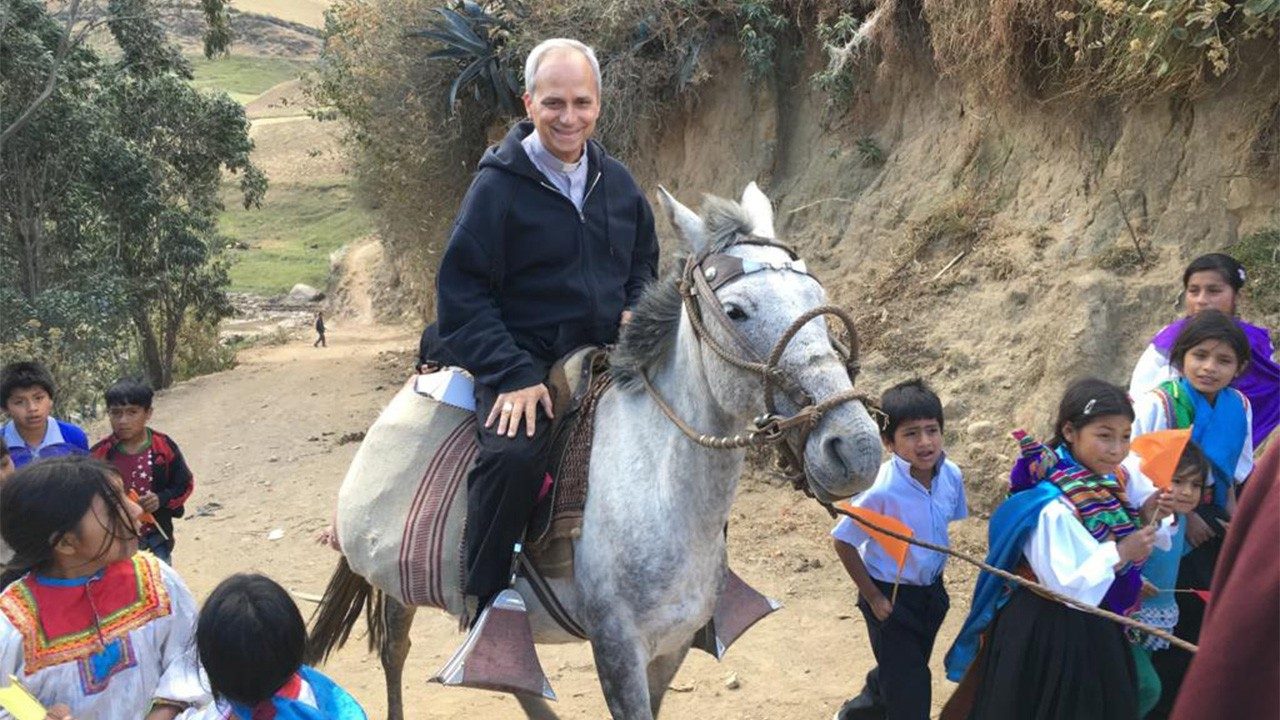
The man we now know as Pope Leo XIV was not only a bishop in the country – of which he became a naturalized citizen in 2014 – but also a missionary priest for several years in the 1980s.
The nation and people of Peru are dear to Leo, especially the faithful of Chiclayo, whom he remembered on the evening of his election, in some of the very first words he spoke as the Roman pontiff.
“[A] greeting to everyone and in particular to my beloved Diocese of Chiclayo, in Peru,” Leo said – in Spanish – from the loggia of St. Peter’s Basilica on May 8, 2025, “where a faithful people has accompanied their bishop, shared their faith, and given so much – so much – to continue being a faithful Church of Jesus Christ.”
By every account, the feeling is mutual.
“The people feel very close to him,” the nuncio to Peru, Archbishop Paolo Rocco Gualtieri told Vatican Media shortly after Leo’s election.
Gualtieri said he remembered then-Cardinal Robert Francis Prevost’s first visit to his adopted home after receiving the red hat.
“I had the honor of accompanying him to Chiclayo,” Gualtieri said, “and the welcome was overwhelming.”
“It was clear, Gualtieri said, “that he had been a pastor who walked with his people.”
Facts Only
* Pope Leo XIV will travel to Peru in November of this year.
* Peruvian President José María Balcázar announced the visit to journalists.
* The planned stops include Lima, Piura, Pucallpa, Cusco, and Chiclayo.
* Balcázar stated the pope will be in Peru in the first half of November.
* Leo XIV was a bishop in Peru and became a naturalized citizen in 2014.
* Leo XIV was a missionary priest for several years in the 1980s.
* Leo XIV remembered the faithful of Chiclayo during his election.
* Archbishop Paolo Rocco Gualtieri reported the welcome was overwhelming.
Executive Summary
Full Take
The narrative employs the authority of official travel and diplomatic exchange to frame a deeply personal connection, leveraging the history between the papacy and the Peruvian people. The structure moves from a formal announcement by the state (President Balcázar) to the intimate historical legacy of the pontiff, culminating in anecdotal evidence of welcome from a key region. This pattern establishes an implicit linkage between spiritual authority and national identity.
The inclusion of personal recollections about Leo XIV’s time in Chiclayo and the overwhelming welcome received by the nuncio serves not merely as color but as rhetorical scaffolding for the significance of the visit. This approach subtly shifts the focus from a routine diplomatic movement to a reaffirmation of a prior, established spiritual relationship. The implicit assumption is that the political act (the visit) is inherently validated by the personal history (pastor walking with his people).
The underlying mechanism utilizes authority games where institutional planning (the itinerary announcement) is softened and legitimized by emotional testimonial (personal history and welcome). The narrative structure works to preemptively address potential skepticism about the motives of a major religious figure, using shared goodwill as the primary proof.
Bridge Questions: How does the framing of personal history versus official itinerary influence public perception of transnational religious movements? What are the implications when diplomatic visits rely heavily on anecdotal emotional testimony to convey state-level intentions? Does this pattern reflect broader strategies for leveraging spiritual authority in geopolitical contexts?
Sentinel — Human
The article reads as high-quality journalistic reporting, utilizing specific historical and religious context, suggesting a strong probability of human authorship.