Space Foundation News
‘Throttle Up’ Takes on New Meaning for L3Harris Engineer Supporting NASA’s Artemis Missions
Written by: Space Foundation Editorial Team
From the Garage to the Moon
A couple of decades ago, Mark Aldaba was working on machines that only left the surface of Earth when something went horribly wrong. Those custom motorcycles and hot rods couldn’t hold a candle to the kind of horsepower he deals with now.
One benefit from his youth spent on wheels, he said: “It gave me the start in metal fabrication that I needed.”
A Hands-On Path to Space Engineering
Aldaba got trade certifications rather than a college degree to get his first space job in 2007 as a welder on the RS-25 engine, then used to launch the space shuttle. He picked up so much knowledge along the way that L3Harris promoted him to lead manufacturing engineer. Now, he’s in a leadership position as L3Harris readies four RS-25 engines for the Artemis II flight.
“When you are working on a car and you can soup it up, it’s always rewarding to see it on the street,” he said. “What I do now is an even greater feeling. Knowing it will send people to the Moon and eventually to Mars just can’t be described.”
Aldaba credits his rise in the space industry to hard work. He admires his college-educated colleagues, but Aldaba says he isn’t the classroom type. “I have always been better working with my hands than typing on a computer behind a desk.”
Building the Engines Behind Artemis
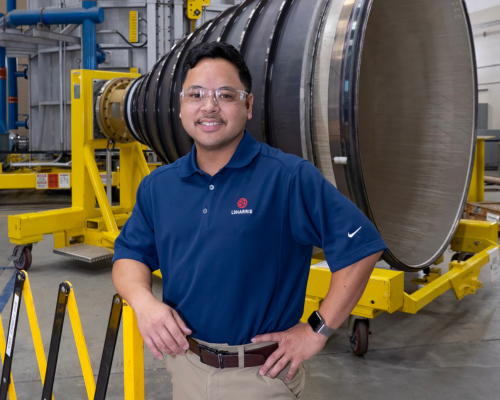
Aldaba works in a California factory that assembles the nozzles for the RS-25. The part may look deceptively simple, but the nozzle has many components. Some parts contain and direct thrust while others, including a heat exchanger cooled by the rocket’s cryogenic fuel, bleed away heat so the engine doesn’t melt. It’s a balance of fire and ice.
Modern manufacturing of the RS-25 involves cutting-edge technologies including additive manufacturing and electron beam welding. Aldaba credits his expertise on the system to the L3Harris craftsmen who taught him every step and showed him how patience and caution create quality.
“It gave me an education I couldn’t find in any classroom,” he said.
Inspiring the Next Generation
Now, Aldaba frequently speaks to young people contemplating their future.
“You can do the four-year college route,” he said. “Or you can go my route and go to a vocational school and pick up a trade.”
Facts Only
Mark Aldaba is a lead manufacturing engineer at L3Harris.
He previously worked on custom motorcycles and hot rods.
Aldaba began his space career in 2007 as a welder on the RS-25 engine.
The RS-25 engine was originally used for the space shuttle program.
He now leads the assembly of RS-25 nozzles for NASA’s Artemis II mission.
The RS-25 nozzle includes components for thrust direction and heat dissipation.
The nozzle uses cryogenic fuel to prevent engine overheating.
L3Harris employs additive manufacturing and electron beam welding for RS-25 production.
Aldaba learned his skills through trade certifications and on-the-job training.
He was promoted to lead manufacturing engineer without a college degree.
Aldaba speaks to young people about vocational education as an alternative to college.
The RS-25 engines are intended for lunar missions and future Mars exploration.
Executive Summary
Mark Aldaba, a lead manufacturing engineer at L3Harris, has transitioned from a background in custom motorcycle and hot rod fabrication to a pivotal role in NASA’s Artemis missions. His career began in 2007 as a welder on the RS-25 engine, originally used for the space shuttle, and he has since advanced to overseeing the assembly of RS-25 nozzles for the upcoming Artemis II flight. The RS-25 nozzle, though appearing simple, is a complex component that manages thrust and heat dissipation using cryogenic fuel. Aldaba’s expertise stems from hands-on experience and mentorship from L3Harris craftsmen, rather than formal college education, which he contrasts with traditional academic paths. He now advocates for vocational training as a viable alternative to four-year degrees, sharing his story to inspire younger generations. The RS-25 engines, built with advanced technologies like additive manufacturing and electron beam welding, are critical to NASA’s plans for lunar and eventual Martian missions.
Aldaba’s journey highlights the value of trade certifications and on-the-job learning in high-stakes industries like aerospace. His work underscores the intersection of traditional craftsmanship and cutting-edge engineering, as well as the broader debate about education and career pathways in technical fields. The narrative also reflects the human element behind large-scale space exploration, where individual contributions play a direct role in historic missions.
Full Take
This narrative presents a compelling case for the value of vocational training and hands-on expertise in high-tech industries, particularly aerospace. At its strongest, it challenges the conventional emphasis on four-year degrees by showcasing Aldaba’s success through trade certifications and mentorship. The story effectively humanizes the Artemis missions, linking individual craftsmanship to monumental scientific endeavors. It also subtly critiques the assumption that formal education is the only path to professional achievement, offering a counter-narrative that resonates with debates about workforce development and accessibility in STEM fields.
However, the piece leans into a binary framing—college versus vocational training—that may oversimplify the spectrum of educational and career pathways. While Aldaba’s story is inspiring, it risks implying that vocational routes are inherently superior or that college education lacks practical value, which could be a false dichotomy. The emotional appeal of his personal journey—from garage tinkerer to space engineer—is powerful but could be exploited to undermine broader discussions about systemic barriers in education and industry access.
Root cause: The narrative reflects a broader cultural tension between credentialism and skills-based hiring, as well as the romanticization of "self-made" success in technical fields. It echoes historical patterns where blue-collar expertise is celebrated in moments of national pride (e.g., space races) but often undervalued in policy or compensation structures.
Implications: For human agency, Aldaba’s story empowers those who thrive outside traditional academic settings, validating alternative career paths. Yet, it may inadvertently shift focus from systemic inequities in education and hiring practices. The beneficiaries here are individuals like Aldaba and industries seeking skilled labor, while the costs could include reinforcing a narrative that devalues formal education or obscures the need for structural reforms in workforce training.
Bridge questions: How might vocational and academic education complement each other in high-tech industries? What systemic changes would make both pathways equally viable and respected? Does celebrating individual success stories distract from broader inequities in access to opportunity?
Counterstrike scan: A coordinated influence campaign might use this narrative to discredit higher education or promote vocational training as a panacea for labor shortages, framing it as a "common-sense" alternative. However, the actual content does not exhibit this pattern; it presents Aldaba’s story as one valid path among many, without dismissing other routes. The tone remains constructive, focusing on individual achievement rather than systemic critique.
Patterns detected: none