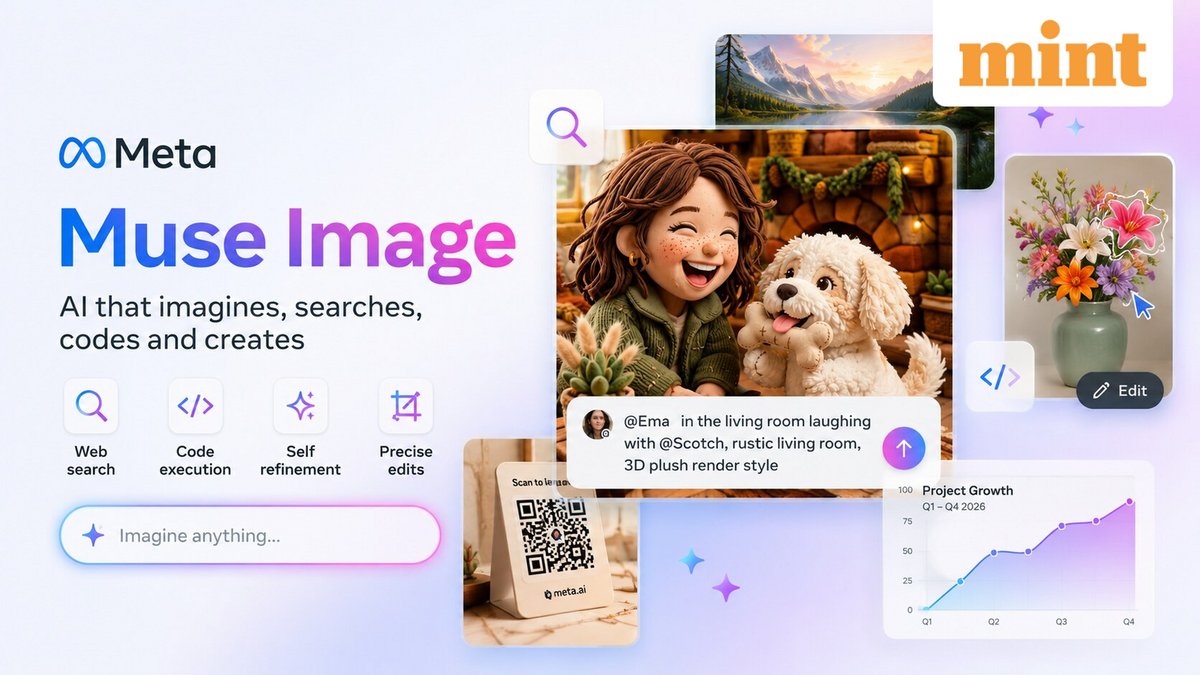
Meta's Superintelligence Labs division has launched two new AI models: Muse Image and Muse Video. While Meta has made the image generation model available to users starting today, the tech giant says Muse Video is currently in preview and will be available to creators in the coming months.
Meta says Muse Image is its most advanced image generation model so far and is capable of following user instructions faithfully, while making edits with precision, composing images from multiple reference shots and even drawing on Instagram data for social context.
Muse Image can also search the web for real-time information, write and execute code to improve accuracy, and even refine its own outputs if it thinks something is not working out.
The new image generation model also connects with Muse Spark, the first AI model from MSL released earlier this year. Meta says that both models can share tools and jointly plan how to create animated GIFs, websites with embedded images and interactive visual games.
“Instead of directly mapping prompts to images, Muse Image operates as an agent: it invokes search and coding tools to improve accuracy, self-refines its own generations, and improves through scaling test-time compute,” Meta said in a blog post.
Meta also claims that Muse Image supports precise image editing, meaning you can change a specific part of an AI-generated image while leaving the rest of the image untouched.
Some of the ways Meta shared that Muse Image supports precise image editing included prompts like "Change the flower so the petals form a rainbow gradient" or "Edit this to clear up the fog and reveal the beautiful valley below."
In terms of benchmarks, Meta claims that Muse Image beats Gemini's Nano Banana 2 across Arena for text-to-image, single-image editing and multi-image editing, taking the number two spot behind only OpenAI's GPT-Image 2.
In order to make sure that AI-generated images are not mistaken for real images, Meta says it is giving people a way to verify these pictures by including a "Content Seal", which is its own invisible watermarking system.
The company also says it is "previewing" a detection tool that would let users see if there is a Content Seal watermark on an image.
The image generation tool can also be used to create images with friends and reimagine photos using social tools in the Meta AI app.
Meta also says users will be able to generate personalised images directly from Instagram by referencing public accounts.
For example, you can ask Meta AI to generate a stylised 3D plush version of yourself and your pet simply by mentioning their Instagram handles in the prompt.
Meta is also bringing personalised AI-powered presets to the Instagram app where users will be able to apply effects like Trending, New, Seasonal, Style and Location with a single tap.
Muse Image is available starting today through the Meta AI app and the meta.ai website. The model is also rolling out to Instagram Stories in the US and WhatsApp in select countries, with support for Facebook to arrive later this year.
Aman Gupta is a Digital Content Producer at LiveMint with over 3.5 years of experience covering the technology landscape. He specializes in artificial intelligence and consumer technology, reporting on everything from the ethical debates around AI models to shifts in the smartphone market. <br> His reporting is grounded in first-hand testing, independent analysis, and a focus on how technology impacts everyday users. He holds a PG Diploma in Radio and Television Journalism from the Indian Institute of Mass Communication, Delhi (Class of 2022). <br> Outside the newsroom, he spends his time reading biographies, hunting for the perfect coffee beans, or planning his next trip. <br><br> You can find Aman on <a href="https://www.linkedin.com/in/aman-gupta-894180214">LinkedIn</a> and on X at <a href="https://x.com/nobugsfound">@nobugsfound</a> or reach him via email at <a href="aman.gupta@htdigital.in">aman.gupta@htdigital.in</a>.
Catch all the Business News, Market News, Breaking News Events and Latest News Updates on Live Mint. Download The Mint News App to get Daily Market Updates.
Oops! Looks like you have exceeded the limit to bookmark the image. Remove some to bookmark this image.
Sentinel — Human
The text reads like a standard technology press release mixed with journalistic framing, indicating high likelihood of human authorship rather than pure synthetic generation.