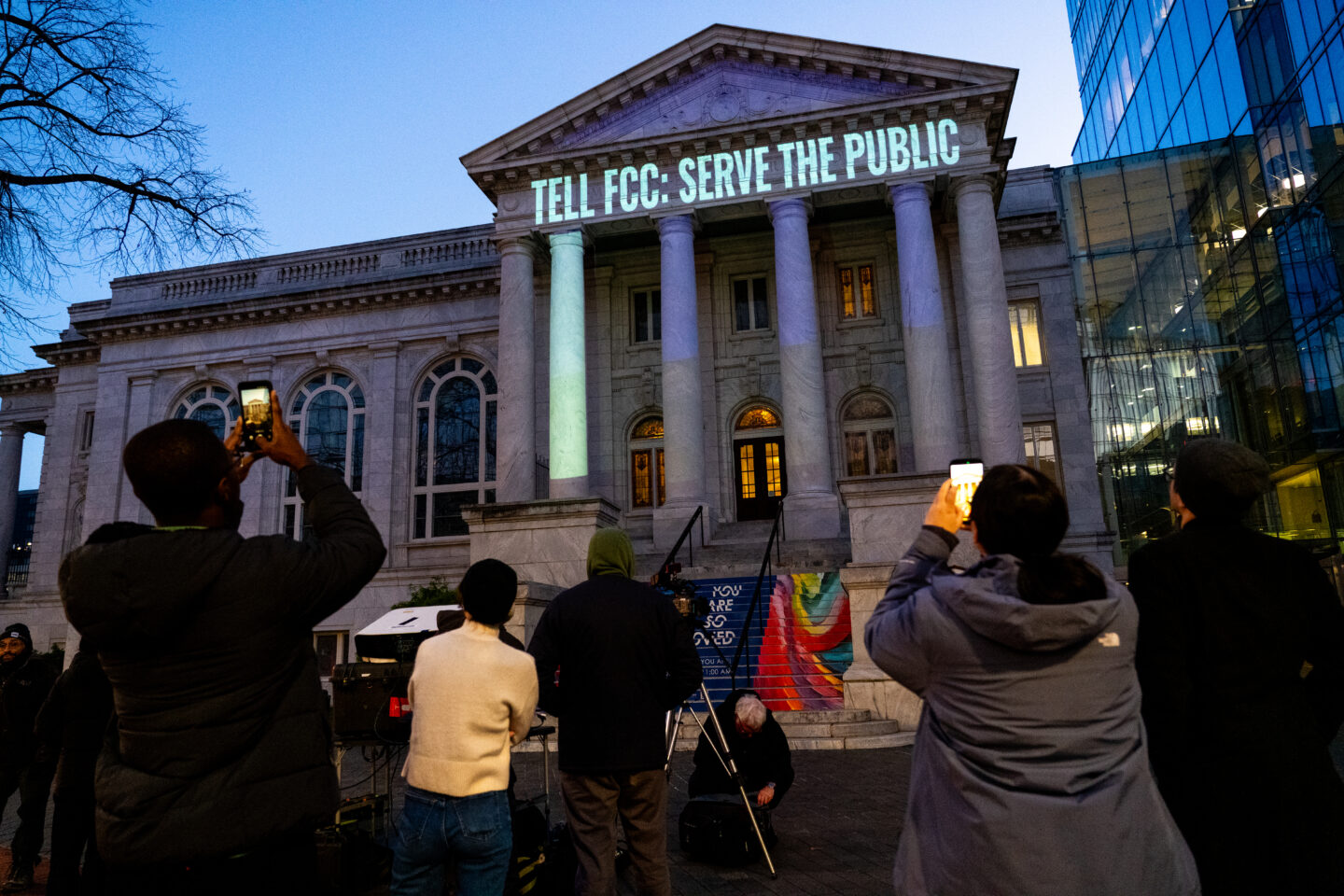
The chair of the Federal Communications Commission is not usually a household name. Back in the ‘00s, if the FCC came up at the dinner table, it was usually about when broadcast licensees got in hot water for programming that might be considered indecent or obscene. Take Eminem, for instance, in 2001. He famously rapped, “the FCC won’t let me be,” after the agency threatened to fine radio stations $7,000 for playing clean versions of his song, “The Real Slim Shady,” which still contained sexual references (the fine was ultimately dropped). Radio licensees airing the “Howard Stern Show” faced $2.5 million in fines for material seen as indecent from 1990 to 2004. In the aftermath of the 2004 Super Bowl, CBS faced a $550,000 indecency fine after Janet Jackson’s wardrobe malfunction, which was later dismissed after years of legal battles. A 2005 episode of “Family Guy” even featured a musical number titled, “The Fellas at the Freakin’ FCC,” satirizing the regulatory agency’s restrictions on speech. The FCC, in the popular imagination, is a prudish gatekeeper powerful enough to make Eminem complain, yet irrelevant enough to be a punchline. But other than John Oliver bringing the FCC back in the spotlight over net neutrality (twice), it’s been relatively quiet since.
That image no longer fits. In the first year of the second Trump administration, FCC Chairman Brendan Carr has turned the agency’s regulatory powers over broadcasting into something far more consequential – and far more troubling – than indecency fines. Chairman Carr quickly established himself as President Trump’s attack dog against the media. Under Chairman Carr, declarations and reminders about broadcasters’ duty to the “public interest” have become routine instruments of pressure, with very real impacts on broadcasters’ editorial judgment – almost always following a social media post from President Trump. A late-night comedian’s monologue. A network news division’s editorial choices. A pending multi-billion-dollar merger. All of this now sits within the reach of an FCC chair willing to use the public interest standard not as a safeguard for democracy or public decency, but as leverage over the press’ First Amendment-protected decisions. It’s crucial to understand why exploitation of the public interest standard is happening now, and, more critically, how the standard was left open enough to allow this abuse (and whether something can be done about it).
So What Is the Public Interest Standard?
The public interest standard emerged from a practical problem in the 1920s: There were limited radio frequencies available, and too many stations broadcasting on the same frequency were interfering with each other. The government needed to decide who could broadcast and on which frequencies, essentially controlling access to a scarce public resource: the airwaves. This created a tension between those who wanted the government to organize frequency assignments to prevent interference, and those who feared that government control over broadcasting licenses would suppress free speech and favor large commercial interests.
The Radio Act of 1927 established the Federal Radio Commission (which later was absorbed by the FCC) to, in part, grant, deny, and promote broadcast licenses. In exchange for these exclusive licenses to use public airwaves, broadcasters were required to operate in the “public interest, convenience, and necessity.” In the century since the Radio Act was enacted, the term “public interest” has never been statutorily defined, but has been generally understood as a requirement for broadcasters to uphold principles of diversity, localism, and competition. In substantive terms, the public interest standard is intended to serve as a safeguard against a concentrated media environment that distributes narrow viewpoints unrepresentative of the diversity throughout the United States. The FCC considers the public interest in every new rulemaking, merger review, license application, renewal, and periodic review of its broadcast ownership rules.
Interpretation of the public interest standard has evolved since its inception a century ago. For much of the 20th century, the standard was understood to be fundamentally about preserving democratic governance through independent media and a free press. Media regulation is intended to serve the informational needs of a well-informed citizenry by protecting the ideals of localism, multiple voices, and access to diverse viewpoints. This means diversity of ownership, which would (at least theoretically) allow for production of diverse programming and content. It also means ensuring broadcasters serve their local communities with programming responsive to local needs, events, and concerns rather than purely national content. And, finally, the public interest is served by a competitive media market with ownership limits to prevent dangerous concentrations of broadcasters. The FCC used structural rules to prevent media concentration, including by imposing strict limits on cross-ownership of newspapers and broadcast stations; caps on the number of stations one entity could own in a market; and ownership restrictions designed to encourage diverse and local owners into the market.
In the beginning, the FCC interpreted the public interest standard by imposing behavioral obligations, such as policing children’s programming and ensuring that stations covered enough matters of community importance. These behavioral obligations proved costly, difficult to enforce, and easily gamed through loopholes. With the general deregulatory tide that began under President Ronald Reagan, the FCC (with nudges from Congress) gradually abandoned behavioral regulation in favor of structural rules designed to promote diversity through ownership limits rather than programming mandates. Congress reinforced this shift by effectively removing any practical requirement that licensees demonstrate they were actually serving their local communities. What remains today are statutory obligations, like equal opportunity rules and indecency standards. Nevertheless, broadcasters still hold their licenses as trustees for the benefit of the local community and carry an obligation to serve it.
That trustee relationship is now being tested. Contemporary FCC leadership under both Trump administrations centered the public interest standard on economic efficiency. Chairman Ajit Pai of President Trump’s first administration eliminated or relaxed major cross-ownership rules, including the 1975 Newspaper/Broadcast Cross-Ownership Rule. Significantly, the FCC under President Trump has downplayed considerations of minority and female ownership diversity, with Justice Thomas’ concurrence arguing that the agency has “no obligation to consider minority and female ownership” and that diversity ownership is merely a “proxy” for viewpoint diversity rather than its own goal.
Why Are We Hearing So Much About the Public Interest Standard Now?
All presidents complain, to some degree, about their press coverage. But President Donald Trump has been uniquely vocal on social media, often expressing that his press coverage is not merely “unfair,” but also that the FCC needs to pull the licenses of those he deems his media enemies. But whereas the FCC chair in President Trump’s first term – Ajit Pai – brushed off President Trump’s tweets against the press as simply something presidents do, the current FCC chairman, Brendan Carr, has taken a very different approach. Chairman Carr broke with the FCC’s 92-year tradition by stating that the agency is not truly independent. This change has effectively allowed the Chairman to support and reinforce President Trump’s criticisms of the media. He has even pledged to use his authority to ensure that licensees “serve the public interest” by penalizing networks, PBS, NPR, and individual broadcasters that draw the president’s ire.
Chairman Carr’s approach to the “public interest” standard is designed to consolidate outlets in the hands of those deemed the president’s friends while simultaneously punishing those President Trump names as enemies. Chairman Carr is pushing the deregulatory posture forward on the competitive front, claiming localism and diversity are represented in broadcast media by giant group owners as long as they are not directly owned by the networks (as if multiple stations in the same market owned by distant companies that also own hundreds of other stations across the country are somehow “locally managed.”) At the same time, Chairman Carr has revived long-dormant behavioral regulations and applied them in novel ways that always seem to align with the president’s allegations of unfairness. Free speech advocacy groups like Public Knowledge accuse Chairman Carr of exploiting the public interest standard to pressure broadcasters over their political content, particularly speech critical of President Trump. Many have pointed out that Chairman Carr’s approach is a sharp departure from not only traditional FCC restraint regarding influencing broadcasters’ editorial tilt, but also Chairman Carr’s own previously stated First Amendment principles.
Chairman Carr’s interpretation centers on the claim that late-night comedy and news coverage critical of the administration fail to serve the public interest because they “enforce a very narrow political ideology” that only appeal to “a slice of the American public.” He emphasizes how licensed broadcasters have “a unique obligation to operate in the public interest” that differentiates them from unregulated platforms like podcasts or cable – which is true. But the FCC cannot determine what the right balance of “political ideology” is in a broadcaster’s programming, because doing so would violate the First Amendment’s prohibition on viewpoint-based government regulation of speech. In Chairman Carr’s interpretation, it would be against the public interest to broadcast anything that more than a few people disagree with. Yet the public should have to contend with a variety of viewpoints and perspectives, including those it disagrees with – hence why diversity in ownership has long been a crucial goal for the FCC.
The most striking controversies demonstrating this interpretation include the Jimmy Kimmel suspension, where Chairman Carr explicitly threatened ABC affiliates by saying, “We can do this the easy way or the hard way,” and warning that companies needed to “take action on Kimmel” or face “additional work for the FCC ahead.” Within hours, major station groups Nexstar and Sinclair both pulled Kimmel’s show, followed by ABC itself. All three companies had major deals pending that required FCC or antitrust approval, creating what legal experts characterized as illegal government “jawboning.” Nexstar’s sycophancy was successful: The FCC has just approved Nexstar’s merger with broadcast company Tegna, despite clearly violating the 39 percent ownership cap set by Congress (the combined company will control 265 full-power TV stations reaching more than 80 percent of U.S. households).
Chairman Carr has also launched formal investigations of all major broadcast networks except Fox, with the ABC and CBS investigations notably dovetailing with President Trump’s lawsuits against both networks. Both companies settled for $16 million each rather than fight. The CBS case particularly illustrates Chairman Carr’s leverage tactics: The network’s previous owners pulled “The Late Show with Stephen Colbert” before the FCC approved Paramount’s sale to Skydance, and the new owners appointed an ombudsman to review complaints about CBS news coverage as a pledge to Chairman Carr.
The threats don’t stop there. Chairman Carr amplified President Trump’s Truth Social post complaining about the “Fake News Media” and its coverage of the United States’ war in Iran in legacy news outlets – namely the Wall Street Journal and the New York Times. The president is free to express his frustration over the media’s framing of his efforts in Iran, but where it takes a turn to concerning First Amendment territory is when the head of the regulatory agency charged with overseeing broadcast news issues a blanket threat to all broadcasters – claiming they are “running hoaxes and news distortions” and that “broadcasters must operate in the public interest, and they will lose their licenses if they do not.” In his response to President Trump’s venting, Chairman Carr effectively establishes that if the president deems news coverage false, then the broadcaster’s licenses may be revoked.
These actions together seem to come from an entirely different man than the Brendan Carr who testified in the Senate in 2018 that “The First Amendment operates as a restraint on the government” and that his job was to avoid putting “a thumb on the scale in favor of one speaker or the other.”
How Does the FCC Choose What Potential Public Interest Violations To Pursue?
Generally, the FCC does not choose to investigate potential violations until it receives a complaint from the public. When the FCC does act on a complaint, the bar for intervention is deliberately high. For example, the Commission should only investigate a station for news distortion when it receives documented evidence – such as testimony or other documentation from individuals with direct personal knowledge – that a licensee or its management engaged in the intentional falsification of the news. For other broadcast violations, the FCC requires complainants to provide specific information, including the date and time of the alleged broadcast; the call sign or frequency of the station involved; and detailed descriptions of what was actually said or depicted. The Commission gives full consideration to the complaints it receives, but can only act on allegations that a station has violated a specific provision of the Communications Act or the FCC’s rules or policies. Such a framework reflects the FCC’s longstanding posture of deference to licensee editorial judgment: The Commission generally will not intervene in cases involving inaccurate or one-sided reporting because doing so would be “inconsistent with the First Amendment.” Absent a compelling evidentiary showing, the agency is expected to stay out.
In this second Trump administration, we have seen an FCC chair who does not hesitate to make claims about a broadcaster’s editorial judgment absent a formal complaint process. The chair does not decide unilaterally which broadcasters to investigate for public-interest violations, yet Chairman Carr has repeatedly broken from this norm. Chairman Carr’s public threats to revoke broadcast licenses based on the president’s social media complaints about the framing of reporting on the Iran war are a clear illustration.
Shouldn’t We Define the Standard If It’s Causing So Much Controversy?
There are several policies and rules that shape, in part, how the FCC enforces public interest obligations as it relates to speech. These rules – either bestowed by Congress through lawmaking, or as a rule through the agency’s formal notice-and-rulemaking process – give some semblance of a concrete framework for how the FCC handles speech. But it is far from cut-and-dry. With the lack of a statutorily defined public interest standard, we see how an enterprising and sycophantic FCC chair can exploit the standard’s ambiguity to make the president happy. Brendan Carr has made it clear that the ambiguity of the public interest standard is a structural vulnerability that a sufficiently motivated FCC chair both can and will exploit.
A potential solution is one that Brendan Carr himself floated before his tenure as FCC chair: the idea of whether the FCC “should start a rulemaking to take a look at what [the Public Interest] means.” That way, rather than Chairman Carr (or any future FCC chair) taking the standard’s ambiguity and making a mockery of the First Amendment, the Commission can open the process to public comment, create an administrative record, and produce a definition courts could actually review – converting a standard that currently functions as whatever the chair says it is into something with enforceable boundaries.
The obvious objection is that a rulemaking is, itself, gameable. An FCC under Chairman Carr is not going to produce a definition designed to constrain its own behavior. At the very least, the Commission could codify what the public interest is NOT. More specifically, the Commission could make it statutorily clear that the public interest standard does NOT give the FCC the authority to police broadcast political views or broadcasters’ editorial decisions.
Ideally, Congress would act. The public interest standard originated in statute, and a statutory definition would bind every administration rather than just the one that established it. In the near term, even targeted statutory fixes would do meaningful work: requiring that investigations close or produce documented findings within a set timeframe; preventing a sympathetic complainant and a like-minded chair from keeping a broadcaster in indefinite regulatory limbo; and limiting news distortion findings to cases involving demonstrable falsehoods rather than editorial calls that simply displease the administration. Importing something like the New York Times v. Sullivan actual malice standard into the news distortion context would give broadcasters a clear evidentiary threshold – and give courts a familiar framework for review.
None of this eliminates the risk of a chair determined to use the FCC as a political weapon. What it does is raise the cost of doing so – by creating a record, forcing justifications, and giving aggrieved parties something to litigate. The public interest standard has survived a century of interpretation precisely because its flexibility let it evolve. But flexibility without limits is not a feature when the person exploiting the ambiguity is the regulator himself. Chairman Brendan Carr testified before the Senate in 2018 that his job was to avoid putting “a thumb on the scale in favor of one speaker or the other.” Defining the public interest standard, especially to clarify that it is not based on viewpoint, is how we hold him, and every chair who comes after, to that commitment.
Facts Only
Public interest standard: a principle governing communications regulation in the U.S., originating from legislation dating back to the 1930s
Federal Communications Commission (FCC): an independent agency responsible for regulating interstate and international communications by radio, television, wire, satellite, and cable in all 50 states, the District of Columbia, and U.S. territories
Brendan Carr: a current commissioner and chairman of the FCC
News distortion investigations: ongoing investigations by the FCC into news broadcasters for alleged news distortion
Lack of findings or closed investigations: instances where the FCC has not produced documented findings or closed investigations within a reasonable timeframe
Executive Summary
Title: The Controversy Over the Public Interest Standard at the FCC
In this article, the author discusses a call for clarification of the public interest standard at the Federal Communications Commission (FCC) in light of recent actions by Chairman Brendan Carr. The piece argues that the lack of a clear definition of the public interest standard has allowed for its misuse as a political weapon.
The article presents facts about the history and purpose of the public interest standard, which originated from legislation dating back to the 1930s. It also provides details about recent actions by Chairman Carr that have sparked controversy, such as investigations into news broadcasters for alleged news distortion without producing findings or closing the investigations within a reasonable timeframe.
The author argues that the current ambiguity in the public interest standard allows for its misuse and manipulation, creating an environment where the regulator can potentially put a "thumb on the scale" in favor of one speaker or another, as Chairman Carr testified before the Senate in 2018. The piece suggests that defining the public interest standard could help address these concerns by creating enforceable boundaries for its interpretation.
Full Take
In this analysis, we will examine the article's call for clarifying the public interest standard at the FCC and assess its implications.
Steelman: The author presents a strong argument for the need to define the public interest standard, suggesting that its current ambiguity allows for potential misuse as a political weapon. The author argues that defining the standard could help address these concerns by creating enforceable boundaries for its interpretation.
Patterns detected: ARC-0024 Ambiguity (the lack of clarity in the definition of the public interest standard contributes to its misuse)
Root Cause: The ambiguity in the public interest standard stems from its original legislative definition, which provides a flexible framework that has evolved over time. This flexibility allows for different interpretations and potential manipulation.
Implications: Defining the public interest standard could help ensure that it is applied consistently and fairly, reducing the risk of its misuse as a political weapon. It would also provide broadcasters with greater clarity about the expectations for their content.
Bridge Questions: What perspectives are missing from this analysis? How might defining the public interest standard impact the balance between free speech and media regulation in the U.S.?
Sentinel — Human
Sentinel analysis incomplete — partial response from fallback model.