Subscription Required
By Scott Hamilton and Karl Sinclair
March 28, 2026, © Leeham News: Oil prices skyrocketed this month with the beginning of the 2026 Iran War.
Yet, as sharply as prices spiked, they are not yet a record relative to inflation-adjusted prices since the 1973-1974 OPEC-inspired oil embargo and other regional or global events, an analysis by LNA shows.
West Texas Intermediate Crude oil prices topped $100/bbl. Brent crude briefly hit $197/bbl on March 20. On March 27, Brent topped $100.
Some airlines worldwide hedged fuel against dramatic price hikes. Our detailed analysis is below.
There are dire predictions that the prices could reach $170 or even $200/bbl if the Iran War continues. Bombing of Iran by the United States and Israel began on Feb. 26. Shortly after, tanker traffic through the Strait of Hormuz all but ceased. Twenty percent of the world’s oil transits through this bottleneck. Some countries, such as Japan and China, obtain more than 90% of their oil via the Strait.
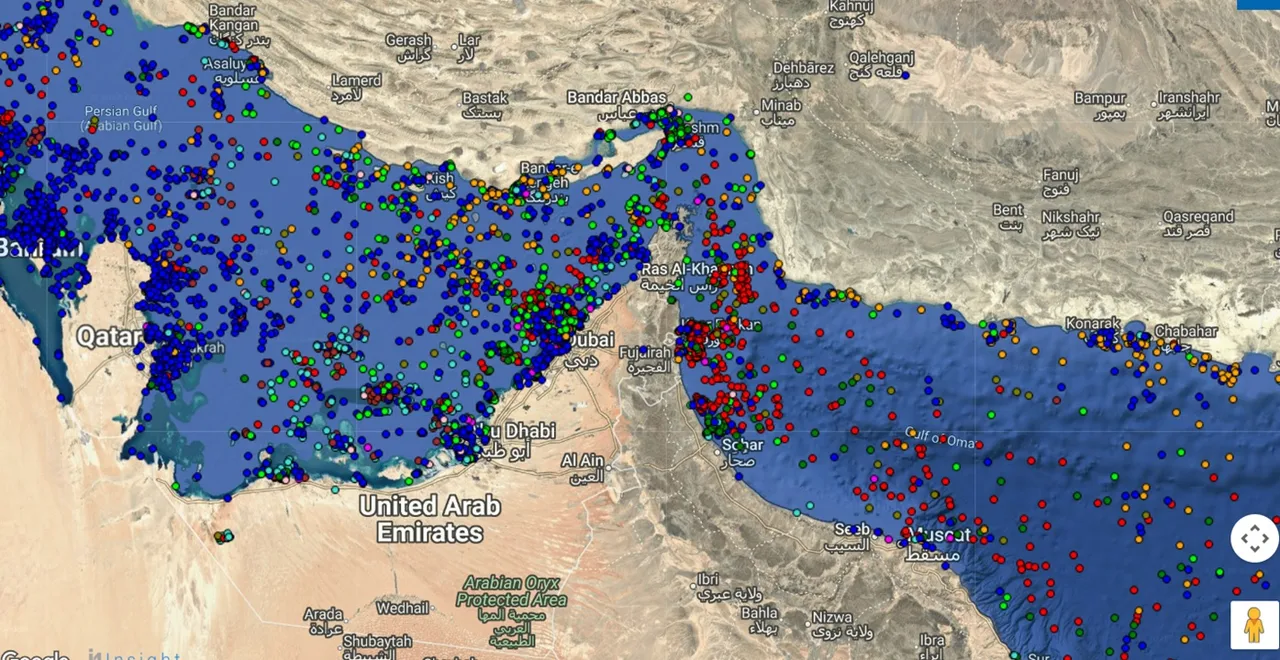
More than 300 tankers are trapped. Some were attacked by Iran. Hundreds of ships of all kinds are blocked on both sides of the 35-mile-wide Strait.
Figure 1. Source: About 750 ships were trapped at the peak. Iran is allowing limited traffic through. Seatrade-Maritime magazine.
The price of oil is being whipsawed as President Donald Trump mixes messages about the war's progress, sometimes within minutes. Sometimes the war is “won,” but more troops and ships are being sent to the region. Trump threatened to increase bombing, attack Iran’s power stations, invade an island, and then take it back. Allies are needed to reopen the Strait, and then they are not.
Facts Only
Oil prices spiked in March 2026 due to the Iran War, with West Texas Intermediate crude exceeding $100 per barrel and Brent crude briefly hitting $197 per barrel on March 20.
The Iran War began with U.S. and Israeli airstrikes on February 26, 2026.
The Strait of Hormuz, a 35-mile-wide chokepoint, saw tanker traffic nearly cease, trapping over 300 tankers and blocking hundreds of other ships.
Approximately 20% of the world’s oil transits through the Strait of Hormuz.
Japan and China rely on the Strait for over 90% of their oil imports.
Some tankers were attacked by Iran, and limited traffic has since been allowed through.
At its peak, about 750 ships were trapped in the region.
President Donald Trump has made contradictory statements about the war’s progress, including claims of victory, threats of increased bombing, and proposals to attack Iranian infrastructure.
Trump has also fluctuated on whether allied support is needed to reopen the Strait.
Some airlines hedged fuel costs in anticipation of price hikes.
Analysts predict oil could reach $170–$200 per barrel if the war continues.
Historical analysis shows current prices have not yet exceeded inflation-adjusted records from past oil shocks, such as the 1973–1974 OPEC embargo.
Executive Summary
Oil prices surged in March 2026 following the escalation of the Iran War, with Brent crude briefly reaching $197 per barrel on March 20 before stabilizing above $100. The conflict, which began with U.S. and Israeli airstrikes on February 26, disrupted global oil supply chains, particularly through the Strait of Hormuz—a critical chokepoint for 20% of the world’s oil. Over 300 tankers were trapped, and traffic through the strait nearly halted, severely impacting oil-dependent nations like Japan and China. While some airlines mitigated risks through fuel hedging, analysts warn prices could climb to $170–$200 per barrel if the war persists. The situation is further complicated by mixed messaging from U.S. President Donald Trump, who has alternately declared victory and escalated threats, including potential invasions and expanded bombing campaigns. Limited tanker traffic has since resumed under Iranian oversight, but the broader economic and geopolitical fallout remains uncertain.
The crisis underscores the fragility of global energy markets and the outsized influence of regional conflicts on commodity prices. Historical comparisons reveal that, while dramatic, current prices have not yet surpassed inflation-adjusted peaks from past oil shocks, such as the 1973–1974 OPEC embargo. The war’s trajectory—including potential allied interventions to reopen the Strait—remains volatile, with conflicting signals from leadership adding to market instability.
Full Take
**Steelman:** The narrative effectively highlights the immediate economic and logistical chaos triggered by the Iran War, grounding its claims in verifiable data (e.g., oil price spikes, Strait of Hormuz disruptions, and historical comparisons). It avoids overt sensationalism by acknowledging that prices, while severe, are not yet unprecedented in real terms. The inclusion of contradictory statements from Trump adds a layer of geopolitical realism, illustrating how leadership instability can exacerbate market volatility.
**Pattern Scan:** The piece leans into *fear appeals* (ARC-0012) by emphasizing dire predictions ($200/bbl oil) and catastrophic supply chain disruptions, though it tempers this with historical context. The focus on Trump’s mixed messaging could subtly invoke *authority games* (ARC-0031), framing his statements as erratic without deeper analysis of strategic intent. The lack of alternative perspectives (e.g., Iranian motivations, allied responses) risks *false framing* (ARC-0021) by presenting the conflict as a one-sided escalation. That said, the article avoids outright distortion or bad faith tactics.
**Root Cause:** The narrative assumes a linear cause-effect relationship between war and oil prices, which is valid but overlooks systemic vulnerabilities in global energy infrastructure. The unstated paradigm is that oil markets are inherently fragile, dependent on a few chokepoints, and susceptible to geopolitical shocks—a reality that benefits oil producers and speculators while disproportionately harming import-dependent nations. The historical parallel to the 1970s embargo is apt but could obscure how modern financialization of commodities (e.g., futures trading) amplifies volatility.
**Implications:** Human agency is constrained by structural dependencies: nations like Japan and China face energy insecurity, while airlines and consumers bear the brunt of price hikes. The war’s second-order effects—potential food shortages, inflation, or shifts to renewable energy—are hinted at but unexplored. The focus on Trump’s rhetoric may distract from broader questions about U.S. foreign policy goals or the role of regional actors (e.g., Saudi Arabia, UAE) in stabilizing markets.
**Bridge Questions:**
How might the war’s economic fallout reshape global energy policies, particularly in nations heavily reliant on Strait of Hormuz imports?
What alternative explanations exist for the Strait’s closure beyond military action (e.g., Iranian leverage, miscalculation)?
If oil prices stabilize despite the war, what would that reveal about market resilience or hidden supply chains?
**Counterstrike Scan:** A coordinated influence campaign would likely amplify the *fear appeals* (e.g., "oil at $200 will collapse economies") while omitting mitigating factors (e.g., strategic reserves, alternative routes). It might also exploit Trump’s contradictions to undermine trust in leadership without offering constructive alternatives. This article does not fully match that playbook—it provides context and avoids hyperbolic language—but the emphasis on worst-case scenarios could still serve to destabilize public confidence. The absence of Iranian or allied perspectives is a gap, but not necessarily deliberate manipulation.
Sentinel — Human
This analysis suggests that the article is likely to be human-written, as indicated by the variety in sentence length, balanced perspective, personal voice, and references to specific sources.