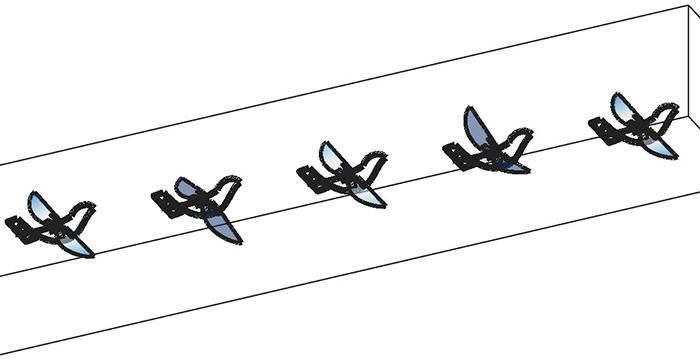
Engineers at Rutgers University in New Jersey, USA, have developed a bird-like drone whose wings flap and twist without motors, gears or mechanical linkages.
The solid-state ornithopter, described in a study published in the journal Aerospace Science and Technology, instead relies on the piezoelectric effect, in which special materials change shape when voltage is applied.
“We apply electricity to the piezoelectric materials, and they move the surface directly, without extra joints, extra linkages or motors,” said Onur Bilgen, associate professor in the department of mechanical and aerospace engineering. “The wing is a composite including a piezoelectric material layer and a carbon-fiber layer. Apply voltage to the piezoelectric layer, and the whole composite flexes.”
Thin strips called Macro Fiber Composites (MFCs) are bonded directly onto flexible wings. When electricity flows through them, the wings flap, twist and morph, with the carbon fiber acting as the structural element and the MFCs functioning as actuators.
Because the system has no gears or joints, the researchers describe it as a mechanism-free or solid-state ornithopter. Such bird-like drones could be well suited for tasks including search and rescue, environmental monitoring and inspection of hard-to-reach structures, where aircraft must navigate complex environments.
The research team also developed a computational model that simultaneously connects the key physics involved in flapping flight: wing and body motion, aerodynamics, electrical dynamics and control architecture. This allows engineers to test and optimize designs virtually before building physical prototypes.
“We’ve scientifically demonstrated that this type of ornithopter can be possible when we make certain material assumptions,” Bilgen said. “We can show the feasibility of designs that are not yet physically possible.”
The principal current limitation is the performance of the piezoelectric material itself. “Today’s piezoelectric materials are not capable enough,” Bilgen said. “However, our mathematical model allows us to look into the future with reasonable assumptions.”
Flapping wings offer advantages over spinning propellers at small scales. “When flapping wings come in contact with the environment, they’re less destructive to themselves and to what they contact,” Bilgen said.
The researchers say the approach could also have applications in renewable energy, with piezoelectric materials applied to turbine blades to subtly alter blade shape in real time and improve aerodynamic efficiency.
Facts Only
Engineers at Rutgers University in New Jersey, USA, developed a bird-like drone with flapping wings.
The drone uses piezoelectric materials to flap and twist its wings without motors, gears, or mechanical linkages.
The design is described in a study published in the journal *Aerospace Science and Technology*.
The wings consist of a composite layer of piezoelectric material and carbon fiber.
Thin strips called Macro Fiber Composites (MFCs) are bonded to flexible wings, acting as actuators when electricity is applied.
The system is referred to as a "solid-state ornithopter" due to its lack of moving parts.
A computational model was developed to simulate wing motion, aerodynamics, electrical dynamics, and control architecture.
Current piezoelectric materials are insufficient for optimal performance, according to the researchers.
Flapping wings are less destructive than spinning propellers in small-scale applications.
Potential applications include search and rescue, environmental monitoring, and infrastructure inspection.
The technology could also improve turbine blade efficiency in renewable energy systems.
Executive Summary
Full Take
The strongest version of this narrative highlights a genuine engineering breakthrough: a drone that leverages piezoelectric materials to achieve bird-like flight without traditional mechanical components. The research team deserves credit for both the physical prototype and the computational model, which allows for virtual testing and optimization. This dual approach—combining material science with simulation—could accelerate innovation in robotics and renewable energy.
However, the narrative leans heavily on future potential rather than current capability. The admission that "today’s piezoelectric materials are not capable enough" is a critical caveat, yet the framing still emphasizes feasibility under "reasonable assumptions." This could be an example of **ARC-0024 Ambiguity**, where the line between present limitations and speculative promise is blurred. The pattern isn’t overtly manipulative, but it risks overpromising without sufficient emphasis on the hurdles ahead.
The root cause here is the tension between scientific progress and the pressure to demonstrate immediate utility. The paradigm assumes that computational modeling can bridge the gap between theory and practice, but material science often lags behind digital simulations. Historically, this echoes the cycle of hype and disillusionment in emerging technologies, where early breakthroughs are met with exaggerated expectations before reality sets in.
For human agency, this technology could democratize access to complex environments, reducing risks in disaster response or infrastructure maintenance. Yet, the costs—both financial and in terms of energy efficiency—remain unclear. Second-order consequences might include regulatory challenges for autonomous flapping drones or unintended ecological impacts if deployed at scale.
Bridge questions: What benchmarks would prove this technology is ready for real-world deployment? How might the limitations of piezoelectric materials be addressed beyond theoretical modeling? What ethical considerations arise from deploying bird-like drones in natural habitats?
Counterstrike scan: A bad actor pushing this narrative might exaggerate the drone’s current capabilities while downplaying material constraints, framing it as a near-term solution to pressing problems like climate monitoring. The actual content doesn’t match this pattern—it acknowledges limitations transparently—but the emphasis on future potential could still be exploited by those seeking to inflate expectations for funding or publicity.
Patterns detected: ARC-0024 Ambiguity (minor)
Sentinel — Human
The article appears to be written by a human journalist, with evidence including variable sentence length, passionate quotes from researchers, and specific details about the drone's mechanism. However, there is a low possibility that AI was used to assist in the writing process.