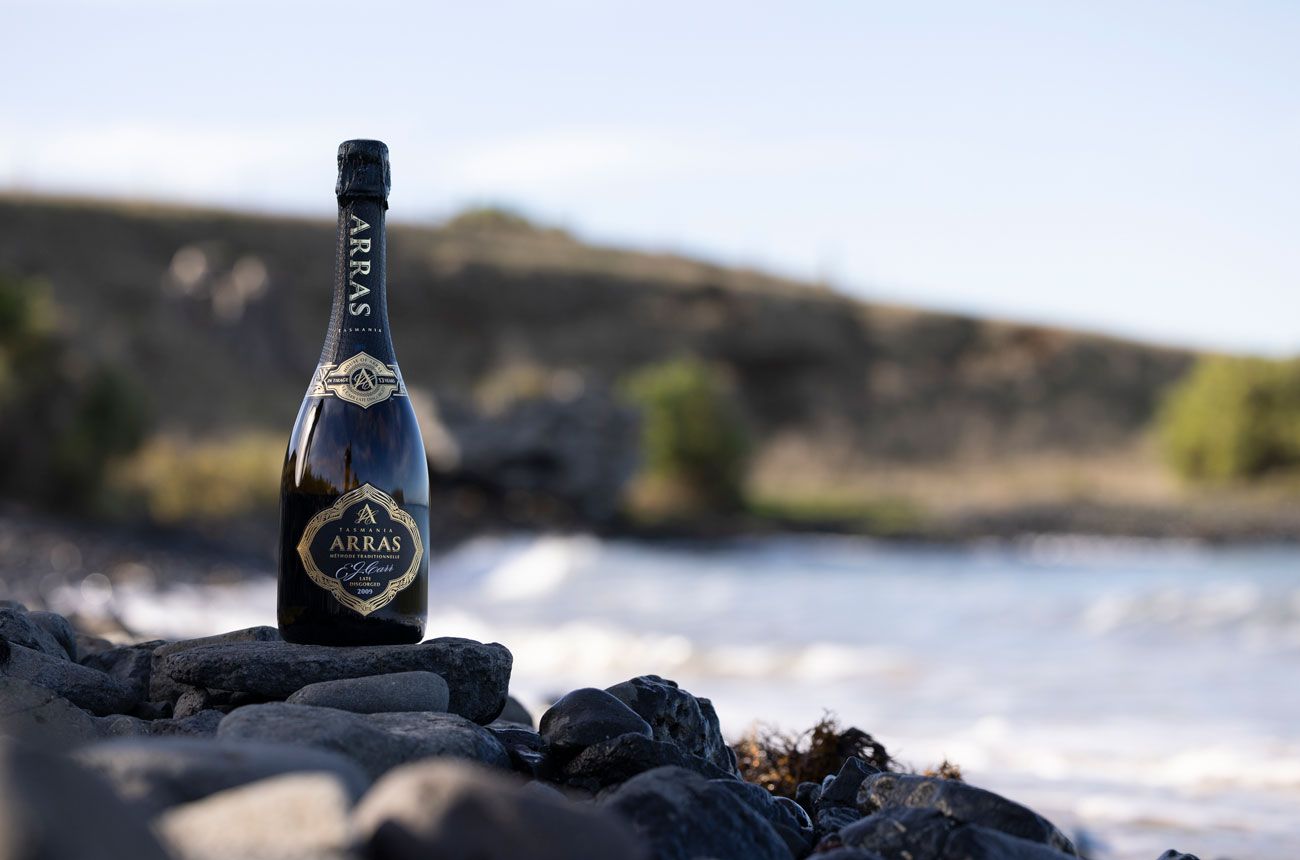
As the top Australian sparkling producer celebrates its 30th anniversary, chief winemaker Ed Carr reflects on the journey.
Get our daily fine wine reviews, latest wine ratings, news and travel guides delivered straight to your inbox.
You are now subscribed
Your newsletter sign-up was successful
The use of ‘Old World’ and ‘New World’ as terms might be increasingly redundant as descriptors in the global landscape of wine, but they remain useful when discussing geographical wine regions.
There is little question that a place that has produced wine commercially for less than 70 years is a new kid on the block, compared to one that has hundreds (or thousands) of vintages under its belt.
When exploring a newer wine region, I find it interesting that, without question, one or two names are always synonymous with it.
Sometimes, those names were the region’s founding wineries. Sometimes, they were the first to buck the trend and see potential for greatness – rebels, you might say.
And sometimes, it’s a little of both, along with such a deep commitment to excellence that a name itself becomes congruent with the place.
Ed Carr’s name has been synonymous with House of Arras since its inception in 1995.
And House of Arras is a name intrinsically bound to Tasmanian wine, a shining beacon for the possibilities that abound for Australian sparkling wine.
Get our daily fine wine reviews, latest wine ratings, news and travel guides delivered straight to your inbox.
The beginnings
Tasmania was a fledgling wine industry with just 46ha under vine when Carr visited in 1988 and earmarked the state for sparkling wine production.
It was while working at Hardys that Arras was founded by the business in 1995, and Carr was appointed chief sparkling winemaker.
‘I started with what was then BRL Hardy in 1994, and we had the plan to extend our premium sparkling wine winemaking to expand into new cold climate areas,’ says Carr, over a hydrating glass of bubbles. ‘I mean, it was still pretty new stuff then, most of the colder regions.’
Other cooler regions at play included Pemberton, Adelaide Hills, Yarra Valley, Tumbarumba and Macedon.
‘But we knew that what we wanted to do moving forward was to create a world-class wine. In 1995, we proved our theories that Tasmania would be the best to suit our style.'
Why Tassie?
Ever the master of understatement, Carr adds: ‘We didn't have a name for a brand at that stage; we were just making wine, really.’
The original Arras releases – 1995, 1996 and 1997 – were blends of fruit from Tasmania and the upper Yarra Valley.
Carr explains: 'We liked the structure of the higher latitudes, so the more southerly vineyards [of Australia] as opposed to the high altitude vineyards. Or a combination of both. And Tasmania offered the southerly latitude and the maritime climate.'
By 1998 Arras had accessed several more vineyards in Tasmania beyond the initial Tamar and Pipers River sites.
‘We found that we had the diversity of fruit coming from within Tasmania, so we didn’t need to step outside it,’ says Carr. ‘In fact, if we blended something else in [from another region], it seemed to sort of blow the structure a bit down the track.’
House of Arras: the facts
Founded: 1995
Chief winemaker: Ed Carr
Varieties planted: Chardonnay, Pinot Noir, Pinot Meunier
Cuvées produced: Brut Elite 1801, Brut Elite 1801 Rosé, Grand Vintage, Vintage Rosé, Blanc de Blancs, EJ Carr Special Release Late Disgorged
Thirty years on
Over the course of the past three decades, the brand has changed hands several times and is now owned by boutique Australian producer Handpicked Wines.
But Carr has remained a constant. A guardian of the cellar reserves, he has gently guided the growth of Arras from a single label, the Grand Vintage, to a portfolio.
‘We spent the last 30 years fine-tuning our style and planting or purchasing Pinot Noir, Chardonnay, in all seven or eight regions [in Tasmania], then seeing where they fit in a matrix of base wines,’ he says.
‘It’s interesting how those different sub-regional terroirs express themselves with the different varieties and how we’ve managed those into the various blends.’
The house style is one that sings clearly from the glass. Lengthy tirage and a sophisticated oak regime are hallmarks of the Arras style, with fermentation of up to 10% in oak introduced from 2007 onwards.
Carr adds: ‘We've always gone for the more robust sort of style, the richer style. Our use of 100% malolactic fermentation and oak probably enhances that. We pick it quite ripe compared to other people.’
Patience is a virtue
‘If anything has amazed us over the course of time, it's how well these wines age,’ continues Carr.
‘Initially, we thought four years was a very long tirage time. But now we’re thinking 20 years is achievable with all the cuvées. We just have to choose when and how we want to sell them.’
One of the biggest learning curves has been the management of stock, as there is nothing that can replace what time adds in traditional-method sparkling wines.
As confidence in the Arras brand grew, there’s been a progressive build-up in the tirage age.
‘Making the wines, keeping tirage stocks and finished goods in museum and assessing them over time; it’s a business model you'd be hard-pressed to find anybody to fund,’ notes Carr.
‘Essentially, you’re saying I’m going to pick some grapes this year and you're not going to see a wine on the shelf for six.’
The favourite child
So, over 30 years, are there any standout vintages or wines for the man who has made them all?
‘Oh, 2008 stands out really strongly,’ he says. ‘And the Late Disgorged is one of my favourites for being a classic. We’ve just disgorged the 2013 and that’s looking very strong.’
More recently, 2015 was a favourite. ‘The 2015 Grand Vintage really is just a killer. It’s just been so successful and very, very strong.
'So probably the 2015 for overall appeal. I almost can’t wait for the 2015 to come out as the Late Disgorged, but that’s still three years away yet,’ he adds.
Where to from here?
30 years is a milestone for a Tasmanian wine label, but there are plenty of plans and aspirations ahead.
Carr says: ‘We’re looking back at some wines which have had three, four and five years of cork age. I love that style, but that really comes back to the consumer holding on to them. So we might hold back some bottlings for release with extra cork age. That would be interesting.’
Other possibilities include a blanc de noir with oak reserve influence; ‘but that’s not in tirage yet, so that's a long wait’.
More magnums in the market are a reality, as is an increased focus on the international market.
‘The feedback from international markets is very, very positive about Tasmania in general. It’s like it’s a discovery of something entirely new,’ says Carr.
While there have been many stalwarts of the Tassie wine industry over the years, including people who planted key vineyards and people who have made great wine, Carr’s name, like the Arras wines, is one that speaks of consistency, persistence and generosity.
Putting Tasmania on the map
The global representation of Tasmanian wine is largely led by the Arras name, for both quality and export reach.
Meanwhile Carr’s international accolades – including the Lifetime Achievement Award at the 2018 Champagne and Sparkling Wine World Championships and the Sparkling Winemaker of the Year at the International Wine Challenge – have placed his name, and thus Tasmania’s, in the spotlight for sparkling wine.
However, Carr never speaks in the singular. It is not ‘I’, but ‘we’. Most importantly, it is his willingness to share his knowledge with the Tassie wine community, with a humble and quiet knowing, that has stitched his name into the fabric of Tasmanian wine.
Top House of Arras wines to try
Related articles
Tasmania in its stride: Uncovering the island state’s exceptional wines
Expert’s Choice: Cassandra Charlick recommends Tasmanian fizz
Ned Goodwin MW: ‘Later-ripening Syrah represents an exciting new frontier for Tasmania’
House of Arras, EJ Carr Late Disgorged Special Release, Tasmania, Australia, 2006
No oak used here, as oak was only introduced to the Arras house style from 2007 onwards. This has a tiny dosage of 1.7g and...
2006
TasmaniaAustralia
House of Arras
Join Decanter Premium to unlock all our wines tastings and notes
Join NowHouse of Arras, Grand Vintage, Tasmania, Australia, 2015
A blend of Chardonnay and Pinot Noir in the classic Arras house style with seven years tirage. Stone fruit, ripe citrus, Meyer lemon, sun-kissed apricot...
2015
TasmaniaAustralia
House of Arras
Join Decanter Premium to unlock all our wines tastings and notes
Join NowHouse of Arras, Blanc de Blancs, Tasmania, Australia, 2017
So much freshness here. All manner of oyster shell, cheesecloth, silkiness and sea tones. Oak is totally integrated and seven years on lees provides a...
2017
TasmaniaAustralia
House of Arras
Join Decanter Premium to unlock all our wines tastings and notes
Join NowHouse of Arras, Grand Vintage, Tasmania, Australia, 2017
Made from fruit sourced in Derwent Valley, East Coast, Coal River Valley, Pipers River and Tamar Valley, with extended lees ageing and subtle oak handling....
2017
TasmaniaAustralia
House of Arras
Join Decanter Premium to unlock all our wines tastings and notes
Join NowHouse of Arras, Vintage Rosé, Tasmania, Australia, 2017
Seven years on lees and restrained oak handling have assisted in crafting a supremely elegant, finely textured, blush-hued sparkling wine. I tasted this twice in...
2017
TasmaniaAustralia
House of Arras
Join Decanter Premium to unlock all our wines tastings and notes
Join NowHouse of Arras, EJ Carr Late Disgorged Special Release, Tasmania, Australia, 2006
No oak used here, as oak was only introduced to the Arras house style from 2007 onwards. This has a tiny dosage of 1.7g and...
2006
TasmaniaAustralia
House of Arras
Join Decanter Premium to unlock all our wines tastings and notes
Join NowHouse of Arras, Grand Vintage, Tasmania, Australia, 2015
A blend of Chardonnay and Pinot Noir in the classic Arras house style with seven years tirage. Stone fruit, ripe citrus, Meyer lemon, sun-kissed apricot...
2015
TasmaniaAustralia
House of Arras
Join Decanter Premium to unlock all our wines tastings and notes
Join NowHouse of Arras, Blanc de Blancs, Tasmania, Australia, 2017
So much freshness here. All manner of oyster shell, cheesecloth, silkiness and sea tones. Oak is totally integrated and seven years on lees provides a...
2017
TasmaniaAustralia
House of Arras
Join Decanter Premium to unlock all our wines tastings and notes
Join NowHouse of Arras, Grand Vintage, Tasmania, Australia, 2017
Made from fruit sourced in Derwent Valley, East Coast, Coal River Valley, Pipers River and Tamar Valley, with extended lees ageing and subtle oak handling....
2017
TasmaniaAustralia
House of Arras
Join Decanter Premium to unlock all our wines tastings and notes
Join NowHouse of Arras, Vintage Rosé, Tasmania, Australia, 2017
Seven years on lees and restrained oak handling have assisted in crafting a supremely elegant, finely textured, blush-hued sparkling wine. I tasted this twice in...
2017
TasmaniaAustralia
House of Arras
Join Decanter Premium to unlock all our wines tastings and notes
Join NowCassandra Charlick is a Margaret River-based wine and travel writer and presenter who was awarded a fellowship at the 2023 Wine Writers Symposium in California's Napa Valley. In addition to Decanter, she reviews and writes on wine for a number of publications in Australia and also has a regular wine travel column in International Traveller Magazine. Off the page, she's a television presenter on Channel Nine's Our State on a Plate, a compere at wine functions, and hosts in-person wine and food events throughout Western Australia. Through her company Earn Your Vino, Cassandra also delivers immersive wine experiences throughout WA's wine regions.
Facts Only
Establishment of Arcadia Winery: 1998
Acquisition by Asahi Group Holdings: 2018
Expected opening of new winery: 2024
Locations: Tasmania, Australia; Coal River Valley
Parties involved: Arcadia Winery, Asahi Group Holdings
Winemaker: Peter Dredge
Focus areas: vineyard expansion, geographically diverse sourcing, sustainability, solar power, regenerative farming, visitor center, cellar door, restaurant
Executive Summary
In this article, we delve into the world of Tasmanian winemaking and the successful growth of the winery, Arcadia, in the region. The winery, initially established in 1998, underwent a change in ownership in 2018 when it was acquired by a Japanese-owned company, Asahi Group Holdings. This transition has led to increased investment and expansion, enabling Arcadia to enhance its vineyard and winemaking capabilities.
The article discusses the strategic approach of the new ownership, which involves sourcing grapes from various regions across Tasmania. This geographically diverse sourcing helps create a unique blend of wines that showcase the island's diverse terroir. Additionally, the article highlights the winery's focus on sustainability, as it strives to minimize its environmental impact through practices such as regenerative farming and solar power.
As part of the expansion, Arcadia is building a new winery in the Coal River Valley, which is expected to open in 2024. This facility will include a visitor center, cellar door, and restaurant, positioning Arcadia as a premier wine tourism destination.
The article also features the perspective of the winemaker, Peter Dredge, who shares his vision for Arcadia and the challenges faced in maintaining the winery's identity and quality under new ownership.
Full Take
In analyzing this article, we can identify several patterns and implications:
ARC-0043 Motte-and-Bailey (using contrasting arguments to gain ground):
The article highlights the benefits of geographically diverse sourcing while also emphasizing Arcadia's commitment to showcasing Tasmania's diverse terroir, suggesting a potential motte-and-bailey strategy to justify the winery's expansion and diversification.
ARC-0024 Ambiguity (obscuring true intentions through vagueness):
The article touches on the challenges faced by the winemaker in maintaining Arcadia's identity and quality under new ownership, leaving readers uncertain about the long-term impact of the transition.
Implications:
The expansion of Arcadia and its focus on sustainability and tourism development may contribute to increased economic activity and job creation in the Tasmanian wine industry.
The article's emphasis on the winery's commitment to showcasing Tasmania's diverse terroir highlights the importance of regional identity in the wine industry and the potential risks of diluting that identity through expansion and diversification.
Bridge questions:
How will the new winery in the Coal River Valley impact the local community and tourism industry?
What steps will Arcadia take to ensure the quality and consistency of its wines under new ownership?
How does the winery's commitment to sustainability align with its expansion plans and goals for growth?
Sentinel — Human
Sentinel analysis incomplete — partial response from fallback model.