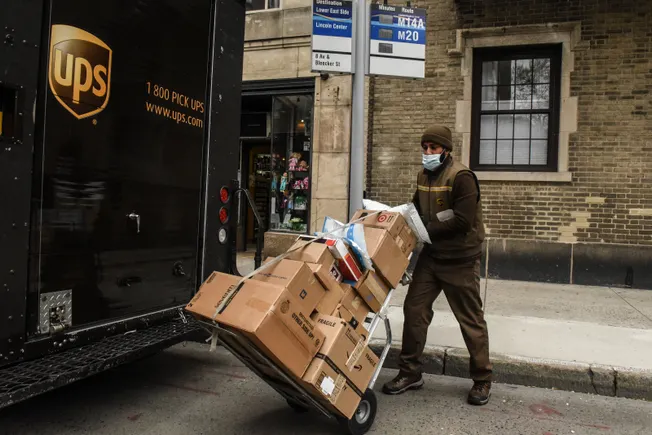
UPS is rolling back its voluntary driver buyout program across 13 states from Nebraska to Ohio, according to the International Brotherhood of Teamsters.
The decision comes after significant pushback to the Driver Choice Program, with more than 30 local unions filing grievances against the parcel carrier, according to the notice. The Teamsters also filed a lawsuit against the parcel company in February to stop the latest round of driver buyouts, although the case was denied by the U.S. District Court of Massachusetts.
In the suit, the union alleged that the voluntary buyout program had at least six violations of its National Master Agreement with UPS. The alleged violations included the direct dealing of new contracts with workers and the elimination of jobs when UPS contractually agreed to establish more positions.
However, UPS told Supply Chain Dive that the Driver Choice Program complies with its contract with the union and “has been well-received by our U.S. drivers around the country.”
“Teamster local unions in the Central Region have raised strong opposition to the Driver Choice Program (DCP) and have demanded that UPS not offer the DCP to drivers,” UPS said in an emailed statement. “We’ve engaged in discussions with the local unions in the Central Region regarding driver participation and in some areas those conversations continue.”
The 13 states where UPS is walking back the driver buyout program make up the Teamster’s central region, which covers more than 68,000 union members, per the union’s notice.
“The Teamsters strongly urge UPS to take the next right step and dismantle its Driver Choice Program across the country,” Teamsters General President Sean O’Brien said in a statement. “If UPS fails to do right by the men and women who deliver its packages and generate its billions in profit, the Teamsters will pursue our grievances nationwide and defeat UPS in arbitration.”
UPS in January announced its intention to launch its Driver Choice Program as it seeks to improve its bottom line and adjust to handling fewer deliveries for Amazon. Under the latest program, UPS planned to offer a $150,000 separation package for full-time U.S. drivers, with the enrollment window running from Feb. 13 to March 12 and separations beginning April 26.
The initiative came months after UPS implemented a similar separation program called the Driver Voluntary Separation Program. UPS executives touted the program as successful, with about 90% of affected drivers voluntarily exiting the company on Aug. 31.
Facts Only
UPS is rolling back its Driver Choice Program (DCP) in 13 states within the Teamsters' Central Region.
The Teamsters' Central Region covers over 68,000 union members.
More than 30 local Teamsters unions filed grievances against UPS over the DCP.
The Teamsters filed a lawsuit in February 2024 to stop the DCP, which was denied by the U.S. District Court of Massachusetts.
The lawsuit alleged six violations of the National Master Agreement, including direct dealing with workers and job elimination.
UPS states the DCP complies with its union contract and has been well-received by drivers.
UPS acknowledged discussions with local unions in the Central Region, with some conversations ongoing.
The DCP offered a $150,000 separation package to full-time U.S. drivers, with enrollment from February 13 to March 12, 2024.
Separations under the DCP were set to begin April 26, 2024.
A similar 2023 program, the Driver Voluntary Separation Program, saw about 90% of eligible drivers exit the company.
Teamsters General President Sean O’Brien urged UPS to dismantle the DCP nationwide or face further grievances and arbitration.
UPS announced the DCP in January 2024 as part of cost-cutting efforts following reduced Amazon deliveries.
Executive Summary
UPS is scaling back its voluntary driver buyout program, known as the Driver Choice Program (DCP), in 13 states across the Teamsters' Central Region, which includes over 68,000 union members. The rollback follows significant opposition from more than 30 local Teamsters unions, which filed grievances alleging contract violations, including direct dealing with workers and job elimination contrary to prior agreements. The Teamsters also filed a lawsuit in February to halt the program, though a federal court denied the case. UPS maintains the DCP complies with its contract and has been well-received by drivers, while acknowledging ongoing discussions with local unions in the affected region.
The DCP, announced in January, offered full-time U.S. drivers a $150,000 separation package, with enrollments from February 13 to March 12 and separations beginning April 26. This follows a similar 2023 program that UPS executives deemed successful, with about 90% of eligible drivers voluntarily exiting. The Teamsters, however, argue the program undermines job security and union agreements, threatening further legal action if UPS does not dismantle the DCP nationwide. The dispute reflects broader tensions between UPS's cost-cutting measures and labor protections as the company adjusts to reduced Amazon deliveries.
Full Take
The strongest version of this narrative frames UPS as a corporation navigating financial pressures while the Teamsters defend worker protections under a collective bargaining agreement. UPS presents the DCP as a voluntary, mutually beneficial program that aligns with contractual terms, while the Teamsters argue it violates job security provisions and undermines union authority. The court’s denial of the Teamsters’ lawsuit adds weight to UPS’s position, but the union’s continued grievances and threats of arbitration signal an unresolved power struggle.
Patterns detected: **ARC-0024 Ambiguity** (UPS’s claim of "well-received" buyouts lacks quantifiable evidence, while the Teamsters’ allegations of contract violations remain legally contested), **ARC-0043 Motte-and-Bailey** (UPS frames the program as "voluntary" while the Teamsters argue it effectively eliminates jobs, shifting between narrow legal compliance and broader labor implications).
Root cause: This dispute echoes the tension between corporate efficiency and labor stability, a recurring conflict in logistics and gig economies. UPS’s cost-cutting measures, driven by reduced Amazon business, collide with the Teamsters’ mission to preserve jobs and union leverage. The unstated assumption is that voluntary buyouts are inherently fair, but the Teamsters’ pushback reveals concerns about long-term job erosion under the guise of choice.
Implications: For workers, the DCP offers short-term financial incentives but may weaken job security and union bargaining power. For UPS, the program could reduce payroll costs but risks prolonged labor disputes. Second-order consequences include potential erosion of trust between management and labor, setting precedents for future contract negotiations.
Bridge questions: How might UPS’s financial pressures reshape labor relations beyond this dispute? What metrics would determine whether the DCP is truly "voluntary" or coercive in practice? Would a compromise—such as job retraining programs—address both cost concerns and worker protections?
Counterstrike scan: A coordinated influence campaign might amplify divisions by framing UPS as a predatory corporation or the Teamsters as obstructionist, using selective data to stoke outrage. However, the article presents both sides’ claims without overt manipulation, focusing on verifiable actions (grievances, lawsuits, statements) rather than emotional appeals. The content does not align with a hypothetical attack playbook.
Sentinel — Human
The article showing opposition to UPS's driver buyout program by the International Brotherhood of Teamsters is likely written by a human.