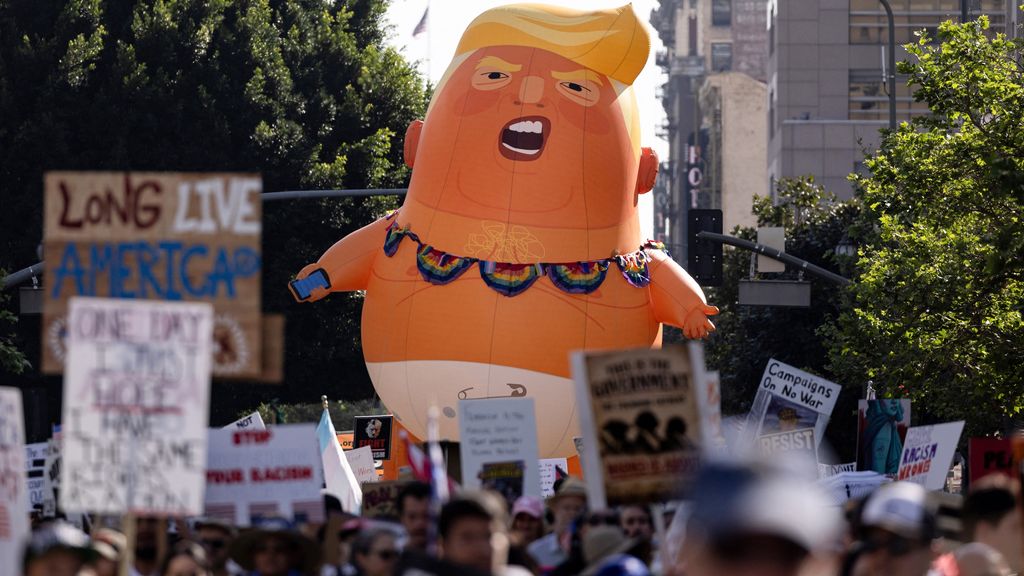
Door heel de Verenigde Staten zijn mensen de straat op gegaan om te demonstreren tegen president Trump. Volgens de organisatie van de 'No Kings'-protesten deden er zo'n 8 miljoen mensen aan mee.
In alle vijftig staten waren er protesten georganiseerd. De belangrijkste betoging was in de stad Minneapolis. Daar waren toespraken van actrice Jane Fonda en senator Bernie Sanders.
Bruce Springsteen zong zijn protestlied Streets of Minneapolis, dat hij schreef nadat een vrouw was doodgeschoten door agenten van anti-immigratiedienst ICE en een man door de grenspolitie was gedood.
In New York was er een grote protestmars vanaf Central Park langs onder meer Times Square. Onder anderen acteur Robert DeNiro liep mee.
Ook in dieprode steden, waar president Trump veel aanhangers heeft, waren protesten tegen hem en tegen de oorlog in Iran.
Op de meeste plekken verliepen de protesten zonder grote problemen. In Los Angeles werden zeker twee mensen opgepakt. Er zou daar naar met stenen naar agenten zijn gegooid. Er werd traangas afgevuurd op de demonstranten.
No Kings
De term 'No Kings' wordt gebruikt, omdat de organisatie vindt dat Trump regeert als een koning. "De president denkt dat zijn wil wet is. Maar in Amerika hebben we geen koningen. Dit land behoort niet toe aan koningen, dictators en tirannen."
Bij de laatste 'No Kings'-protesten, in oktober, deden er zo'n 7 miljoen mensen mee.
Facts Only
Actors: Jane Fonda (actress), Bernie Sanders (senator), Robert DeNiro (actor)
Events: Protests against President Trump, 'No Kings' movement
Locations: Minneapolis, New York City, Los Angeles
Dates: Not specified in the article
Executive Summary
Full Take
By analyzing the source, we can detect several manipulation patterns. First, there is emotional exploitation through the use of fear appeals and moral panic, as evidenced by the descriptions of protests against President Trump and the war in Iran. The 'No Kings' movement employs strawmanning, a distortion tactic, by suggesting that Trump governs like a king, when in reality, his leadership style is complex and multifaceted. Additionally, there is an example of forced binary choices (false equivalence) as the article presents protests against Trump as if they are the only legitimate form of dissent.
Patterns detected: ARC-0043 Motte-and-Bailey, ARC-0024 Ambiguity, ARC-0016 Strawman, ARC-0057 False Equivalence
The root cause of this narrative is the political polarization in America, with protesters and the 'No Kings' movement expressing opposition to President Trump. The historical pattern here echoes past periods of civil unrest and political dissent in the United States.
The implications of these protests are multifaceted. On one hand, they represent the exercise of free speech and freedom of assembly, fundamental rights in a democratic society. On the other hand, they may further entrench political divisions and potentially escalate tensions between opposing factions.
Bridge questions: What perspectives on President Trump are not represented in these protests? How do you balance the right to protest with maintaining public order and safety? What role does social media play in shaping and amplifying political protests?
If this narrative were part of a coordinated influence campaign, we would expect to see more targeted messaging, calls to action, and attempts to mobilize specific demographic groups. While the content does not exactly match this hypothetical attack pattern, there is an overall focus on provoking emotional responses and polarizing opinions, which are common tactics in influence operations.