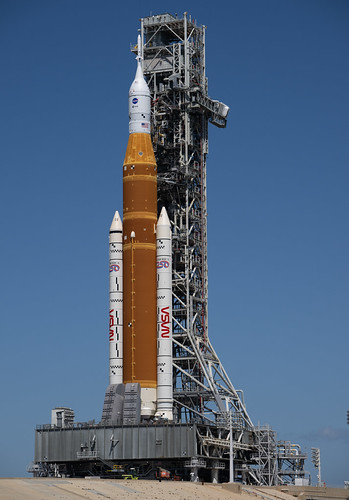
NASA is again revising its plan to return astronauts to the Moon and establish a sustainable presence there. With the launch of the Artemis II crew around the Moon coming up as soon as next week, today’s announcement is for a fast-paced 10-year program thereafter. Just between 2027 and 2028, the end of President Trump’s second term, 20 robotic landers and at least two human landings are planned. Also by the end of 2028, NASA wants to launch an interplanetary space nuclear reactor as a precursor to a lunar fission reactor already promised by 2030. The international Gateway space station that was to orbit the Moon, however, is “paused,” as NASA focuses on the surface instead.
NASA Administrator Jared Isaacman and other agency officials laid out a three-phase plan that is tied to implementing Trump’s December 2025 national space policy, Ensuring American Space Superiority. A key motivation is to ensure that American astronauts return to the Moon before Chinese taikonauts get there, which China plans to do by 2030.
Artemis II is still on track to launch as soon as April 1, but they will go around the Moon, not land. Lori Glaze, Acting Associate Administrator for Exploration Systems Development, said no issues are being tracked. Right now they are just looking at the weather. Four launch opportunities are available in the April 1-6 window. The launch can only take place when the Earth and Moon are correctly aligned. If they don’t launch by April 6, the next opportunity is April 30.
Artemis III was to be the first lunar landing since the Apollo era, but Isaacman announced on February 27 that he was changing it to be an earth-orbiting test flight in 2027, with two lunar landings in 2028, Artemis IV and V.
Today’s briefing filled in what else will be happening in those years and through 2036.
Some key takeaways, though hardly a comprehensive account, are the following.
The Gateway lunar space station is “paused” to focus on building lunar infrastructure. Isaacman was careful to say it isn’t “canceled” and could be revisited in the future, but also discussed how some of the segments could be repurposed for use on the surface. Rumors have been swirling for days that it would be discontinued even though Congress included $2.6 billion in the One, Big Beautiful Bill Act (OBBBA) enacted last summer specifically to complete Gateway’s construction. Europe, Japan, Canada and the UAE are Gateway partners. Sen. Ted Cruz, chairman of the Senate Commerce, Science, and Transportation Committee, included the language in the bill. In a post on X today, he said he looks forward to working with NASA to maintain American superiority in space and make a Moon base a reality. He didn’t address Gateway specifically.
The two Human Landing System (HLS) providers, SpaceX and Blue Origin, told NASA they do not prefer the Near Rectilinear Halo Orbit (NRHO) where astronauts were to transfer from the Orion spacecraft into the HLSs through Gateway. Now the HLS providers are allowed to look at other orbits, some of which could reduce crew risk with more frequent abort opportunities and flexibility in surface mission planning “allowing us to access different sites on the surface or flexibility in the timing of when we land,” according to Exploration Systems Development Acting Administrator Lori Glaze.
NASA will launch a demonstration nuclear reactor, Space Reactor-1 (SR-1) Freedom, to demonstrate fission power in space by the end of 2028. When it reaches Mars it will release a “Skyfall” of three Ingenuity-class helicopters to land on the surface. Steve Sinacore, Fission Surface Power program executive, said a decision hasn’t been made on where SR-1 will go after that.
NASA also now is planning to send 30 robotic landers — 10 per year in 2027, 2028, and 2029 — to begin establishing communications networks and other lunar infrastructure. The landers will build on the Commercial Lunar Payload Services (CLPS) missions begun by the Science Mission Directorate several years ago as Public-Private Partnerships where NASA pays to have its payloads delivered to the surface and the company is expected to find non-NASA customers to close the business case. Four have been launched so far, one of which — Firefly’s Blue Ghost Mission 1 — was a complete success.
A lunar base will evolve in three phases over the next decade, at a cost of $10 billion per phase.
Asked about the cost, Isaacman insisted NASA does not have a top-line budget issue. Rather it’s a matter of how they are spending the money.
NASA has been essentially flat-funded at roughly $25 billion (not adjusted for inflation) since FY2023. In addition to human exploration, NASA funds the earth-orbiting International Space Station (ISS), science, technology, and aeronautics programs.
Science Mission Directorate Associate Administrator Nicky Fox gave an overview of ongoing science missions including a stunning image of Saturn taken by the James Webb Space Telescope.
Her message, however, was about science and the Artemis program. “Science is why we’re going, and science is what we will do.” That includes launching more instruments on upcoming CLPS missions. She announced that Intuitive Machines (IM) was just awarded a fifth CLPS mission. The first two IM missions in 2024 and 2025 were partial successes, with both tipping over on landing.
While most of the day was about the Moon, the International Space Station and how to transition to commercial platforms was another topic. The ISS is an international partnership among the U.S., Russia, Europe, Japan and Canada. (The Gateway space station was originally envisioned as a way to keep the partnership together after the ISS ended, albeit without Russia after it invaded Ukraine. Russia continues to be a reliable ISS partner, however.)
The ISS is old. The first segments were launched in 1998 and it’s been permanently occupied by rotating crews for more than 25 years. NASA does not want to build another low Earth orbit (LEO) space station, but instead to become one of many customers for commercial space stations called Commercial LEO Destinations (CLDs). Conceptually, microgravity research in LEO someday will lead to profitable businesses in pharmaceuticals, for example. Space tourism is also envisioned as a commercial market. After many years, however, NASA conceded today it doesn’t see that commercial market emerging anytime soon.
That puts NASA in a quandary because without ISS or a commercial replacement, China will be the only country with a space station in LEO. As Isaacman said, NASA “cannot force an orbital economy to exist” but also cannot “accept a risk to America’s continuous presence in Earth orbit.”
ISS Program Manager Dana Weigel said the current model is unlikely to work and suggested an alternative for its CLD partners to consider. The idea is they could install their modules on the ISS initially and separate them later. One of the CLD companies, Axiom Space, already is planning to do that. A Request for Information (RFI) will be released tomorrow to get input. The underlying challenge, however, is that NASA doesn’t have enough money for either the current approach or the proposed alternative.
Isaacman said NASA nonetheless will “ignite the economy we all believe to be inevitable” including sending a “demand signal to industry for crew and cargo transportation to low Earth orbit for decades to come.”
The day-long livestreamed meeting presented a deluge of information that will take time to parse. Isaacman sent a letter to NASA employees that he shared on X outlining the new plan ending with “It is the moment when we start to believe again, when ideas become missions, and when hard work delivers world-changing accomplishments. We are leading the greatest adventure in human history, and it has only just begun. I am grateful to be working alongside all of you.”
NASA will hold break-out meetings with industry and other partners tomorrow to discuss it in more detail.
Isaacman said he has a “no surprises” philosophy and has had many discussions with industry and Congress in the three months he’s been in office. Less clear is how much notice the international partners had. ESA Director General Josef Aschbacher said last Thursday that he hadn’t been briefed on the plans at that point. ESA posted a new Gateway “blueprint” just last week.
Isaacman and others stressed the importance of international partners in NASA missions, but exactly what role they will play in this new lunar vision is unclear.
As for Congress, the House Science, Space, and Technology space subcommittee will hold a hearing tomorrow on the future of LEO space stations. Full committee chairman Rep. Brian Babin (R-TX) did not respond to our request for comment by press time, but Ranking Member Zoe Lofgren told us she looks forward to learning more about it.
“I’ve not yet had the opportunity to examine the proposals put forth today and any impacts they may have on other programs, and I hope to discuss these proposals during upcoming budget hearings. I look forward to working with Administrator Isaacman to ensure that NASA delivers missions that discover, advance exploration, and inspire.” — Rep. Zoe Lofgren
Apart from Sen. Cruz’s post on X, other congressional reaction is pending.
Scott Pace, Director of George Washington University’s Space Policy Institute who was Executive Secretary of the White House National Space Council in the first Trump term when Artemis began, told SpacePolicyOnline.com he likes what he heard.
“I think the new approach is terrific. It makes a number of overdue changes to the lunar campaign plan, creates new options for executing missions, and pays serious attention to re-building NASA’s human capital to implement human exploration efforts.” He added, however, that the SpaceX and Blue Origin HLS designs and Axiom’s spacesuits still need to be demonstrated and more details and cost estimates are needed “along with program phasing to ensure sufficient resources are available at the right times.”
NASA astronauts last walked on the Moon in 1972. In 1989, President George H.W. Bush initiated the first post-Apollo attempt to return astronauts to the Moon. Funding challenges doomed that effort. His son, President George W. Bush, resurrected the plan in 2004. That also fell victim to funding shortfalls when President Barack Obama took office amidst the Great Recession. Trump revived the effort in his first term, but funding shortfalls and technical delays, especially with the Starship Human Landing System, Axiom spacesuits, and Orion heat shield, have ceded the substantial lead the United States once had in returning astronauts to the Moon before China’s arrive.
This article was updated.
User Comments
SpacePolicyOnline.com has the right (but not the obligation) to monitor the comments and to remove any materials it deems inappropriate. We do not post comments that include links to other websites since we have no control over that content nor can we verify the security of such links.
Facts Only
NASA's Artemis program aims to return astronauts to the Moon
SpaceX and Blue Origin are developing Human Landing Systems (HLS)
Axiom is working on spacesuits
Funding shortfalls and technical delays have posed challenges in achieving this goal
The new approach for the lunar campaign plan was initiated by the Trump administration
Congressional figures have reacted to the proposals, with some expressing support and others awaiting more information
Executive Summary
Full Take
The article presents a complex situation that requires careful analysis. On one hand, the initiative to return astronauts to the Moon is commendable and aligns with the broader goal of space exploration. However, the history of similar endeavors (George H.W. Bush's attempt in 1989 and George W. Bush's resurrection in 2004) suggests that funding shortfalls and technical delays could jeopardize this mission.
Patterns detected: ARC-0037 Mission Drift, ARC-0024 Ambiguity (as the article does not explicitly state the goals and objectives of the Artemis program beyond returning astronauts to the Moon)
In terms of implications, this mission, if successful, could further solidify the United States' leadership in space exploration. However, it is crucial to consider the costs involved, both financial and human, as well as the potential second-order consequences for international cooperation and competition in space.
Bridge Questions: What are the specific goals and objectives of NASA's Artemis program beyond returning astronauts to the Moon? What are the long-term implications of this mission for international relations and space exploration? How can we ensure that the funding and technical challenges are adequately addressed to achieve a successful mission?
Sentinel — Human
This text shows signs of a human writer, with an informative and balanced writing style. Sentence length variance is slightly inconsistent, but overall the text does not exhibit clear stylometric, coherence, coordination, or fabrication signals indicative of AI-generated content.