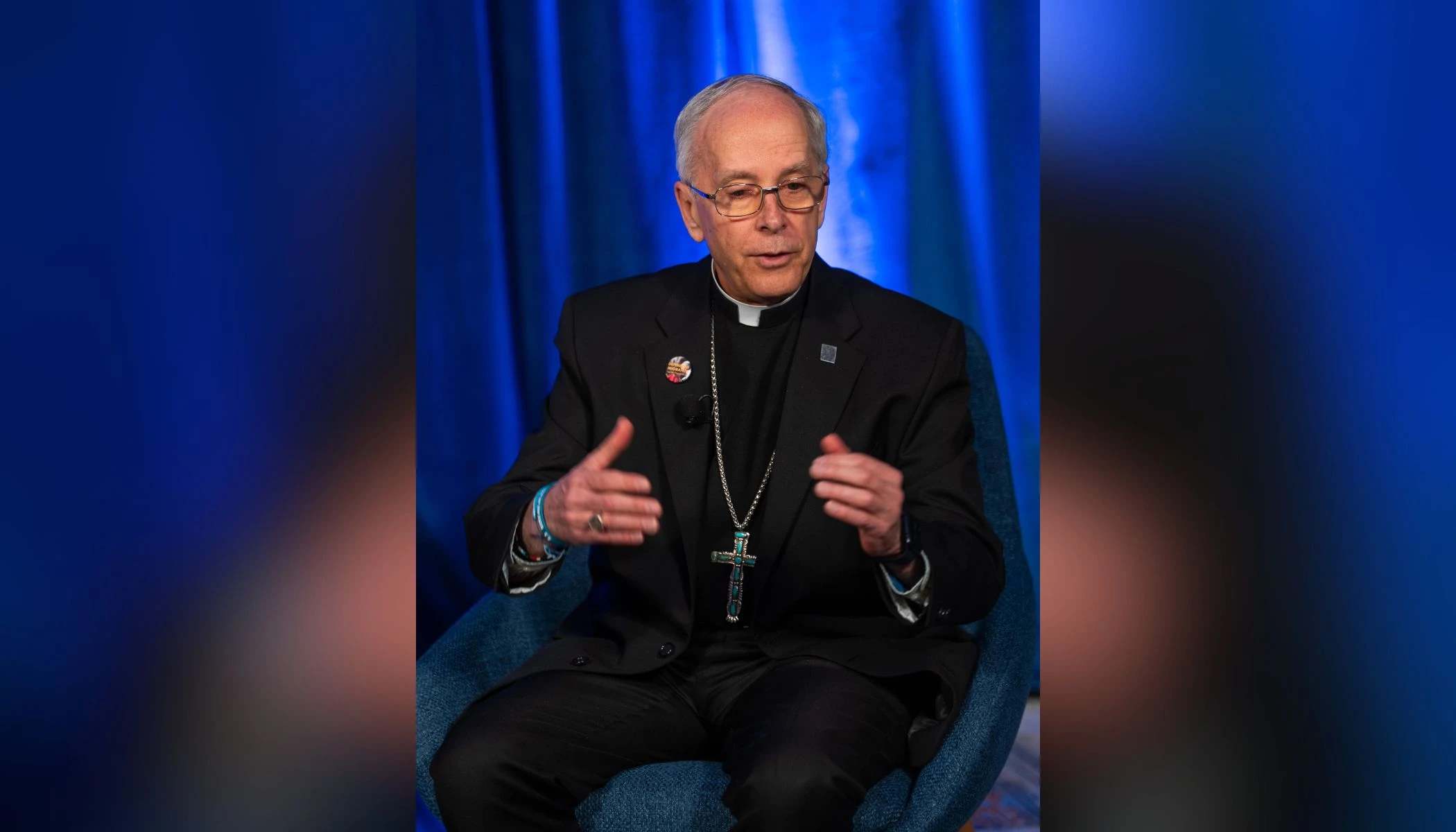
Bishop Mark Seitz of El Paso, Texas, released the first pastoral letter on mass detention and deportations.
The “current national campaign of mass detention and detention is a grave moral evil, one which must be opposed, with prayer, peaceful action, and acts of solidarity with those affected,” Seitz wrote.
The Diocese of El Paso will hold a vigil on March 24 to “plead for respect for human life,” Seitz announced in the letter. He invited the faithful “to march and pray” with him and Auxiliary Bishop Anthony Celino as “an act of Lenten solidarity.”
“In this holy season of Lent, God invites us to journey with the suffering Jesus to the cross and to new life in the Resurrection,” Seitz wrote. “For this reason, I take this opportunity to speak to all the faithful in our El Paso Catholic community, and in particular to immigrant families.”
“Our Holy Father, Pope Leo XIV, told me personally to stand in solidarity with suffering migrant families and not to remain silent,” he said. “I will do everything I can to uphold the God-given dignity of every person in our borderlands community.”
The message written by Seitz was the first pastoral letter, a message authored by a U.S. bishop, on mass detention and deportations, according to the Diocese of El Paso.
The letter follows the United States Conference of Catholic Bishops’ (USCCB) special message on immigration approved at the 2025 Fall Plenary Assembly on Nov. 12, which expressed the bishops’ opposition to “the indiscriminate mass deportation of people.”
The bishops also addressed their concerns over the conditions of detention centers and prayed “for an end to dehumanizing rhetoric and violence, whether directed at immigrants or at law enforcement.”
Deportation and detention facilities
“To those of you affected by hatred and discrimination and afraid of what comes next, know that the Church stands with you,” Seitz wrote. “As your bishop, I carry your pain daily in my heart and in my prayers.”
The bishop wrote that people in the El Paso community are being taken by law enforcement as they leave immigration court proceedings, workers are being taken from their jobs, and parents are no longer able to work because the government has taken away their work permits.
Seitz also detailed the treatment of immigrants in detention centers, specifically at El Paso’s Camp East Montana immigrant detention center.
“Young women are languishing in mental torture for months in private detention centers, even when, coerced by the conditions of their imprisonment, they beg to be deported,” he wrote. “So many people are once again being made to feel like they are less than American.”
To combat this, the El Paso Catholic Church “will redouble our ministries with those in the downtown courthouse, in the detention centers, in Ciudad Juarez and with families in our parishes,” Seitz wrote. “We will continue to celebrate your contributions to our community, to defend your human dignity, and to work to end racism and make immigration reform a reality.”
Need for ‘significant immigration reforms’
“While we do need significant immigration reforms, it is an injustice to make families, children, and the vulnerable pay the price of our inaction,” Seitz wrote. “Policies, laws, and borders must always be at the service of human dignity, genuine community security, and human flourishing.”
Addressing law enforcement, Seitz said he is “blessed with many friendships” in local law enforcement and immigration enforcement agents. “Their work to keep our community safe is vital,” he said. “But the death of those in immigration detention is unacceptable.”
... the death of those in immigration detention is unacceptable.
Thirty-eight people have died in custody of Immigration and Customs Enforcement (ICE) since the start of fiscal 2025, 58% more detainee deaths in ICE custody than occurred during all four previous fiscal years combined (24 deaths), according to ICE detainee death reporting data.
Seitz called on immigration enforcement to follow the Gospel rather than “immoral order,” offering them guidance on how to decide what actions align with the faith.
“No one has to obey an immoral order. I implore all involved to carefully discern the moral requirements of the Gospel at this moment with integrity and honesty,” Seitz said.
“I promise the pastoral support of our priests, chaplains, and myself as you navigate the demands of conscience with sincerity. You are also in my prayers,” he wrote.
“May Mary of Guadalupe, who challenges us to build up a common home of tenderness and love, pray for us,” Seitz concluded.
U.S. bishops said they hope to work with Homeland Security Secretary Kristi Noem’s replacement. Policy scholars said they expect that many of the administration’s priorities will remain in place.
Facts Only
Bishop Mark Seitz of El Paso, Texas, released a pastoral letter on mass detention and deportations, calling them a "grave moral evil."
The Diocese of El Paso will hold a vigil on March 24 to advocate for respect for human life and immigrant rights.
Seitz invited the faithful to participate in a march and prayer as an act of Lenten solidarity.
The letter references Pope Leo XIV’s directive to stand in solidarity with migrant families.
The U.S. Conference of Catholic Bishops (USCCB) issued a special message in November 2025 opposing indiscriminate mass deportations and dehumanizing rhetoric.
Seitz described conditions in El Paso’s Camp East Montana immigrant detention center, including reports of mental distress among detainees.
The El Paso Catholic Church plans to expand ministries in detention centers, courthouses, and Ciudad Juárez.
Seitz called for immigration reform that serves human dignity and community security.
He acknowledged friendships with law enforcement but condemned deaths in immigration detention as unacceptable.
ICE reported 38 detainee deaths in fiscal 2025, a 58% increase from the previous four years combined.
Seitz urged immigration enforcement agents to follow moral principles and offered pastoral support.
The bishops expressed hope to work with Homeland Security Secretary Kristi Noem’s replacement.
Executive Summary
Bishop Mark Seitz of El Paso, Texas, issued the first pastoral letter by a U.S. bishop addressing mass detention and deportations, condemning them as a "grave moral evil." The Diocese of El Paso will hold a vigil on March 24 to advocate for human dignity and immigrant rights, framing it as an act of Lenten solidarity. Seitz cited Pope Leo XIV’s directive to support migrant families and criticized conditions in detention centers, including reports of psychological distress and deaths in custody. The letter aligns with the U.S. Conference of Catholic Bishops’ opposition to indiscriminate deportations and dehumanizing rhetoric. Seitz called for immigration reform that prioritizes human dignity while acknowledging the role of law enforcement, though he condemned deaths in detention as unacceptable. The bishop also urged enforcement agents to follow moral principles over "immoral orders," offering pastoral support. The context includes rising detainee deaths under ICE custody, with 38 fatalities in fiscal 2025 alone, a 58% increase from previous years. The narrative balances moral advocacy with calls for systemic change, though it remains unclear how broader policy shifts might address these concerns.
The situation reflects tensions between enforcement priorities and humanitarian values, with religious leaders positioning themselves as advocates for vulnerable populations. While Seitz’s stance is rooted in Catholic social teaching, the letter’s impact on policy or public opinion is uncertain. The bishops’ hope to collaborate with Homeland Security leadership suggests a willingness to engage institutionally, though the article does not specify concrete proposals for reform.
Full Take
The strongest version of this narrative frames mass detention and deportations as a moral crisis, leveraging religious authority to challenge systemic injustices. Bishop Seitz’s pastoral letter is a rare and deliberate act of institutional opposition, grounding its critique in Catholic social teaching while appealing to both faith and conscience. The letter’s timing—during Lent—and its call for solidarity with immigrants amplify its emotional resonance, positioning the Church as a defender of the vulnerable. The inclusion of specific details, such as deaths in ICE custody and conditions in detention centers, strengthens the moral urgency of the argument.
However, the narrative risks emotional exploitation (ARC-0012) by framing the issue in stark moral terms without fully addressing the complexities of immigration enforcement or policy trade-offs. The appeal to "human dignity" is powerful but abstract, potentially sidestepping pragmatic debates about border security or legal frameworks. The letter also employs a form of moral authority (ARC-0031) by invoking the Pope’s directive, which may resonate with Catholic audiences but could alienate others who view immigration through different lenses.
Rooted in the paradigm of human rights and religious duty, the narrative assumes that moral clarity alone can drive policy change. This echoes historical patterns of faith-based activism, from civil rights movements to sanctuary campaigns, where religious institutions position themselves as counterweights to state power. Yet, the letter’s focus on individual conscience—urging enforcement agents to disobey "immoral orders"—raises questions about institutional accountability and systemic reform. Who decides what constitutes an "immoral order"? How can moral appeals translate into structural change?
The implications for human agency are significant: the narrative empowers individuals to act on conscience but risks oversimplifying the role of law enforcement and policy. The costs are borne by detainees and their families, while the benefits accrue to those who align with the Church’s moral framework. Second-order consequences could include heightened polarization, as critics may dismiss the letter as partisan or naive.
Bridge questions: What perspectives from law enforcement or policymakers are missing from this critique? How might immigration reform balance humanitarian concerns with enforcement realities? What evidence would change your view on the morality of detention policies?
Counterstrike scan: A coordinated influence campaign would likely amplify emotional appeals, omit counterarguments, and frame the issue as a binary moral choice. While this letter leans into moral urgency, it does not suppress opposing views or engage in outright distortion. The focus on human dignity and institutional accountability aligns with genuine advocacy rather than manipulation. No structural alignment with a hypothetical attack playbook is detected.
Sentinel — Human
The article shows strong signs of human authorship, with minor inconsistencies (e.g., 'Pope Leo XIV') that may reflect editorial errors rather than synthetic generation.