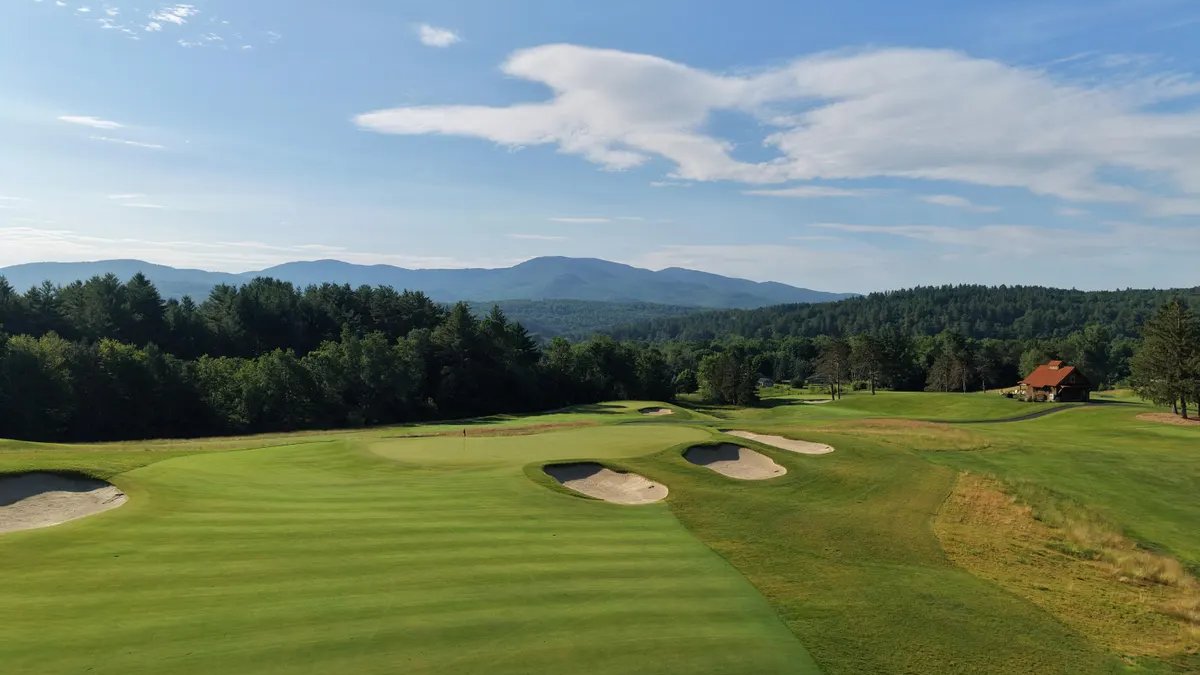
Vermont might be best known for its breathtaking ski resorts when it comes to outdoor pursuits, but the golf offerings in the historic community of Stowe are now better than ever with the recently completed redesign of the Stowe Country Club by architect Beau Welling and his team.
The transformation at the course, set on a former dairy farm with views of the Green Mountains, firmly establishes Stowe as one of New England’s top 36-hole golf destinations.
The wide open and walkable nature of Stowe CC complements the ruggedness and dramatic elevation changes at The Mountain Course at Spruce Peak just minutes up the road, with both courses accessible by guests staying at The Lodge at Spruce Peak as well as members of The Club at Spruce Peak.
“This project honors the history of the course while reimagining it for the next generation, creating a place where members, guests, and local residents can gather to enjoy the landscape, the sport, and the shared experiences that define this region,” said Sam Gaines, who is the president of Mt. Mansfield Company, the ownership group behind Stowe Country Club, and lives in the town with his wife and three children.
Stowe CC has transitioned from a public facility to a private club (with the limited guess access) as part of the redevelopment, which reflects a broader vision for the area as a four-season mountain destination. Also in the plans are a new clubhouse, expanded dining, racquet sports, fitness and wellness activities, and additional recreational offerings.
But improving the golf course was the first step in that evolution and the results are the culmination of a process that started more than a decade ago when Gaines first invited Welling to see the property. The two had met at gatherings of the Urban Land Institute, which puts a focus on the environment in transforming communities, and Gaines was eager to have Welling offer advice on what needed to be done most urgently on “175 acres in the middle of the most affluent and amazing historic town” in Vermont.
Welling, who for years has worked with Tiger Woods and his design team, traces his New England ties back to his days playing for the Brown University golf team in Rhode Island.
“I could see the potential, almost immediately, of how special an environment this place is,” said Welling. “But when we first started talking about this project, I think it was more of a dream.”
Full Redesign
Early efforts included Welling redesigning two greens encumbered by wetlands and other issues. But the scope of the project expanded dramatically after the pandemic, as golf surged in popularity.
Around 2022, Welling started to put together a full 18-hole redesign plan for Stowe Country Club, which had long been a welcoming and community-focused public course. It was popular in a hybrid community of sorts that brought together a diverse mix of year-round residents, seasonal residents, and tourists – whether for ski season or during the spring, summer and fall (peak leaf-change season) months.
When the work started on the first nine holes in 2024, the breadth of the project continued to grow, becoming much more than new green complexes.
Today’s finished product includes complete reconstruction of all greens and tees, a reshaping and regrading of all fairways, modernization of the bunkers, upgraded irrigation and drainage systems, and a full re-grassing of premium bentgrass across greens, tees and fairways.
Several holes were changed significantly, notably the 13th and 15th holes, and a new comfort station – the Sugar Shack – has been added between the 5th and 14th tees. Hundreds of non-native pine trees were removed from the course itself, with about 150 new ones planted on its perimeter. The removal of the interior trees opened views of the surrounding mountains, including Mt. Mansfield, and the addition of waving fescue grasses to replace them helps better frame the holes.
For Welling, the overall focus was on improving playability, variety, strategy, and aesthetics.
“It feels like the sort of classic Northeast golf course, with rolling topography, distinctive bunkering, challenging greens contours, fescue grasses,” said Welling. “The environment feels classic and special to me.”
A secondary club logo, a flying cow, is a nod to the property’s history.
An Artistic Process
For Gaines, who’s worked in private equity and real estate for well over a decade and was accustomed to executing strategic plans with little deviation, the artistic process of an evolving golf course redesign was something he said he had to “hold onto my seat” for. Especially if it involved the relocation of an entire green complex. He joked that part felt “a little bit building the airplane while you're flying it, but it’s also pragmatic problem solving. And that’s what you're after.”
The initial response to the course changes and broader project have been overwhelmingly positive.
More than 200 new members have been added at Stowe Country Club and The Club at Spruce Peak, many of them coming from the Boston and New York areas.
And for those looking to travel to Vermont for golf (and any number of other outdoor activities) rather than skiing, Stowe and The Mountain Course are both accessible through stay-and-play packages in guestrooms, suites and private residences at the luxurious Lodge at Spruce Peak.
While the Mountain Course remains a wild ride, climbing and diving across elevations of about 1,800 feet, Stowe Country Club in the valley is drastically different – and now better than ever.
“For the most part, we left the topography the way it is, because it’s naturally undulating,” said Gaines. “There are golf course developers who will pay $40 million to end up with this result. The only difference is they start with a flat site.”
Facts Only
* Stowe Country Club was redesigned by architect Beau Welling and his team.
* The course is set on a former dairy farm with views of the Green Mountains.
* The project established Stowe as a top 36-hole golf destination in New England.
* Stowe CC transitioned from a public facility to a private club.
* Improvements included reconstruction of greens and tees, reshaping of fairways, and modernization of bunkers.
* Non-native pine trees were removed and new fescue grasses were planted on the course perimeter.
* The project involved redesigning the 13th and 15th holes and adding the Sugar Shack comfort station.
* The work spanned a process initiated over a decade ago with Beau Welling.
* More than 200 new members were added to Stowe Country Club and The Club at Spruce Peak.
Executive Summary
Full Take
The narrative presents an evolution of a landscape driven by aesthetic and experiential goals, moving from a public recreational space to a high-end private destination. The underlying pattern suggests that significant perceived value—in this case, the marketability of a region as a mountain resort—is often unlocked through intentional design intervention and segmentation of access. The shift in ownership status, moving from public to private, mirrors a broader trend where shared natural assets are re-framed for exclusive consumption. Gaines’s perspective highlights the tension between pragmatic execution (problem-solving) and artistic vision (dreaming), suggesting that high-level transformations often require balancing both structural logic and aspirational design. The emphasis on improving playability, variety, and aesthetics points toward an ongoing process where physical space is engineered to support a desired social and economic narrative—the "classic Northeast golf course" ideal. This suggests that the perceived 'specialness' of the environment is directly tied to its managed presentation.
Bridge Questions: What are the long-term effects of structuring natural environments primarily around aesthetic and experiential standards? How do evolving definitions of 'public' vs. 'private' space impact community identity in resort areas? If property owners initiate value creation through design, what checks exist against aesthetic goals overriding functional or ecological concerns over time?
Sentinel — Human
The article is well-structured feature writing that blends architectural specifics with personal reflection, strongly indicating human authorship focused on a specific real estate/lifestyle story.