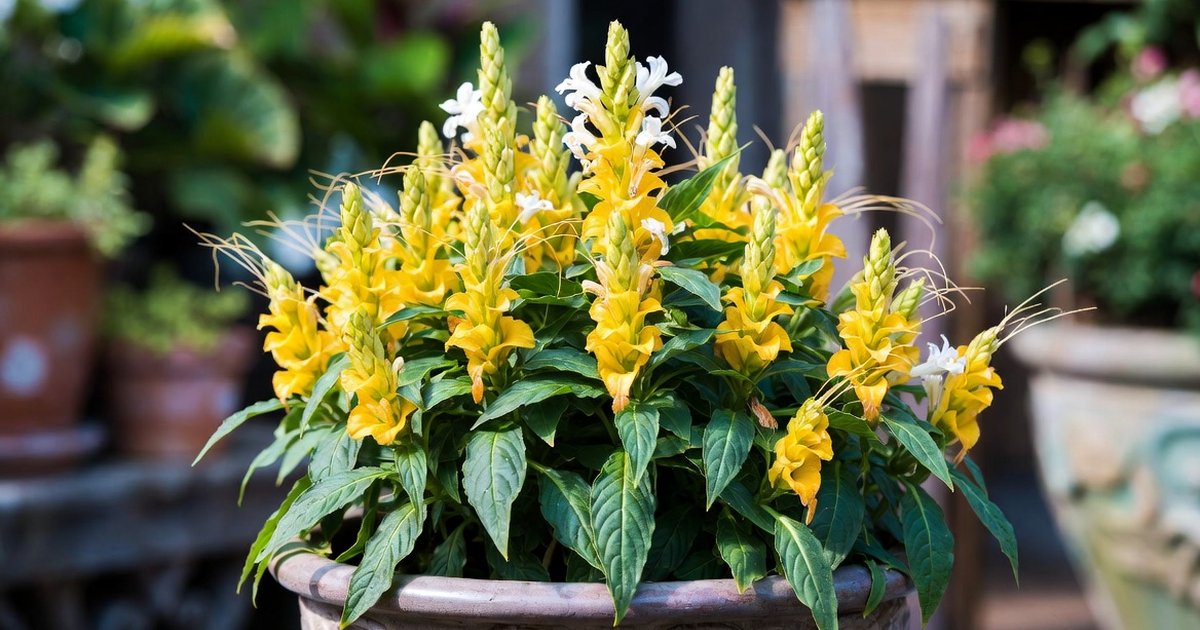
Few plants turn heads quite like the Golden Shrimp Plant (Pachystachys lutea). Also known as the Lollipop Plant or Yellow Shrimp Plant, this delightful tropical offers unique charm with its bright golden-yellow bracts that overlap like stacked shrimp or little lollipops. From the bracts emerge tiny white tubular flowers that add delicate contrast, creating a long-lasting display that brings a playful, exotic touch to any setting.
At Plantorium in Fort Collins, we love recommending the Shrimp Plant as a standout choice for mixed containers, hanging baskets (as a thriller or upright accent), and shaded patios. Its bold architectural form and vibrant color make it an excellent conversation starter.
Why Gardeners Love the Shrimp Plant
- Striking blooms: Golden-yellow bracts appear from spring through fall, often lasting for months.
- Lush foliage: Deep green, lance-shaped leaves provide beautiful contrast.
- Versatile growth: In containers, it typically stays a manageable 18–36 inches tall, making it perfect for 12- to 22-inch planters.
- Pollinator magnet: The flowers attract hummingbirds and butterflies.
Growing Conditions
Light: The Golden Shrimp Plant prefers partial shade to full sun (with afternoon protection in hot climates). In Colorado, morning sun with afternoon shade often produces the best results.
Water: Keep the soil consistently moist but never soggy. It appreciates regular watering, especially during hot summer days.
Soil: Use a rich, well-draining potting mix. Adding some compost helps support its lush growth.
Temperature: As a true tropical, it thrives in warm conditions and should be protected once nights drop below 50–55°F. In our area, it’s best grown as a seasonal annual or brought indoors for winter.
Fertilizer: Feed monthly during the growing season with a balanced liquid fertilizer or bloom booster to encourage abundant bracts.
Maintenance Tip: Pinch the growing tips regularly to encourage bushier growth and more flowers. You can also prune it back in early spring to maintain a compact, attractive shape.
Design Ideas
The Shrimp Plant excels as a Thriller in the Spillers-Fillers-Thrillers formula. Pair it with trailing Bacopa, Lysimachia, or Petunias in sunny to part-shade baskets, or combine it with Coleus, Begonias, and Asparagus Fern for a lush shade container. Its upright habit and bright color bring energy and height to any composition.
Whether displayed alone in a beautiful planter or as the centerpiece of a mixed arrangement, the Golden Shrimp Plant delivers weeks of cheerful color and tropical flair.
Ready to add some shrimp to your garden?
Stop by Plantorium and let our team help you choose the perfect companions for your Pachystachys. Don’t let budget concerns hold you back—start with one standout plant and watch your containers come alive with personality and color.
Look for more individual plant spotlights and our full “Spillers, Fillers, and Thrillers” guide on Plantorium.com.
Facts Only
*Pachystachys lutea* is the Golden Shrimp Plant.
It is also known as the Lollipop Plant or Yellow Shrimp Plant.
The plant features bright golden-yellow bracts that overlap.
Tiny white tubular flowers emerge from the bracts.
It is recommended for mixed containers, hanging baskets, and shaded patios.
Optimal light conditions are partial shade to full sun, with afternoon protection in hot climates.
In Colorado, morning sun with afternoon shade is often recommended.
The plant requires consistently moist soil.
It needs a rich, well-draining potting mix.
It thrives in warm conditions.
It should be protected once nights drop below 50–55°F.
Monthly feeding with liquid fertilizer is recommended during the growing season.
Maintenance involves pinching growing tips and seasonal pruning.
Executive Summary
Full Take
The presentation of the Golden Shrimp Plant relies heavily on aesthetic appeal and aspirational gardening narratives. The framing positions the plant as a desirable, "exotic" object that provides immediate, cheerful color and tropical flair, suggesting that possessing the plant equates to achieving a playful, exotic aesthetic. This is supported by the use of vivid, sensory language ("delightful," "vibrant," "cheerful").
The practical instructions regarding growing conditions are presented as absolute rules (e.g., specific temperature limits, specific watering requirements) alongside commercial recommendations (which types of fertilizer, which container sizes). This structure subtly leverages authority—the plant's perceived beauty and the store's expertise—to guide the consumer toward specific purchasing decisions and maintenance routines.
The designation of the plant as a "Thriller" in the Spillers-Fillers-Thrillers formula is a classic example of framing reality to fit a specific, pre-existing pattern. This pattern is not inherent to the plant itself but is an externally imposed design convention used to create a functional, marketable structure for container arrangements. The emphasis on "excellent conversation starter" and "outstanding choice" transforms botanical facts into consumer desires.
The narrative operates by establishing a predictable cycle: beauty is observed, conditions are managed, and specific design roles are assigned. The implications for the reader are that gardening is not just a biological act but a staged performance aimed at fulfilling an aesthetic ideal, where commercial entities provide the blueprint for success. The implied assumption is that the gardener seeks validation and ease, and the product is marketed as the solution to achieving that validated, visually rich outcome.
Sentinel — Human
The text reads as human-authored instructional content, demonstrating contextual knowledge and a specific voice rather than purely generalized, machine-generated information.