If you wind up with an upset tummy after eating some questionable food, you're probably one of the lucky ones.
Food-borne illnesses are a global and potentially lethal problem that causes much more than intestinal anguish.
It's estimated that more than 850 million people fall ill every year after eating contaminated foods, resulting in over 1.5 million annual deaths, according to the World Health Organization (WHO).
And although technology has commandeered most aspects of daily life, our go-to food safety practice is still a quick, perfunctory sniff test to determine the freshness of yesterday's milk or last week's leftovers.
But the human nose is an imperfect chemical detector, as evidenced by many morning-after Pepto-Bismol chugs.
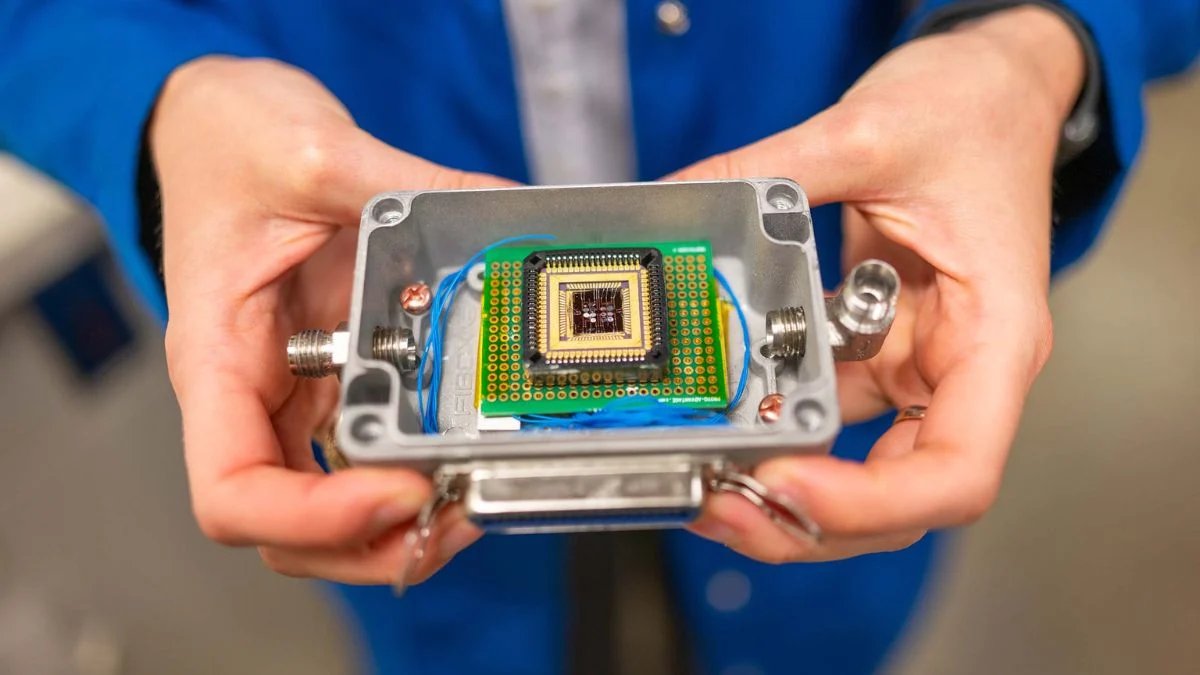
So, to save us from a secretly sickening slice of salmon, engineers at the University of California (UC) Berkeley have developed an 'electric nose', describing their work in Science Advances.
Importantly, this technology can be incorporated into everyday appliances to protect us from hidden pathogens, including those associated with food spoilage.
"I think 'smart' fridges – which come with sensors that you can control on your phone – would be a great application for this kind of technology," explains Carla Bassil, an electrical engineer at UC Berkeley and the study's lead author.
"How great would it be if your fridge could tell you, 'Hey, your broccoli's going to go bad soon, so you should probably eat that'? Or, 'Your chicken is on its last day'?"
The 'electric nose' consists of 16 sensors, each sensitive to a slightly different mix of gases, to give uncertain eaters a thumbs up or down on that leftover chicken leg.
Bassil likens these sensors to 'digital taste buds', each tuned to a different stimulus.
"Each of these 16 sensors has a different sensing film on it, and it works by converting chemical reactions between the sensor surface and the gas molecule into electrical signals," she explained in a recent talk.
The researchers used machine learning methods to train the e-nose to recognize 16 different food products, achieving an overall prediction accuracy of nearly 93 percent.
These items include fruits and common nut allergens, such as walnuts and peanuts. They also gave it the unenviable task of identifying raw chicken, milk, and eggs left out of the fridge for 24 to 48 hours.
The e-nose represents multiple advances over other single-chip gas detection systems that may use only 2 to 10 sensors, the researchers claim.
For example, the e-nose works at room temperature, thanks to semiconductors made of carbon nanotubes – a nigh-miraculous material that offers a high surface area, in addition to strength and lightness.
What's more, manufacturing this artificial proboscis requires a relatively simple technique called drop casting, in which researchers apply a nanoparticle-laden solution onto a chip, rinse it, and dry it with a sci-fi-sounding nitrogen gun.
"The truly scalable aspect of my electronic nose is that we can use all these different types of sensing materials while depositing them all in a single step," Bassil says.
Yet there are still multiple avenues for improvement.
The researchers have already made strides in preventing category confusion, which may confound tree nuts and peanuts (which are legumes) – an essential distinction, as these are among the nine most common allergens in the US and may cause potentially life-threatening anaphylaxis.
As a result, this synthetic schnoz may eventually be used to detect allergens as well. This will hopefully prevent some of the nearly 3.4 million emergency hospital visits due to food allergies that happen each year in the US, amounting to one patient every 10 seconds.
Furthermore, while the e-nose can detect a scant 0.05 grams of isolated walnut, or about one-hundredth of a single nut, it has yet to be tested in more complex conditions. Detecting a whiff of walnut that's baked in a cake, or picking out a single spoiled item in a fridge stocked full of food, are trickier tasks.
The team is also developing a portable e-nose that syncs with a smartphone app. Restaurant patrons swiping a cyber-sniffer over their sushi could one day become a common sight across eateries.
How much such a device would cost, and whether it could be used in other, low-resource settings, remains to be seen. Many food-borne illnesses are due to a lack of refrigeration, contaminated water, or intermittent electricity – basic needs which need to be addressed.
Related: The 4 Key Signs You Should Chuck Old Food, According to Science
But there's no reason to limit e-nose applications to food. This technology could potentially be expanded to biometrics, to understand and track human-health scents à la diabetes alert dogs.
"Machine learning has proved to be a game changer for sensor technology, thanks to advances in pattern recognition capabilities and greater ease of use," Bassil concludes.
"And what's exciting is that you can train the e-nose on your choice of objects, so you can potentially design sensors tailored to any application."
This research was published in Science Advances.
This article was fact-checked by Rachel Garner and edited by Clare Watson. While we pride ourselves on our process, we are only human. If you spot a mistake, please let us know.
Sentinel — Human
The text is a well-structured journalistic piece effectively balancing high-level public health concerns with specific scientific innovation, showing strong human narrative control and grounding in verifiable claims.