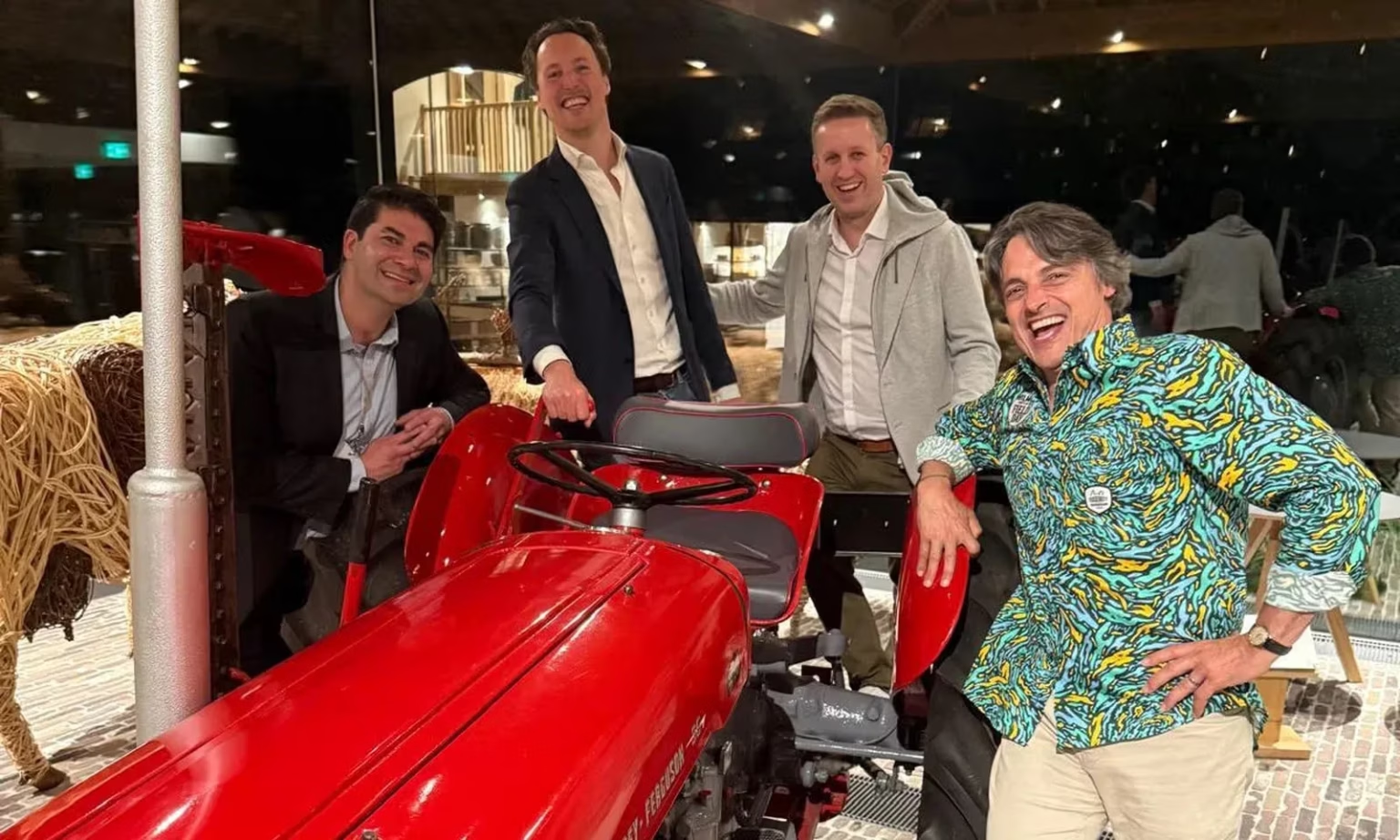
“The key in our space is not to focus on creating new categories but focus on the system itself and rewire it,” Anterra Capital founding partner Maarten Goossens said this week as his firm announced a $100 million first close of its Fund III for food and agriculture.
“The system itself is big enough that if we rewire it the right way, we will have far more impact,” he added.
Fund III’s $100 million first close (against a target of $200 million) is a milestone not just for food and ag VC Anterra, but for the entire agrifood industry, which saw investment drop 69% between 2021 and the present day.
The storyline is old hat now: generalist VCs rushed lemmings-style into newly created investment categories like alternative protein and vertical farming, dumping hundreds of millions into a handful of startups. When said startups failed to deliver on promises of revolutionizing the food system, generalists fled and a massive correction ensued.
“It’s certainly been a tougher environment than when we raised Fund II during 2021, 2022,” Goossens tells AgFunderNews.
Fund II reached $260 million against a $175 million target, which he says “shows how hot the environment was at the time.”
He suggests his firm’s continued focus on rewiring rather than reinventing the food system is what has enabled Anterra to continue delivering returns and ultimately make its first close of Fund III.
“We stay away from the hype and look at fundamentals every time, and then stick to them. That is the most important piece, is and a big part of our DNA.”
‘Far more value’ in meat vs alt meat
Consider the protein space. Anterra’s portfolio includes multiple startups working in animal health including animals used for food production.
As Goossens explains it, Anterra focuses on making the protein category better for planetary health and animal welfare versus trying to eradicate the meat industry altogether.
“If you put things in perspective, the alternative meat industry is somewhere between $10 billion to $20 billion in annual revenue, whereas the meat industry is close to $2 trillion. Our hypothesis is, fix the bigger industry,” he says.
There is, he adds, “far more value, and far more impact, in rewiring how it operates than in chasing the smaller one.”
Anterra’s portfolio includes veterinary health company Invetx, which Dechra Pharmaceuticals acquired in 2024 for around $500 million.
The AI opportunity
The firm will continue to focus in part on animal health in Fund III, which has already made two investments. It has already founded and funded veterinary biologics company Aminerra, for example.
Other possible investment areas will include startups using AI to address bottlenecks in food production.
Anchr, which bills itself “the AI operating system for food production,” and in which Fund III has already invested, is an AI-native platform that deals with inefficiencies in the seafood production chain from fishing vessel to restaurant.
“That’s where agentic AI is actually a perfect solution because it can link to disparate data sets, analyze online and offline information, and connect with different software systems,” notes Goossens.
“The opportunity sits in building vertical specific solutions, which are less hyped, where it’s harder to build, and therefore it doesn’t scale as quickly. At the same time, you can build defensible businesses with real moats, which compound over time”
Continued focus on fundamentals
Anterra has not publicly disclosed backers to Fund III, saying only that the pool includes “the world’s largest food and agriculture bank, one of the largest life sciences investors globally, a leading Asian sovereign wealth fund, and the world’s largest animal health company.”
Goossens won’t disclose specific names, but does note that many previous investors returned for Fund III.
Rabobank, which spun out Anterra in 2013, along with Novo Holdings, and Zoetis are among Anterra’s existing investors.
Fund III will also see Anterra continue to create startups from within its own walls, something Goossens says is a major standout feature of the firm.
“It differentiates us from the rest in our space, makes us unique, and has shown to deliver real returns.”
Anterra built three companies in Fund I and seven in Fund II. It aims for seven to 10 for Fund III.
As for how Anterra is navigating the current reset in agrifood investing, Goossens simply says the firm will “continue to challenge the fundamentals.”
“We don’t want to compare ourselves with niche sectors within VC. We want to be compared with general VC benchmarks, and as it stands, Fund I and Fund II are delivering top-tier returns.
“That’s the key thing, which drives interest and which ultimately keeps us afloat and enables us to continue on this journey.”
Facts Only
* Anterra Capital announced a $100 million first close for its Fund III focused on food and agriculture.
* The fund target was $200 million.
* The agrifood industry experienced an investment drop of 69% between 2021 and the present day.
* Fund II reached $260 million against a $175 million target.
* Anterra’s portfolio includes animal health startups, such as Invetx, which Dechra Pharmaceuticals acquired in 2024 for approximately $500 million.
* The firm has founded and funded veterinary biologics company Aminerra.
* One potential investment area is AI-native platforms addressing food production inefficiencies, like Anchr.
* Previous investors include Rabobank, Novo Holdings, and Zoetis.
* Anterra aims for seven to ten companies in Fund III.
Executive Summary
Full Take
The narrative highlights a fundamental critique of venture capital’s role in rapidly creating new market categories, suggesting that this approach is unsustainable and often leads to a systemic correction when promised revolutions fail to materialize. The shift advocated by Anterra—from reinventing the food system to rewiring it—implies a resistance to the superficial layer of innovation often seen in early-stage VC. This pattern echoes historical cycles where capital flows chase novelty, only to correct when underlying economic or scientific realities prove more complex than the hype suggests.
The emphasis on animal health as a means to increase value over alternative proteins reveals an underlying tension between public-facing ethical demands (animal welfare) and large-scale industrial economics (the $2 trillion meat industry). The implication is that true, scalable impact resides in optimizing established, massive systems rather than disruptive reinvention. This pattern suggests a rejection of short-term hype cycles in favor of durable, compoundable value creation.
This focus on defensible, vertical-specific solutions powered by AI—like agentic AI for supply chain bottlenecks—points toward a paradigm where genuine long-term returns are found in addressing hard physical constraints and operational inefficiencies rather than purely abstract market disruption. The system being "rewired" is not merely a set of companies but the entire economic infrastructure, suggesting that resilience depends on deep structural understanding over superficial category creation.
Sentinel — Human
The text exhibits strong human markers related to idiosyncratic emphasis, specific proprietary details, and naturally varied flow, indicating it is likely authentic investigative reporting or an expert interview rather than machine synthesis.