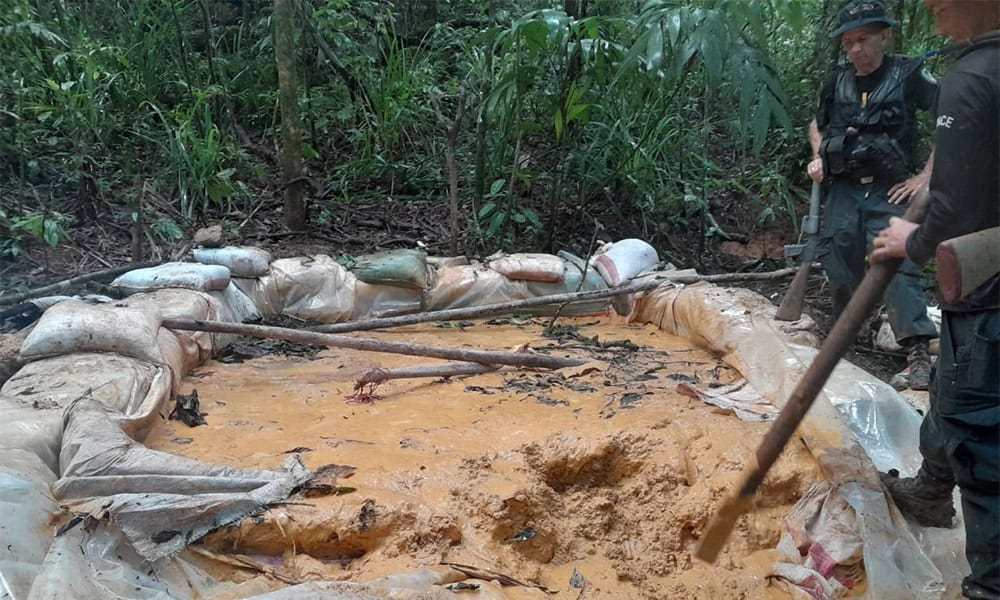
Costa Rica’s Constitutional Chamber, known as Sala IV, has condemned the government’s repeated failure to act against illegal mining in Crucitas, a remote area of Cutris de San Carlos near the Nicaragua border. In a binding ruling, the court ordered five state institutions to take immediate action to confront what it described as an ongoing environmental and public health crisis.
Crucitas has been at the center of one of Costa Rica’s most contentious environmental battles for nearly three decades. The area sits atop major gold deposits and drew national attention in 2008, when then-President Óscar Arias declared a Canadian mining company’s open-pit gold project to be of national convenience, speeding up its approval.
That decision triggered fierce opposition from environmental groups and local communities. In 2010, a court revoked the concession after finding that environmental procedures had not been properly followed. The Supreme Court later upheld that decision, shutting down the formal mining project. Although the land remained legally protected, it was left largely unguarded.
That vacuum was soon exploited. In the years since, informal and illegal miners, reportedly many of them foreign nationals entering through weakly monitored border crossings, have moved into the area. Authorities and local residents have long raised concerns that gold extraction methods involving mercury and arsenic are contaminating water sources and damaging surrounding forest.
In ruling No. 2026-10560, the Sala IV upheld an amparo petition and found that the Ministries of the Presidency, Health, Public Security, and Environment, along with the Costa Rican Water and Sewage Institute, AyA, had engaged in repeated and systematic neglect of their constitutional duties. According to the court, that inaction has allowed serious environmental damage to grow, put local communities at risk through contaminated drinking water, and weakened state control in a sensitive border zone.
The Ministry of Public Security was ordered to establish a permanent police presence in Crucitas, strengthen border controls to prevent illegal crossings, and secure the budget and personnel needed for lasting surveillance and enforcement.
AyA must continue providing potable water to affected communities for as long as contamination risks remain. The institution was also ordered to complete a comprehensive drinking water infrastructure project within 18 months for the communities of Llano Verde, Crucitas, Jocote, Chorreras, El Roble, and Chamorro.
The Ministry of Health was instructed to maintain active participation in the inter-institutional commission coordinating the government’s response in the region and to continue its monitoring and oversight role.
MINAE and the Ministry of the Presidency were jointly ordered to submit a detailed action plan to the court within three months. That plan must include timelines for environmental protection, remediation, and restoration. The court said all measures must be fully funded and carried out within one year of notification of the ruling.
The magistrates left little room for delay. Both the State and AyA were ordered to pay court costs and damages, with those amounts to be determined in later proceedings. The Sala IV also warned that failure to comply with its orders could bring criminal penalties under Costa Rican constitutional law, including prison sentences of three months to two years or fines equal to 20 to 60 days of wages.
Facts Only
Costa Rica’s Constitutional Chamber, Sala IV, issued a binding ruling condemning government inaction against illegal mining in Crucitas, near the Nicaragua border.
The ruling orders five state institutions to take immediate action: Ministries of the Presidency, Health, Public Security, and Environment, and the Costa Rican Water and Sewage Institute (AyA).
Crucitas has been a site of environmental conflict since 2008, when a Canadian mining company’s open-pit gold project was declared of national convenience by then-President Óscar Arias.
In 2010, a court revoked the mining concession due to improper environmental procedures, a decision later upheld by the Supreme Court.
Illegal miners, including foreign nationals, have since exploited the area, using mercury and arsenic in gold extraction.
The Sala IV ruling found systematic neglect by the named institutions, leading to environmental damage and contaminated drinking water.
The Ministry of Public Security must establish a permanent police presence, strengthen border controls, and secure funding for enforcement.
AyA is ordered to provide potable water to affected communities and complete a drinking water infrastructure project within 18 months.
The Ministry of Health must participate in an inter-institutional commission and maintain oversight.
MINAE and the Ministry of the Presidency must submit a detailed action plan within three months, with full implementation required within one year.
Non-compliance could result in criminal penalties, including prison sentences or fines.
Executive Summary
Costa Rica’s Constitutional Chamber, Sala IV, has issued a binding ruling condemning the government’s inaction against illegal mining in Crucitas, a remote area near the Nicaragua border. The court ordered five state institutions—including the Ministries of the Presidency, Health, Public Security, and Environment, as well as the Costa Rican Water and Sewage Institute (AyA)—to take immediate action to address environmental and public health risks. The region has been a focal point of environmental conflict since 2008, when a Canadian mining company’s open-pit gold project was fast-tracked by then-President Óscar Arias, only to be revoked in 2010 due to procedural violations. Since then, informal and illegal mining has flourished, with reports of mercury and arsenic contamination threatening water sources and local communities. The court’s ruling mandates specific measures, including a permanent police presence, strengthened border controls, and infrastructure projects to provide clean water within 18 months. Failure to comply could result in criminal penalties, including fines or imprisonment for officials.
The decision highlights systemic neglect, as authorities have repeatedly failed to enforce environmental protections despite legal safeguards. The ruling also underscores broader challenges in border security and resource management, particularly in sensitive ecological zones. While the court’s intervention is a decisive step, its effectiveness depends on sustained political will and inter-agency coordination. The case reflects ongoing tensions between economic interests, environmental conservation, and community rights in Costa Rica.
Full Take
The strongest version of this narrative is a clear indictment of institutional failure in Costa Rica, where legal protections for the environment and public health have been undermined by bureaucratic inertia and weak enforcement. The Sala IV ruling is a rare moment of accountability, forcing multiple agencies to confront a crisis they have long ignored. The case also exposes the lingering consequences of past policy decisions, such as the 2008 fast-tracking of the mining project, which set the stage for today’s illegal exploitation. The court’s detailed mandates—from police presence to water infrastructure—demonstrate a recognition that half-measures will no longer suffice.
Pattern scan: The narrative avoids overt manipulation, but there are subtle framing choices worth noting. The emphasis on "foreign nationals" entering through "weakly monitored border crossings" could inadvertently fuel xenophobic sentiments, even if the primary concern is environmental harm. Additionally, the focus on institutional neglect might oversimplify the systemic challenges—corruption, underfunding, and competing priorities—that hinder effective governance. That said, the article presents a fact-based critique without resorting to emotional exploitation or false binaries.
Root cause: This situation reflects a broader paradigm where short-term economic interests clash with long-term environmental stewardship. The 2008 decision to prioritize mining convenience over rigorous oversight created a precedent for exploitation, and the subsequent legal void allowed illegal actors to thrive. The assumption that legal protections alone suffice—without adequate enforcement—is a recurring flaw in environmental governance.
Implications: The ruling is a victory for accountability, but its success hinges on political will. If agencies drag their feet, the cycle of neglect will continue, eroding trust in state institutions. Local communities bear the immediate costs of contamination, while the benefits of illegal mining flow to shadowy actors. Second-order consequences could include heightened border tensions or a backlash against environmental regulations if enforcement is perceived as heavy-handed.
Bridge questions: What structural reforms are needed to prevent similar failures in other ecologically sensitive areas? How can border security be strengthened without disproportionately targeting vulnerable migrant populations? What role should international actors play in addressing transnational environmental crimes?
Counterstrike scan: If this were part of a coordinated influence campaign, the playbook might involve amplifying the "foreign invaders" angle to stoke nationalism or using the case to discredit environmental regulations as unenforceable. However, the actual content does not align with such a pattern. It presents a measured critique of institutional failure without demonizing any group or ideology.
Sentinel — Human
The article shows strong signs of human authorship, with detailed context, stylistic variation, and specific attributions that are unlikely to be AI-generated.