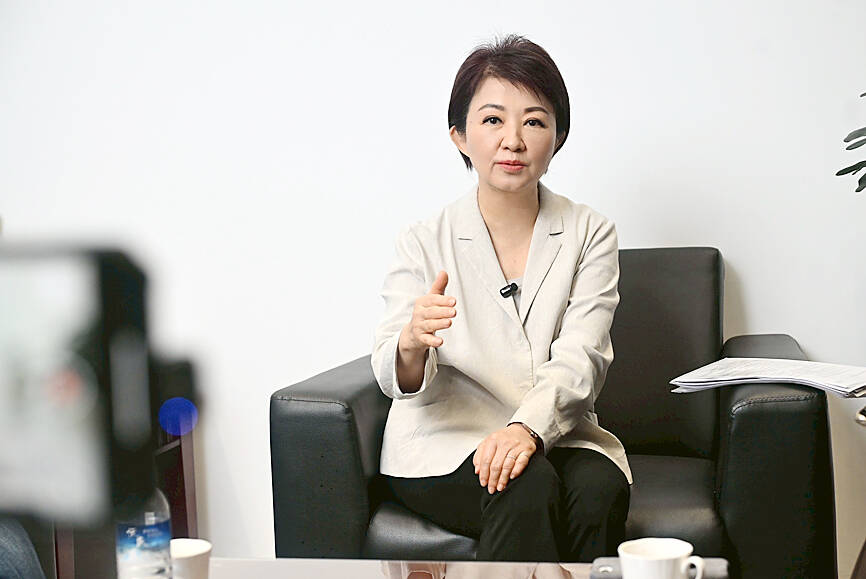
It would be “reasonable to pass NT$800 billion to NT$1 trillion” (US$25.09 billion to US$31.37 billion) for the special defense budget, Taichung Mayor Lu Shiow-yen (盧秀燕) of the Chinese Nationalist Party (KMT) said yesterday.
Lu made the remarks in an exclusive interview with the Liberty Times (sister paper of the Taipei Times).
Legislative committees recently completed reviewing the three versions of the budget bill, but cross-party lawmakers could not reach a consensus on the amount, requiring further negotiation.
Photo: Liao Yao-tung, Taipei Times
The KMT, under the lead of its Chairwoman Cheng Li-wun (鄭麗文), presented the so-called “NT$380+N billion” bill instead of a version of NT$810 billion reportedly planned by KMT Legislator Hsu Chiao-hsin (徐巧芯).
The KMT’s final version of “NT$380+N billion” is far lower than the Executive Yuan’s proposed NT$1.25 trillion, leading to speculation that the KMT opposes arms procurement.
Lu, who earlier this month visited the US, said she told US officials that different politicians from the same party might have different views and “an individual cannot represent the whole.”
Having spent 13 legislative sessions on the Foreign Affairs and National Defense Committee, Lu said she is “very familiar” with arms and commercial procurement procedures.
The Executive Yuan’s proposed NT$1.25 trillion special defense budget can be divided into three parts, Lu said.
First, the US$11 billion that the Legislative Yuan has already authorized to pass, she said.
Second, the US$14 billion in arms procurement that the US and Taiwan together deemed necessary for Taiwan’s self-defense, she said.
“I think that US$14 billion, or roughly NT$400 billion, should also be supported,” Lu told the Liberty Times.
Some legislators worry about authorizing the US$14 billion before the US has sent a letter of acceptance (LOA), or official pricing letter, for the arms procurement, she said.
“My view is exactly the opposite,” Lu said, adding that authorizing the budget would allow both sides to formalize an agreement and communicate the importance of this procurement as “the whole world is competing for weapons.”
“If we waited for the LOA, the US would have room to choose to not sell these weapons, use them itself or sell them to other countries such as Japan, South Korea or NATO countries,” she said.
The third part of the special defense budget allocates about US$15 billion for commercial or domestic procurements for military and non-military use, which some legislators worry about how to oversee, as they are not considered military procurements, Lu said.
Procuring equipment for military use commercially or through private contractors should be no problem, as it is a government procurement and both sides have appropriate laws in place, she said, adding that such procurements, covering drones and C5ISR systems, should be approved.
The remaining portion covers equipment meant to support private and industrial development, and could be included in the regular budget, as the exact figures are unclear, she said, urging the Cabinet to clarify them.
Lu has been perceived as a contender for the 2028 presidential race, and, with eight months left in her term as Taichung mayor, her next move is being closely watched.
While some have speculated her visit to the US this month and meeting with US Department of State officials could be seen as the opening move of her presidential campaign, Lu said it is still early to consider the 2028 election.
A national leader must not only make correct decisions, but also unite the country, as unity reflects national strength, defense and security, Lu told the Liberty Times.
‘UNFRIENDLY’: Changing the nationality listing of Taiwanese residents to ‘China’ goes against EU foreign policy as well as democratic and human rights principles, MOFA said Taiwan yesterday called on Denmark to correct its designation of the nationality of Taiwanese residents as “China” or face retaliatory measures. The Danish government in 2024 changed the nationality of Taiwanese citizens on their residence permits from “Taiwan” to “China.” The decision goes against EU foreign policy and contravenes democratic and human rights principles, Ministry of Foreign Affairs (MOFA) spokesman Hsiao Kuang-wei (蕭光偉) said. Denmark should present a solution acceptable to Taiwan as soon as possible and correct the erroneous designation to preserve the longstanding friendship between the two nations, Hsiao said. The issue could damage Denmark’s image and business reputation in Taiwan,
Taiwan climbed to its highest position in global export rankings in more than three decades last year, buoyed by demand linked to artificial intelligence (AI) that lifted shipments of semiconductors and technology products, Ministry of Finance data released yesterday showed. Taiwan accounted for 2.4 percent of global exports last year, or about US$640 billion, ranking 12th worldwide, the data showed. That was up four places from a year earlier and marked the nation’s best ranking since 1994, the ministry said. Taiwan’s share of global exports rose by 0.5 percentage points from the previous year, the largest increase among major economies, reflecting the nation’s
FIRST TRIAL: Ko’s lawyers sought reduced bail and other concessions, as did other defendants, but the bail judge denied their requests, citing the severity of the sentences Former Taipei mayor Ko Wen-je (柯文哲) was yesterday sentenced to 17 years in prison and had his civil rights suspended for six years over corruption, embezzlement and other charges. Taipei prosecutors in December last year asked the Taipei District Court for a combined 28-year, six-month sentence for the four cases against Ko, who founded the Taiwan People’s Party (TPP). The cases were linked to the Core Pacific City (京華城購物中心) redevelopment project and the mismanagement of political donations. Other defendants convicted on separate charges included Chinese Nationalist Party (KMT) Taipei City Councilor Angela Ying (應曉薇), who was handed a 15-year, six-month sentence; Core Pacific
J-6 REMODEL: The converted drones are part of Beijing’s expanding mix of airpower weapons, including bombers with stand-off missiles and UAV swarms, the report said China has stationed obsolete supersonic fighters converted to attack drones at six air bases close to the Taiwan Strait, a report published this month by the Arlington, Virginia-based Mitchell Institute for Aerospace Studies said. Satellite imagery of the airfields from the institute’s “China Airpower Tracker” shows what appear to be lines of stubby, swept-winged aircraft matching the shape of J-6 fighters that first flew with the Chinese People’s Liberation Army (PLA) Air Force in the 1960s. Since their conversion to drones, the aircraft have been identified at five bases in China’s Fujian Province and one in Guangdong Province, the report said. J.
Facts Only
Taichung Mayor Lu Shiow-yen of the KMT suggested a special defense budget of NT$800 billion to NT$1 trillion (US$25.09 billion to US$31.37 billion).
The KMT proposed a "NT$380+N billion" defense budget, lower than the Executive Yuan’s NT$1.25 trillion proposal.
Lu argued that US$14 billion (NT$400 billion) for arms procurement should be authorized before receiving a US Letter of Acceptance (LOA).
The Executive Yuan’s budget includes US$11 billion already authorized, US$14 billion for joint US-Taiwan arms procurement, and US$15 billion for commercial/domestic procurements.
Taiwan protested Denmark’s 2024 decision to change Taiwanese residents’ nationality from "Taiwan" to "China" on residence permits.
Taiwan’s Ministry of Foreign Affairs warned of retaliatory measures if Denmark does not correct the designation.
Taiwan ranked 12th in global exports in 2023, its highest position since 1994, with exports totaling US$640 billion.
Former Taipei Mayor Ko Wen-je was sentenced to 17 years in prison for corruption related to the Core Pacific City project.
A US report identified China’s deployment of converted J-6 fighter drones at six air bases near the Taiwan Strait.
Executive Summary
Taiwan is engaged in a contentious debate over a special defense budget, with the Executive Yuan proposing NT$1.25 trillion (US$39.1 billion) for arms procurement and military modernization. The opposition KMT has countered with a significantly lower "NT$380+N billion" proposal, reflecting internal party divisions and broader political tensions. Taichung Mayor Lu Shiow-yen, a KMT member, argued that a budget of NT$800 billion to NT$1 trillion would be reasonable, emphasizing the need to secure US arms sales before formal pricing letters are issued to avoid losing procurement opportunities. The debate highlights concerns over oversight, particularly for commercial procurements, and the strategic urgency of bolstering Taiwan’s defenses amid global competition for weapons.
Separately, Taiwan has protested Denmark’s decision to change the nationality designation of Taiwanese residents from "Taiwan" to "China," calling it a violation of EU foreign policy and democratic principles. The Ministry of Foreign Affairs warned of retaliatory measures if the issue is not resolved. Meanwhile, Taiwan’s export rankings surged to 12th globally in 2023, driven by AI-related demand for semiconductors, marking its highest position since 1994. Former Taipei Mayor Ko Wen-je was sentenced to 17 years in prison for corruption linked to the Core Pacific City project, underscoring ongoing political and legal challenges. Additionally, a US report noted China’s deployment of converted J-6 fighter drones near the Taiwan Strait, signaling Beijing’s expanding airpower capabilities.
Full Take
The strongest version of this narrative underscores Taiwan’s precarious geopolitical position, balancing urgent defense needs against political fragmentation and external pressures. Lu Shiow-yen’s argument for a middle-ground defense budget reflects a pragmatic attempt to reconcile security imperatives with fiscal caution, while the KMT’s lower proposal signals deeper skepticism about arms procurement—possibly tied to cross-strait relations or domestic political maneuvering. The Denmark nationality dispute highlights Taiwan’s persistent struggle for international recognition, framing sovereignty as a zero-sum game where even bureaucratic labels carry diplomatic weight. Meanwhile, Taiwan’s export surge and China’s drone deployments paint a dual picture: economic resilience amid technological dominance, juxtaposed with escalating military tensions.
Patterns detected: **ARC-0024 Ambiguity** (KMT’s "NT$380+N billion" proposal leaves room for interpretation), **ARC-0043 Motte-and-Bailey** (Lu’s framing of "reasonable" budgets as a compromise while the KMT’s actual proposal is far lower).
Root cause: The narrative is driven by Taiwan’s existential security dilemma—how to deter aggression without provoking conflict, while navigating domestic political divisions and global supply chain dependencies. The unstated assumption is that defense spending alone can guarantee security, ignoring the role of diplomatic alliances or de-escalation strategies.
Implications: Human agency is constrained by structural forces—geopolitical rivalry, partisan gridlock, and economic interdependence. The costs fall disproportionately on Taiwanese citizens, who face both the financial burden of defense spending and the psychological toll of living under constant threat. Second-order consequences include potential erosion of public trust in institutions if corruption cases like Ko’s persist, and the risk of Taiwan’s economic success being weaponized as leverage in cross-strait relations.
Bridge questions: How might Taiwan’s defense strategy evolve if the US prioritizes other allies (e.g., Japan, South Korea) in arms sales? What alternative frameworks for sovereignty could reduce Taiwan’s vulnerability to symbolic diplomatic slights like Denmark’s? Would a bipartisan consensus on defense spending emerge if the threat from China were framed differently—e.g., as a regional rather than ideological conflict?
Counterstrike scan: A coordinated influence campaign would amplify divisions within the KMT to stall defense spending, while simultaneously framing Taiwan’s protests against Denmark as "overreactions" to undermine its international standing. The actual content does not fully match this pattern, as the defense debate appears driven by genuine policy disagreements rather than external manipulation. However, the lack of clarity in the KMT’s budget proposal could be exploited to sow further discord.
Sentinel — Human
The article exhibits strong human authorship signals, including natural language variation, specific sourcing, and narrative idiosyncrasies. Minimal stylometric or coherence red flags suggest low synthetic probability.