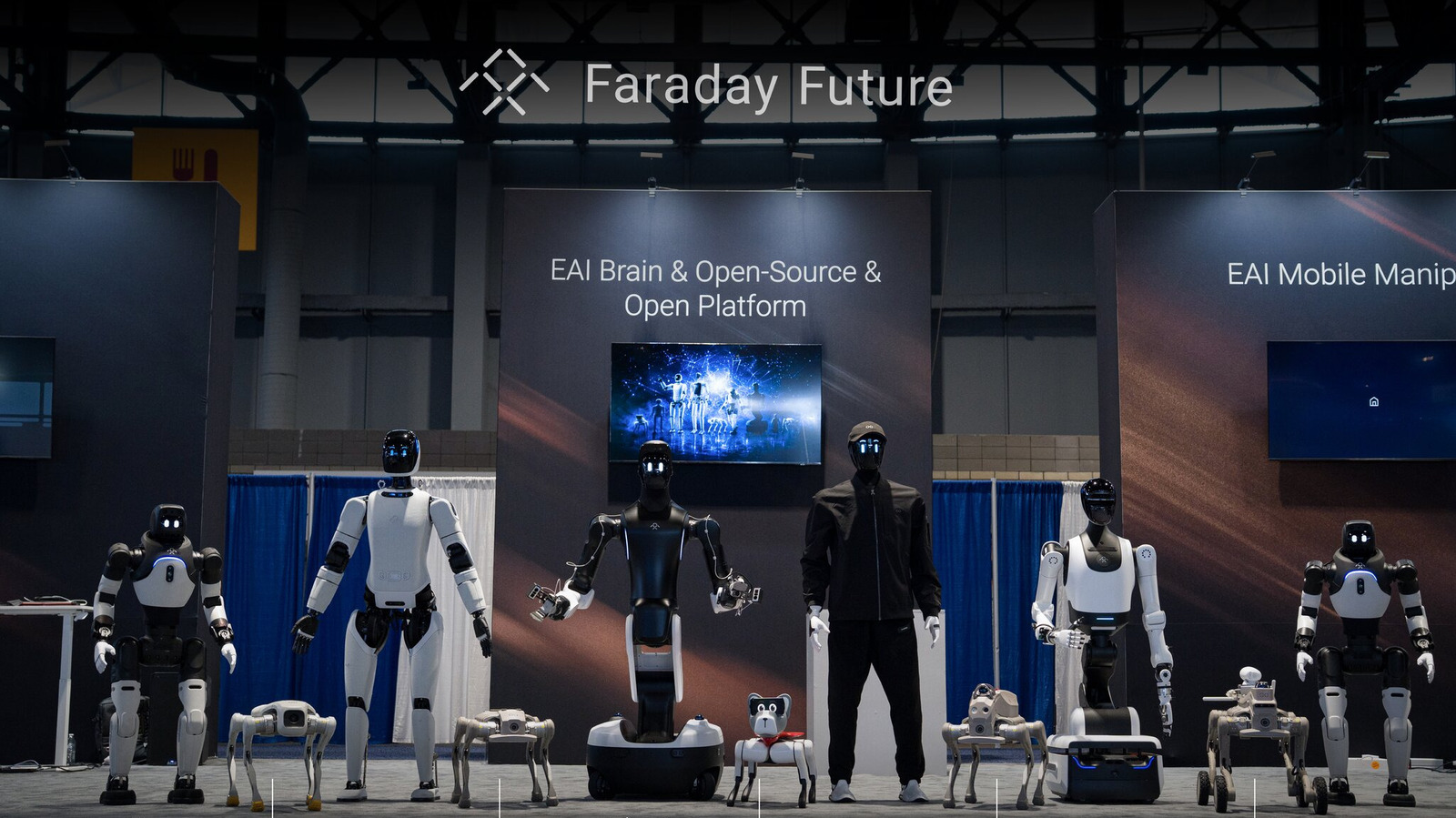
Faraday Future would like you to purchase an $89,900 robot. As part of its latest revamp, the embattled electric car company is now pitching a lineup of robots, including humanoids, quadrupeds and a robotic arm. If that name doesn't ring any bells, that could be because the company has been going through a bit of a pivot over the past year in an attempt to salvage its bottom line, if not its reputation.
That's become something of a theme for Faraday. The business generated a fair bit of hype years before it showed off its first production-ready electric car at CES 2017. Its leaders certainly had lofty goals. But in the almost decade since, both the business and its founder, YT Jia, experienced financial tumult. Compounded by about a dozen lawsuits, internal turmoil, layoffs and yet more confusion around money, a lot of Faraday's plans went on hold. It showed. In January 2025, it said it had sold "15 or 16" vehicles.
However, Faraday Future returned to CES that year promising a new electric minivan and a "fresh start." The return of founder YT Jia as sole global CEO in May of this year as part of a larger executive shakeup might mean a loose definition of "fresh." The company is still putting work into its EV strategy, with the first pre-production model of its FX Super One MPV van completed in December. But now it seems to be taking a page from Tesla's book and directing more energy into robotics.
This month, Faraday Future shared some new details about its robotics lineup. There's a quadruped model called Navi that looks to be targeted toward kids for learning embodied AI. That one starts at just under $2,000, but you may have to pay extra to give it a 3D-printed canine head. The company also has a new version of its humanoid model called Futurist. The 5'8" robot, equipped with NVIDIA Sonic's full-body motion control system, is on sale for just shy of $90K. It's also selling an industrial-grade robotic arm that it's calling a "mobile manipulator product." There's no public pricing, which is likely code for unbelievably expensive, even for business customers.
Despite the massive price tags and a history one could most politely call spotty, the company seems to be counting on at least some sales. According to its latest press release, Faraday Future claims to expect shipments of more than 100 robotics units in June and that total shipments for the first six months on the year are "expected to surpass our original target of 220 units." Hey, at least it's better than 15.
Facts Only
* Faraday Future sold "15 or 16" vehicles in January 2025.
* The company is shifting energy toward robotics as part of a strategy to salvage finances and reputation.
* A quadruped model named Navi is available, starting at under $2,000.
* A humanoid model named Futurist is available, priced just shy of $90,000.
* An industrial-grade robotic arm, called a "mobile manipulator product," is also offered.
* Faraday Future expects shipments of more than 100 robotics units in June.
* The pre-production model for the FX Super One MPV van was completed in December.
* Founder YT Jia became the sole global CEO in May of this year.
Executive Summary
Full Take
The narrative presents a strategic pivot from an established, high-profile automotive venture into the highly speculative and capital-intensive robotics sector, framed by prior financial instability. The juxtaposition of recent corporate distress—evidenced by lawsuits and internal turmoil—with the launch of expensive robotic hardware requires scrutiny regarding the coherence of the strategy and the use of public relations as a mechanism for distraction. The transition from building vehicles to selling sophisticated embodied AI systems suggests an attempt to leverage cutting-edge technology to redefine value, potentially mitigating historical reputational damage through novelty. However, the pricing structure, particularly the $90,000 humanoid model, raises questions about market viability and whether these products are serving a genuine technological need or merely acting as speculative ventures tied to short-term sales targets. The stated goal of surpassing unit targets for robotics suggests that volume is prioritized over sustainable profit margins, echoing the pattern of companies using perceived innovation to mask fundamental operational challenges.
Patterns detected: ARC-0043 Motte-and-Bailey, ARC-0024 Ambiguity
Sentinel — Human
This text reads like a professionally synthesized business news article, effectively balancing company history with current product announcements.