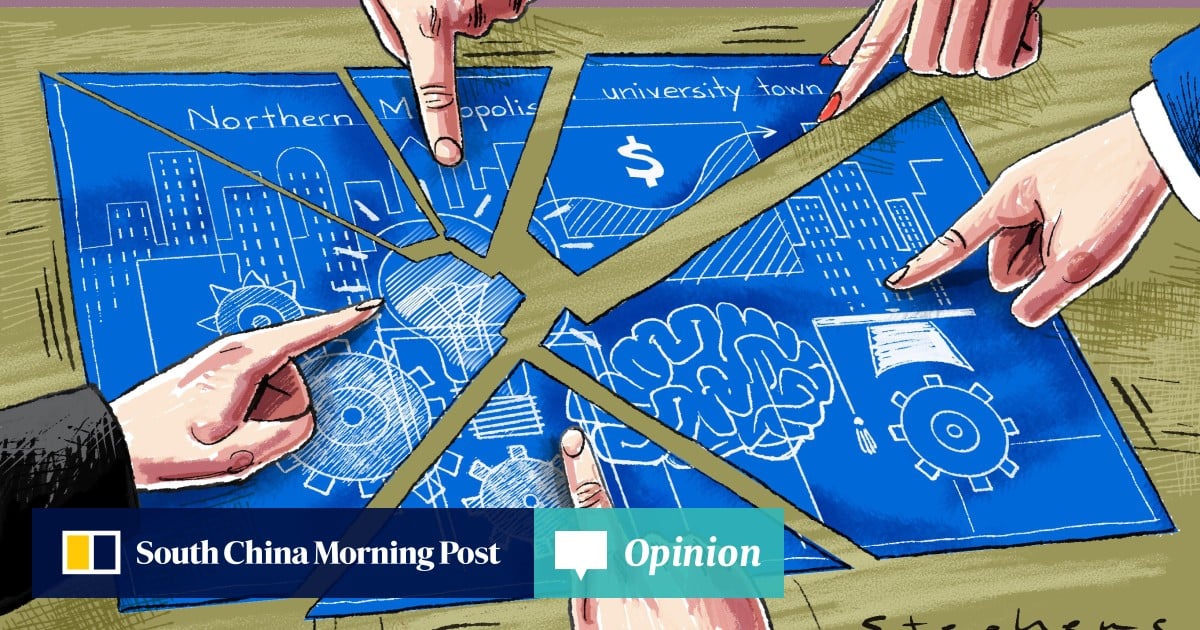
If done right, the university town could break down silos, liberate world-class research capacity and align academia with industrial goals
At its core, the Northern Metropolis bears a dual mission. For Hong Kong, it must become a growth engine, creating a third curve of development, beyond finance and real estate, by nurturing original innovation, driving technological breakthroughs and attracting high-end talent. For the nation, it must serve as a global centre for science and technology, talent and frontier research.
Despite its strategic mission, early signs of concern have surfaced. In June, the Education Bureau announced that 19 local institutions had submitted proposals for the Northern Metropolis. The response was enthusiastic, but the common requests were clear: relieve campus pressure and improve facilities.
Two contradictions define the challenge. First, a mission mismatch: conceived as a science and innovation hub, the Northern Metropolis is being treated as an expansion site, with land intended for research – or a platform where frontier research meets industrial incubation – diverted to classrooms and dormitories. Second, a mechanism gap: while Hong Kong’s universities excel in basic research, they lack pathways to translate discoveries into industry or feedback loops that connect market demand to research priorities.
These contradictions strike at the heart of the Northern Metropolis’ mission. Without clear direction, the project risks drifting into a patchwork of expanded campuses rather than rising as the world-class innovation hub Hong Kong and the nation urgently need.
Sentinel — Human
The text presents a tightly structured, coherent argument about institutional challenges in urban development. It reads like well-edited policy commentary.